Today is officially the last day of winter.
If the weather forecasters have it correct, we will hit 86 degrees in Manteca-Ripon-Lathrop.
That will be a record going back to the mid-1850s when California temperatures were first recorded.
Elsewhere in California, temperatures on the last day of winter are expected to be 90 degrees or higher. As a sidenote, it reached a record 90 degrees Wednesday in Manteca.
The highs will start receding back into the mid-80s and high 70s next week.
There is nothing in the long range forecast that calls for a repeat of the odd heat wave we are now having.
Giving precipitation statewide since the start of the water year on Oct. 1 as of March 16 was 103 percent of average — based on data at the California Water Watch website operated by the Department of Water Resources (DWR) — what we are experiencing is a lark, right?
After all, reservoirs such as New Melones on the Stanislaus River that South San Joaquin Irrigation District relies on to supply farmland as well as the cities of Manteca, Lathrop, and Tracy also have above storage for this time of year.
New Melones happens to be at 103 percent of average storage as of March 25.
But that’s not the storage that is the proverbial bird in the coal mine. Nor is what is behind Shasta Dam and Oroville Dam, the state’s two largest reservoirs.
The linchpin of California’s waterworks is the Sierra snowpack.
And it isn’t doing so hot thanks to the heat.
The Sierra snowpack provides 30 percent of California’s water needs.
The peak snowpack reading is typically on April 1.
In a normal year, there is plenty of snow left at the higher elevation that it is still melting in mid-May and beyond.
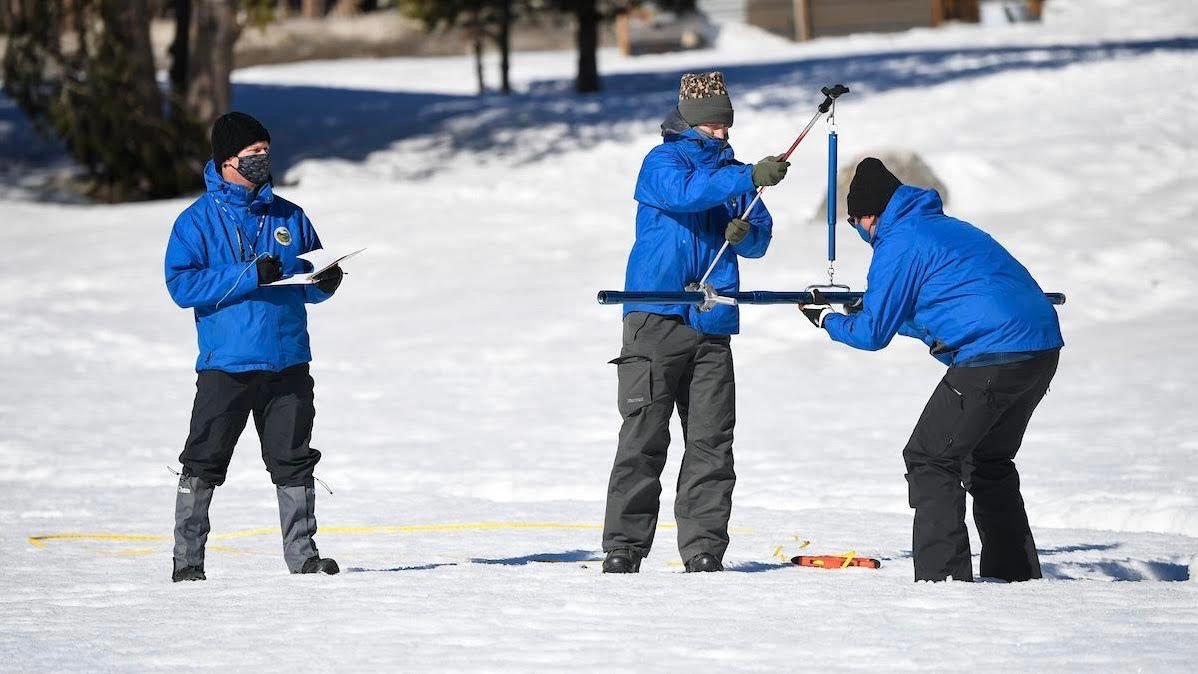
The Sierra snowpack was 45 percent as of March 1.
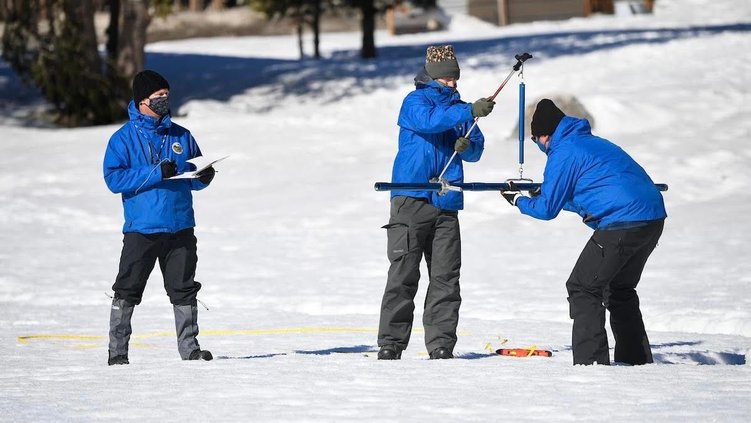
Since then, snow pillows — DWR electronic measuring devices — have indicated the unseasonable heat has been melting the snowpack, even in the highest elevations, at a rate of 1 percent a day.
It is why Dodge Ridge Ski Resort near Pinecrest off of Highway 108, with a base elevation of 6,600 feet and a peak elevation of 8,800 feet, shut down this past weekend for the season.
The snowpack is on target to meltdown to the single digits by April 1.
In doing so, it will challenge the lowest recorded mark on April 1 set in 2015 when the remaining snowpack on that date was at 5 percent of average.
What is melting is simply heading downstream as reservoirs have little operating wiggle room to take in more water.
The odds are the state’s largest reservoir — the frozen snowpack in the Sierra — will be virtually history by April 1. That means typical April and May snowmelt — and the water it flows into reservoirs — won’t really be happening this year.
But how can that be given the statewide precipitation currently is at 103 percent of average?
The climate hydrology models that have been predicting a shift in how precipitation falls in California based on hundreds of years of what dendrochronology — the study of tree rings — has told them.
We are entering an extended period where more and more precipitation in California will be in rain and less in snow.
And most of that increase is rain will be in lower elevations, ironically below the state’s major storage reservoirs such as Shasta, Oroville, and New Melones.
Having more off-line reservoirs such as San Luis below Pacheco Pass and the Sites Reservoir nearing construction in western Colusa County will be critical in the coming decades as well as recharging groundwater basins.
State water planners know this, which is why the push for new storage space is only going on at Sites and other smaller off-line reservoirs where water is essential diverted from the Sacramento River or on its way south of the Delta via the California Aqueduct.
It further underscores the superfluous nature of the myopic Delta Tunnel.
The shift in precipitation patterns means more storage in the proverbial backyard of the Los Angeles Basin and other areas along the coast makes more sense if one is worried about reliable water supplies for massive urban areas.
Spending $30 billion or so on the Delta Tunnel is going to make spending $100 billion plus to connect high speed rail from San Francisco to Los Angeles look absolutely brilliant in terms of bang for the buck.
The tunnel, at the end of the day, will have less water to divert from the Sierra snowpack.
Los Angeles’ real concern should be creating off-line reservoir storage whether it is in their backyard or father north.
The shift in precipitation also is making the $476 million 200-year levee protection upgrade for the parts of Lathrop, Manteca, and the Weston Ranch area of southwest Stockton a wiser investment than it already is.
The frequency of 100-year floods and 200-year floods will increase.
The 100-year & 200-year hydrology jargon can be a tad misleading.
It doesn’t mean a flood that can happen once every 100 or 200 years. Instead, it is that odds that an intensity of such a flood event happening in any given year.
Flooding has been happening more frequently with more of the San Joaquin Valley being covered with impermeable surfaces such as roof tops, parking lots, streets, sidewalks, and such.
The shift of precipitation to more rain at lower elevations will also add to the increased frequency.
Keep in mind the entire 1,169 square miles of the San Joaquin River watershed essentially drains into the Delta via the stretch of the river between its confluence with the Stanislaus River less than a sixth of a mile south of the Airport Way bridge south of Manteca and the Old River just west of the Mossdale Crossing in Lathrop.
And all that water will add more pressure to 1,100 miles of levees.
It is why State Senator Jerry McNerney’s Senate Bill 872 is the right solution.
The measure would divert $300 million over 20 years from greenhouse gas fees to strengthen the levees and another $300 million to repair subsidence damage to the conveyance system south of the Delta.
If the ability to deliver water is severely compromised and water storage is in the wrong place, the Delta tunnel won’t be much more than a 45-mile long hole in the ground.
This column is the opinion of editor, Dennis Wyatt, and does not necessarily represent the opinions of The Bulletin or 209 Multimedia. He can be reached at dwyatt@mantecabulletin.com