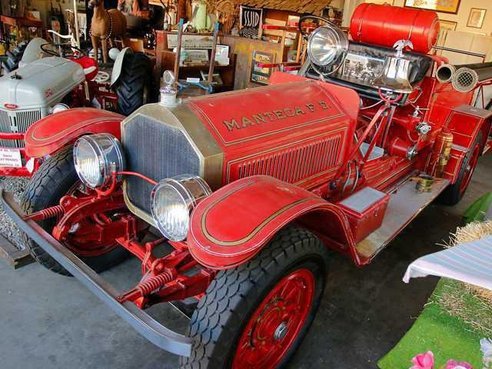
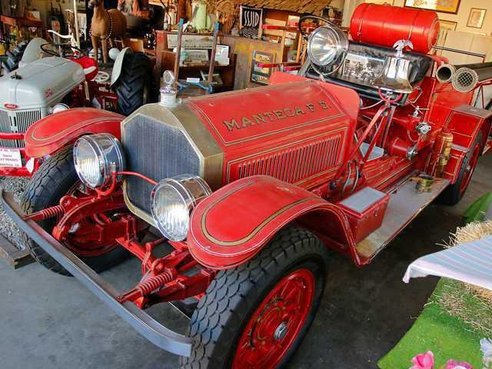
Saturday’s downtown Christmas parade will include an entry many have come to expect to see — the Manteca Fire Department’s 1927 LaFrance fire engine.
It is a staple of both the Fourth of July and Christmas parades as well as National Night Out parties when it is not on loan for display at the Manteca Historical Museum.
At 98 years, it is showing wear.
It is why firefighters are hopeful the community may be able to help them get the antique engine back into shape for its centennial year.
It will require finding someone with the expertise to the do the work as well as funding any needed parts and such. All of that will take money.
No one at the department is sure how to accomplish the goal to keep the LaFrance going for another 100 years and are hoping they can find expertise and backing in the community to do so.
The fire department
got its start in 1915
The first “fire department” consisted almost of everyone in town.
There were as many as 60 men and women who would come running with buckets, ladders and axes to form a bucket brigade any time a fire broke out.
The organized department came on the scene on Nov. 1, 1915 when 30 Manteca residents gathered at the Palace of Amusement – a theatre that was once located directly across from where The Vernada Event Center. is today – and formed a fire department while electing D. O’Leary as the first volunteer fire chief.
Manteca had a private water system in 1915 that served only a small segment of the homes. Everyone else had their own water wells.
The first equipment the department bought was a gas-powered pump they could connect to private wells around Manteca. Anyone connected to the water works were asked to stop all water consumption whenever the fire alarm sounded.
By 1917, the department had collected $759.50 from citizens and was able to buy two fire hydrants, 400 feet of hose and two hose carts.
Fighting fires was precarious at best. One such fire happened on Oct. 11, 1918. One of Ed Powers’ warehouses on Moffat Boulevard caught fire. It had been built in 1917 for $10,000.
There was no fire hydrant or other source of water within reach.
Firefighters were forced to lay a hose line from the just completed Spreckels Sugar plant from over 3,000 feet away. A chemical engine that arrived to help from Ripon had a malfunction.
By the time the hose reached the building and the water was turned on, 700 tons of alfalfa valued at $15,000 was destroyed as was the building.
Firefighters had to use wet gunnysacks to beat back flames and keep them from spreading to a nearby Standard Oil bulk plant.
Even with such a fire fresh in everyone’s mind, the City Council in 1918 – the year Manteca was incorporated — refused to provide financial support to the fire department. That prompted the volunteers to start an annual firemen’s ball to raise funds.
The annual dances allowed the volunteers in 1920 to buy their first fire engine – a Ford combination pump and chemical engine equipped with 1,000 feet of hoses and ladders - for $4,000. The department put down $1,000 and paid $1,000 a year thereafter.
Manteca buys LaFrance
fire engine in 1927
Manteca’s population had grown to over 1,500 by 1927.
That prompted volunteers to purchase a second engine – a 1927 American La France that had a 600-gallon-per-minute pump capacity. It cost $10,750 fully equipped.
Compare that to $1.2 million for a typical, full-equipped fire engine that is in front line service today for Manteca Fire.
The fire engine was bought on installment.
In June 1934, the department faced a financial crisis. It was unable to make the final $275.72 payment and was facing the possibility of losing the fire engine.
The department was able to get a short extension from the mortgage holder in San Jose.
They then returned to Manteca and conducted bake sales, dances, and an open house at the department allowing them to pay the engine off in August.
The department’s third engine was bought in 1946.
To contact Dennis Wyatt, email dwyatt@mantecabulletin.com
Saturday’s downtown Christmas parade will include an entry many have come to expect to see — the Manteca Fire Department’s 1927 LaFrance fire engine.
It is a staple of both the Fourth of July and Christmas parades as well as National Night Out parties when it is not on loan for display at the Manteca Historical Museum.
At 98 years, it is showing wear.
It is why firefighters are hopeful the community may be able to help them get the antique engine back into shape for its centennial year.
It will require finding someone with the expertise to the do the work as well as funding any needed parts and such. All of that will take money.
No one at the department is sure how to accomplish the goal to keep the LaFrance going for another 100 years and are hoping they can find expertise and backing in the community to do so.
The fire department
got its start in 1915
The first “fire department” consisted almost of everyone in town.
There were as many as 60 men and women who would come running with buckets, ladders and axes to form a bucket brigade any time a fire broke out.
The organized department came on the scene on Nov. 1, 1915 when 30 Manteca residents gathered at the Palace of Amusement – a theatre that was once located directly across from where The Vernada Event Center. is today – and formed a fire department while electing D. O’Leary as the first volunteer fire chief.
Manteca had a private water system in 1915 that served only a small segment of the homes. Everyone else had their own water wells.
The first equipment the department bought was a gas-powered pump they could connect to private wells around Manteca. Anyone connected to the water works were asked to stop all water consumption whenever the fire alarm sounded.
By 1917, the department had collected $759.50 from citizens and was able to buy two fire hydrants, 400 feet of hose and two hose carts.
Fighting fires was precarious at best. One such fire happened on Oct. 11, 1918. One of Ed Powers’ warehouses on Moffat Boulevard caught fire. It had been built in 1917 for $10,000.
There was no fire hydrant or other source of water within reach.
Firefighters were forced to lay a hose line from the just completed Spreckels Sugar plant from over 3,000 feet away. A chemical engine that arrived to help from Ripon had a malfunction.
By the time the hose reached the building and the water was turned on, 700 tons of alfalfa valued at $15,000 was destroyed as was the building.
Firefighters had to use wet gunnysacks to beat back flames and keep them from spreading to a nearby Standard Oil bulk plant.
Even with such a fire fresh in everyone’s mind, the City Council in 1918 – the year Manteca was incorporated — refused to provide financial support to the fire department. That prompted the volunteers to start an annual firemen’s ball to raise funds.
The annual dances allowed the volunteers in 1920 to buy their first fire engine – a Ford combination pump and chemical engine equipped with 1,000 feet of hoses and ladders - for $4,000. The department put down $1,000 and paid $1,000 a year thereafter.
Manteca buys LaFrance
fire engine in 1927
Manteca’s population had grown to over 1,500 by 1927.
That prompted volunteers to purchase a second engine – a 1927 American La France that had a 600-gallon-per-minute pump capacity. It cost $10,750 fully equipped.
Compare that to $1.2 million for a typical, full-equipped fire engine that is in front line service today for Manteca Fire.
The fire engine was bought on installment.
In June 1934, the department faced a financial crisis. It was unable to make the final $275.72 payment and was facing the possibility of losing the fire engine.
The department was able to get a short extension from the mortgage holder in San Jose.
They then returned to Manteca and conducted bake sales, dances, and an open house at the department allowing them to pay the engine off in August.
The department’s third engine was bought in 1946.
To contact Dennis Wyatt, email dwyatt@mantecabulletin.com