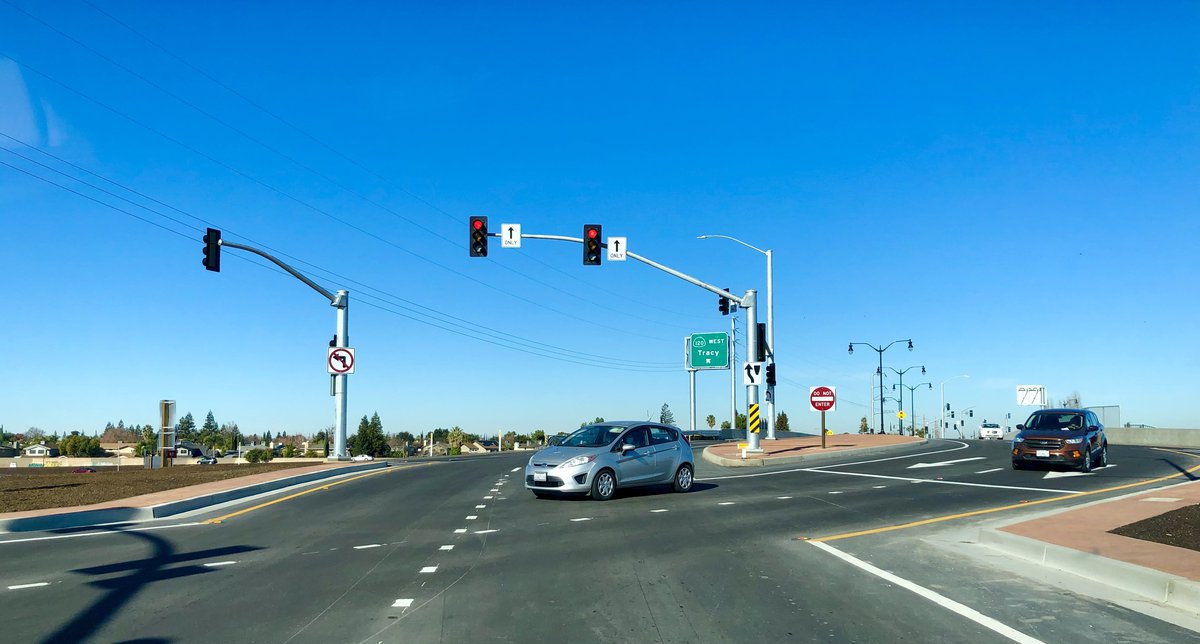
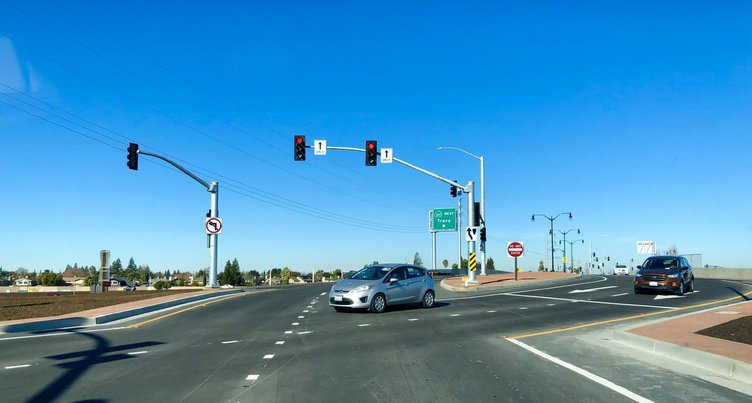
It moves traffic quicker. It reduces the potential for traffic collisions. It takes less time to build. It costs a third less than a conventional interchange.
It is why California’s first diverging diamond interchange has earned the City of Manteca recognition from the Sacramento Chapter of the American Public Works Association.
The interchange at the 120 Bypass and Union Road completed in November received Project of the Year honors in the Transportation Category.
The APWA Sacramento Chapter Awards Program recognizes public works projects that demonstrate excellent management, design, sustainability, construction and community relations, and the teamwork among the agencies involved.
The Manteca project is California’s first ever diverging diamond interchange. City leaders have indicated that one day they hope to replace the 120 Bypass interchanges at Airport Way and Main Street with diverging diamonds as well.
The diverging diamond design that has been used in other states with great success came about after elected officials tasked municipal Public Works staff to come up with a solution to improve traffic movements through the Union Road and 120 Bypass interchange in the most efficient and cost effective way possible. The result — after an intense collaboration with Caltrans — was the diverging diamond interchange.
The interchange that employs a bridge deck where travel lanes cross each other twice will be used as a model for similar interchanges through the state including the second one that will be built at Highway 99 in Ceres, a third being considered on Interstate 580 to serve Tracy’s International Park of Commerce and a fourth being contemplated in the Los Angeles Basin.
The project was completed for $23.7 million — about $10 million less than a full-blown cloverleaf interchange. The more traditional interchange to move high volumes of traffic would have required demolition of the existing bridge deck and the taking of nearby land and homes to get the ramps in place.
How diverging
diamond design works
With a diverging diamond interchange the flow across the freeway has lanes crossings to the opposite side of Union Road where the ramps are and then cross back over at the ramps on the other side of the bridge.
Where the traffic crisscrosses there are traffic signals. On a traditional overpass turn movements on and off the freeway would also go through the traffic signals. That’s not the case with a diverging diamond interchange.
If Union Road was improved to a partial cloverleaf interchange as was originally envisioned there would be 24 conflict points for vehicles. The diverging diamond has 12.
Even more significant is the reduction in the potential for frequent T-Bone crashes that can result in extensive property damage and serious injury. There are 20 such conflicts on a traditional interchange and just two on a diverging diamond. Those two would be where the north and south lanes on Union Road crisscross.
Due to the interchange’s geometry the average speed is slowed from 40 mph to 25 mph.
To contact Dennis Wyatt, email dwyatt@mantecabulletin.com