It was a busy day at the “office” for Charleen Carroll, Paula Juarez, and Lisa Catalano
They were in the midst of managing a labor shortage.
As such, they were making random productivity checks on contracted gig workers.
What they found was good news.
The contracted workers were literally as busy as bees.
The three Manteca residents are bee brokers.
Their office is adorned with millions of white and pink blossoms.
And, if all goes according to plan, the almonds the bees are helping along by year’s end will have made their way to tables from Manteca to New Delhi.
Working with almond growers to get to that point hasn’t been easy this year.
In excess of 50 percent of the hives that come from as far away as Florida to make their way to California in what is arguably one of the largest — if not the largest — movement of hives for pollination on earth — have died off.
Given the United Nations Food & Agricultural Organization indicates 75 percent of the world’s crops rely on at least some pollination, a reduction in the numbers of any pollinating insects is serious business.
However, with almonds having an extremely heavy reliance on pollination, it created an even more pressing than the usual sense of urgency as the calendar neared February for the trio to secure sufficient hives for their clients.
Carroll — called the “queen bee” by her partners in Pollination Contractors Inc. due to her 47 years in the bee brokering business — has been through such low ebbs before.
Even without massive bee die outs, bringing together beekeepers with almond growers is fraught with challenges.
Those run the gamut from losses during transportation to Mother Nature showing a cold shoulder and offering up a bit too much rain and wind.
This year the temperatures as well as the timing and intensity of rain so far has been good.
And thanks to decades of contracts, working the phone all hours of the day and night, the trio has been able to scramble to meet growers’ needs.
“We’re like personal shoppers for growers,” noted Juarez, who is Carroll’s daughter.
In a typical year, the three partners match up 40 to 50 beekeepers across the nation with 200 to 300 growers between Fresno in the south and Woodland in the north to Oakdale in the east and Tracy in the west.
Agriculture experts indicate that roughly 90 percent of the nation’s commercial bee hives make their way to California between early February and mid-March.
It is in California — almost exclusively in the Great Central Valley — where 80 percent of the world’s almond crop and 100 percent of the commercial crop in the United States is grown.
California’s 1.52 million acres of almonds produced 2.6 billion pounds of almonds in 2023.
That represents $3.88 billion of California’s $59.9 billion in annual overall ag production. California is by far the nation’s most productive state for farming.
The 180 million almond trees in California do more for the air than just make it sweet smelling this time of year.
They are credited with storing 300 million metric tons of carbon. That’s the equivalent of the carbon emissions in a year of 24.5 million gas powered vehicles.
Making quality checks
Juarez and Catalano make spot checks of roughly 15 percent of the hives in all the orchards they contract to have them placed.
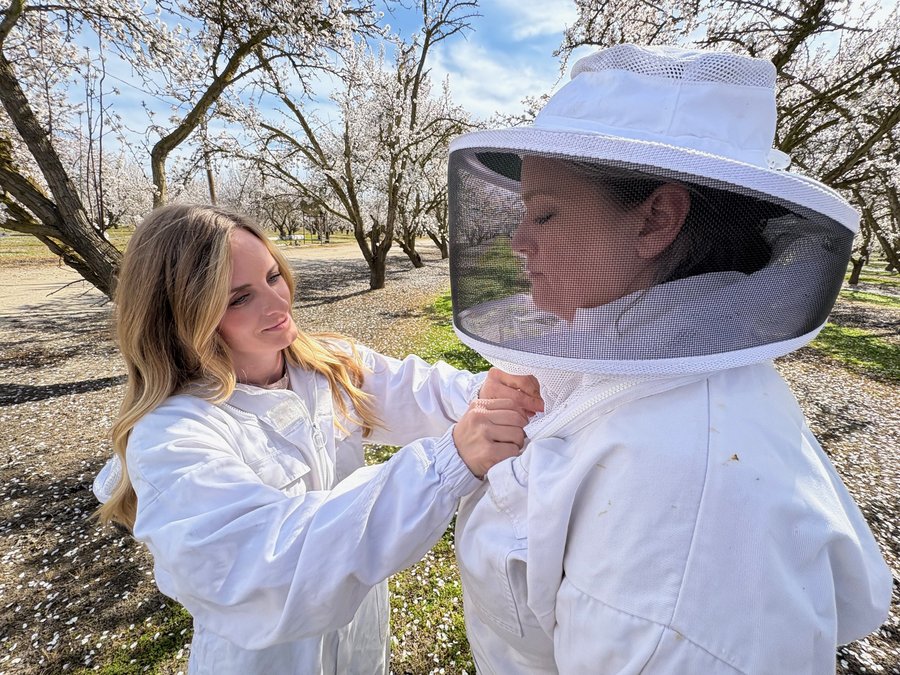
That requires them to don the prerequisite beekeeper suit and hat that work to keep the bees out while allowing the sweet smell of the blossoms in.
The color white is used for beekeeping suits for a reason. Darker color, especially black, agitates the bees. White tends to be a more soothing color.
Typically they carry a bee smoker.
Puffs of smoke are used to calm the bees down. It rolls across the frames already partially covered with honey combs, countless bees and
They use a pry tool to get off the lid. You can try all you want to remove the lid by hand but the bees have secured it with beeswax to protect the hive.
Once the lid is off you can see why they want to calm the bees down. There are some 80,000 bees per hive.
Puffs of smoke are used to calm the bees down. It rolls across the frames already partially covered with honey combs, countless bees and eggs.
They will pull one of the eight frames for inspection. The honey combs are far from being ready to harvest the honey that beekeepers sell wholesale. Almond pollination is feeding time for the bees as it gets them back into the swing of things.
They will gently turn the frame over to check for the queen.
While the worker bees that nature has selected to serve as foragers are busy buzzing around orchards gathering nectar, other bees are doing specific tasks in the hive such as caring for the brood.
The queen produces well over 2,000 eggs a day to make sure there is adequate bees to get the job done.
Healthy and active hives translate into the more the bees cross pollinate the white and pink blooms. That means better the odds are for bigger yields.
The goal is to place two hives per acre for the best pollination.
To contact Dennis Wyatt, email dwyatt@mantecabulletin.com