SACRAMENTO — The cradle of modern-day California civilization is not San Francisco or Los Angeles.
It’s Sacramento, or more precisely, Sutter’s Fort.
John Sutter’s desire for two things set the stage for California to balloon from 92,597 residents in 1860 — the federal Census did not count Native American Indians at the time — to being on the cusp of 40 million residents today. They were his dreams of an agriculture and the need for lumber to build it.
Hired hand James Marshall — who was obtained by Sutter to build a sawmill on the American River near modern-day Coloma — found the first shiny nugget in the mill’s tailrace on Jan. 24, 1848.
Marshall brought it to Sutter at the fort he had built.
In a small, no thrills office, together they read an encyclopedia entry on gold and performed primitive tests to confirm whether it was precious metal. Sutter concluded that it was, in fact, gold.
Sutter was very anxious that the discovery not disrupt his plans for construction and farming. At the same time, he set about gaining legitimate title to as much land near the discovery as possible.
Because of the Gold Rush that triggered — and the boom that turned Sam Francisco from an outpost to a world-class city in less than two decades — Sutter’s Fort has gotten the short-end of the stick when many think of California history.
Admittedly, my first visit to Sutter’s Fort on a third grade class trip may have helped whet my interest in California history as only seeing a “fort” with garrison, blacksmith stores, and other cool stuff can intrigue a 9-year-old boy. It wasn’t until a return visit as an adult that I really appreciated what is within the walls of the restored fort in the 2700 block of L Street in central Sacramento.
The fort that was built in 1840 was the civilized hub of the Central Valley and Northern California outside of Sam Francisco.
Some experts say as many as 300 people worked at the fort on some days to support Sutter’s vast agricultural empire that stretched between what are today the cities of Sacramento and Redding and covered nearly 300 square miles. Perhaps as many as 50 people at the max spent the night within the fort’s wall. The fort was not much more than ruins by the time 1860 rolled around.
The carefully restored fort — the work was done between 1891 and 1893 — gives a fairly thorough accurate glimpse of what life was like back in the 1840s.
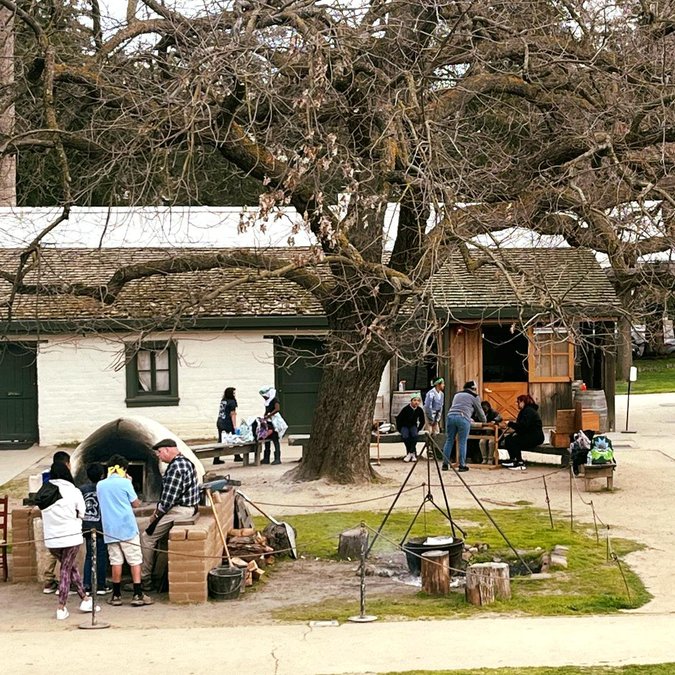
The interpretative days that feature docents dressed in period clothes doing various tasks needed day-to-day 183 years ago are well worth the additional admission.
A visit to the fort is definitely a low-key excursion conducted by primarily self-tours. Actually, that is the charm of Sutter’s Fort. It is a place you can wander through at your leisure and soak up history.
Thanks to how the fort was reconstructed makes it easy to put yourself back in the 1840s within the adobe walls that are 2½ feet thick and upwards of 18 feet high. A distillery, grist mill, blanket factory, gunsmith, carpenter shop, sleeping quarters, blacksmith shop were all nestled up against the fort’s walls. Sutter’s personal quarters — and the office where history has it Marshall and Sutter examined that fateful rock — were in the building in the center of the fort.
Outside the walls were buildings for livestock and such, corrals and dwellings.
The reconstructed fort is 312 by 156 feet. Some historic sources say the fort was really 425 by 175 feet although that is not known with any degree of certainty.
It is, by the way, the oldest restored fort in the West.
Sutter was also smart enough to build on high ground to the east of what would be eventually known as Old Sacramento and downtown where the State Capitol is located that was the subject of floods in the early years until the ground was raised and levees built.
A trip this time of year has an added bonus as the low-key gift shop has some unusual items for holiday giving. They run the gamut from clothespin dolls, gold-filled bottles and harmonica necklaces to books perfect for young readers and quirky socks inspired by Wide Open Walls. Each purchase supports vital educational programs, like field trip supplies for local schools and free or low-cost community events.
Sutter’s Fort is located at 2701 L Street in Sacramento within blocks of Business 80 that Highway 99 turns seamlessly into when you reach the Highway 99 interchange heading north out of Manteca. The entrance is from the large gates facing 28th Street.
There is not a separate parking lot for park. Street parking is metered and there are several nearby public parking lots.
The historic park is open daily except om Thanksgiving. Christmas, and New Year’s Day. Hours are 10 a.m. to 5 p.m.
Admission is $5 for adults and $3 for those ages 6 to 17. Those 5 and under are free
The other nice thing about going to Fort Sutter’s is the wide array of nearby choices for additional historical sites to visit as well as dining options.
Among the historic sites and state parks in Sacramento are:
*Old Sacramento that features two of my favorite Sacramento area restaurants — The Firehouse as well as Frank Fats. You will also find a well restored one-room school house in Old Sacramento as well as the historic waterfront.
*The California Railroad Museum that features the Western Hemisphere’s largest collection of historic engines and rolling stocks. It is located next to Old Sacramento.
*The Governor’s Mansion and 16th and H Street.
*The California State Indian Museum at 26th and K Street.
*The California Museum for History, Women and the Arts.
*The Leland Stanford Mansion.
*The State Capitol Museum.
*The Eagle Theatre.
To contact Dennis Wyatt, email dwyatt@mantecabulletin.com