TRONA, San Bernardino County — “There’s no there there.”
It seemed like a throwaway line when literary figure Gertrude Stein used it in her 1937 book “Everybody’s Autobiography” to describe her feelings about returning to Oakland where she was born and raised after finding no trace of her childhood home.
Over the years, some have attached the four words to less than pleasant descriptions of Oakland.
But in all fairness, there is a there where ever you go even though it is hard to see that if you experience a place by looking out a windshield as you drive through it.
Trona could be one of those places that people are apt to hang the moniker ‘there’s no there there.”
Those that live there would likely disagree with that assessment, well maybe not the teens, as they did with reporters that blew into town after a pair of major quakes on July 4 and July 5 in 2019.
The first was a 6.4 quake on July 4 followed by an even more massive 7.1 quake on July 5.
The July 5 was the 11th strongest in California since the 1850s and hasn’t been topped since.
They were dubbed the “twin quakes”.
Smaller quakes shook the region for nearly two hours following the 7.1 event with little time between. For weeks afterwards, residents reported aftershocks every half hour or so.
Trona is located in the Eastern California Shear Zone where 25 percent of the fault movement takes place between the Pacific and North America tectonic plates.
What brings Trona up is the fact it was back in the news this week.
Fighter jets on the
way to Death Valley
Trona is on the western edge of the Searles Valley.
It has an airport north of the community where an Air Force Thunderbirds F-16 fighter jet crashed nearby on Dec. 3.
It was a reminder of one of the charms of Trona as it is on the edge of the southernmost point of the Argus Range overlooking a vast area with rugged mountains and desert valleys where Air Force and Navy fighter pilots conduct evasive dogfight maneuvers flying through canyons or weaving in and out of rugged terrain.
On my first five visits to Death Valley, I opted to take Trona Road via Ridgecrest.
Trona is a 24-mile drive east from Ridgecrest where the massive, in terms of land mass, Naval Weapons Station China Lake is located.
The military installation’s 1.1 million acres is larger than Rhode Island.
Back in 1989 as I crossed over a ridge from Searles Valley into the Panamint Valley, I noticed a radar station off the road perhaps a half mile. There were also large numbers painted on the pavement.
I didn’t give either another thought until about 10 minutes when I heard a rumble that kept getting louder and then saw a jet fighter perhaps 200 yards off the ground coming toward me above the roadway.
Since then, much of Panamint Valley was added to the boundaries of Death Valley National Park.
On ensuing trips to Death Valley — I intend to rack up No. 25 in 2026 — I’ve had several “close” encounters with fighter jets included one flying perhaps 1,000 to 2,000 feet high past the edge of the remote Panamint Valley Sand Dunes I had hiked to.
The only one that gave me a borderline heart attack was when I was just about to emerge from Wildrose Canyon going downhill on a racing bicycle and a jet suddenly zoomed by titled at what was a sharp angle.
Planet of the Apes’
has ties to Trona
Trona is the closest “town” to my go to spot to stay in Death Valley, which is Stovepipe Wells some 76 miles away.
The route takes you by Trona Elementary with an enrollment of 132 and Trona High with 116 students and is the Home of the Tornadoes.
Why this is of interest is the football field.
There is not a blade of grass on it, or anywhere in Trona.
The highly saline soil kills grass.
The football field is dirt.
School maintenance crews routinely walk across it clearing small stones. Game day prep involves dragging the field as one would the base paths on a baseball field.
Trona plays eight-man football. They are also known as the “Sandmen” for obvious reasons.
Speaking of sandmen, there is a perhaps a more enticing setting near Trona where Hollywood has helped show the world there is a there there.
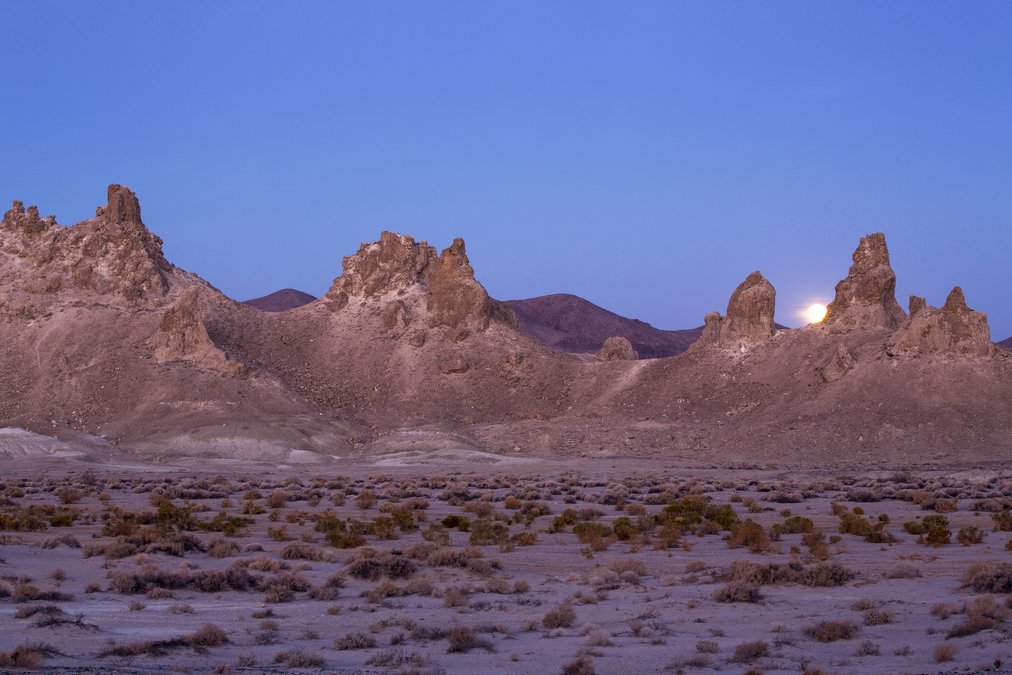
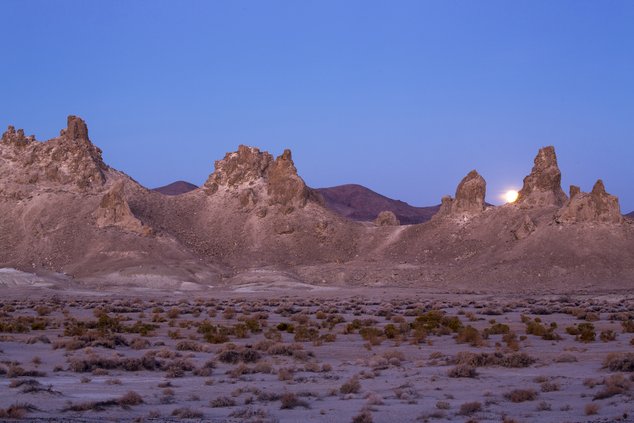
Located just a few miles south of Trona are the Trona Pinnacles.
It is where you will find more than 500 tufa spires with soaring as high as 140 feet.
They rise from bed of the dry Searles Lake basin.
You may have seen them and not realize it.
They were backdrops for movies such as “Planet of the Apes (2001), “Star Trek V: The Final Frontier”, “The Mandalorian”, “Oblivion” (2013), and “The Lost World: Jurassic Park.”
The lakebed is why Trona was officially establish in 1913 and what keeps the community’s largest employer, Searles Valley Minerals, humming.
The firm produces borax, boric acid, soda ash, salt cake, and salt.
Trona played a key role in World War I as it was the only reliable American source of potash, a key element in the production of gun powder.
John Searles, for whom the valley and dry lake are named after, established the first mining operation targeting borax in 1863.
Trona, by the way, is named for a gray mineral which occurs as an evaporite in salt deposits and consists of a hydrated carbonate and bicarbonate of sodium found in the Searles Valley.
The harsh environment for grass didn’t stop the community many decades ago from having an 18-hole golf course. It was all sand save for the “greens” composed of a softer grade of brown dirt.
The Trona area has somewhere around 1,500 residents scattered about.
The community supports two small grocery stores, a handful of restaurants, post office, and a San Bernardino County sheriff’s substation.
In short, Trona is a place people remember for its relative isolation and desolation although it’s a 30-minute drive from the bustle of Ridgecrest with its shopping centers, restaurants, fast food places, and the other trappings of a city of 28,000.
Trona clearly isn’t a San Francisco or Yosemite Valley.
But it is unique.
And as such, there is a there there.
You just have to slow down, stop and soak it in.
Desolation and isolation can be a beautiful thing even in small does.
To contact Dennis Wyatt, email dwyatt@mantecabulletin.com