I hadn’t been in a 7-Eleven for six weeks.
With that in mind, forgive me if I sound a bit taken aback about the new option when it comes to paying for your purchase in cash.
I was paying for a $5.29 purchase with a $20 bill.
As the cashier rung it up, I was given three options:
*Do you want to donate 0.01 cents to charity?
*Do you want to donate 0.11 cents to charity?
*Do you want to donate 0.21 cents to charity?
I get that the supply of pennies are slowly dwindling down given they are no longer being minted.
And I have no problem not getting a penny back.
I did, however, want to know what the charity was I was being asked to donate to forgo the pleasure of sticking a penny in my pocket that I’d later deposit into some nook and cranny at home and likely never see again.
The clerk may have been new or was just forgetful.
When asked, she couldn’t tell me what charity my penny would end up lining its proverbial pocket.
I honestly don’t think the store owner would simply keep it.
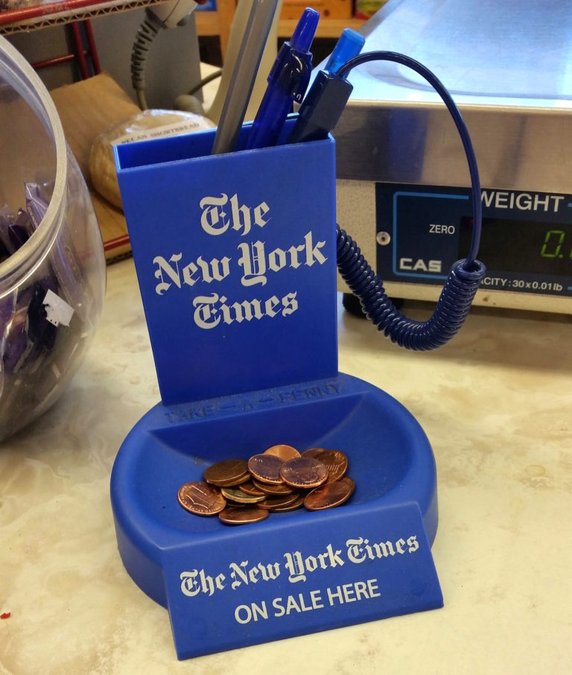
But then again, back in the 1990s when five pennies still bought the adolescent thrill of a piece of Bazooka Bubblegum that cost me a penny when I was 7 years old, I would occasionally toss one to four pennies in change in a “small tray” many convenience stores had at the counter by the cash register.
For those that never knew coffee not only cost a dime but there were two simple options of regular or decaffeinated, Bazooka Bubblegum had the basic dimensions of a raffle ticket and thickness of a USB device.
It was pink and wrapped in packaging that was in the mid-ranges of red and blue with white tossed in.
The older versions — that you could buy with a penny you picked up off the sidewalk often in close proximity to a discarded piece of gum that had been stomped into submission and was virtually black — had a three to four panel Bazooka Joe & his Gang comic strip and puzzle or offer of some “free” prize printed on the inside of the wrapper.
Apparenty when the gum got up to a nickel, the bubblegum barons had to cut corners to keep up profits so they dumped the cartoon et al.
Conscientious bubblegum chewers would keep the wrappers to properly dispose of the wad of gum after one worked it long enough to reduce it to the taste of rubber.
It was always a delight to step on a recently discarded wad of gum on a 90-degree plus day and then spend the next hour or so trying to scrape it off your sneakers.
It could be worse. You could get it in your hair.
I never could figure out how that happens until one day when I was 12. I was walking by the back corner of portable bleachers at a Little League game and heard what I assume was a mother saying “I told you to spit out the gum.”
Seconds later, a wad landed in my hair.
The kid she was talking to likely launched the gum by aimlessly spitting it out, it was a fitting move given the Topps Co. named the bubblegum after the rocket-propelled American soldiers used during World War II.
There was actually a time when schools — back in the Dark Ages before students were allowed to wear sweatpants to school and sling shots were the weapons that vice principals worried about — that gum chewing was aggressively banned in classrooms.
Not only did janitors tire of cleaning it off underneath desks once a year, but some students couldn’t resist blowing a big bubble until it popped, making a smacking noise during class that teachers equated as being as annoying as dragging one’s fingernails down a chalkboard.
To further explain how oppressive of a time that was, teachers didn’t dare bring coffee into the classroom and no one had a water bottle.
If you were thirsty, you roamed the campus looking for a fountain that was still working and sent out a stream of water at least an inch from the “bubbler” when you turned the drinking fountain on.
You also scored if someone hadn’t deposited gum in the porcelain basin or used it as a spittoon — I grew up in a small town where the high school student parking lot default vehicle was a well-used pickup truck.
But then again, that was back when pickup trucks were less expensive than sedans, AC was a lavish option, and in-cab tunes were only AM radio.
It was a time 55 pennies bought you something substantial such as a gallon of gas, even in California.
That’s right, we were talking pennies and their relative value.
It was back when a piece of Bazooka cost a then outrageous nickel that I stopped making voluntary contributions to the penny trays found in some stores.
You “donated”, on the assumption, that some customer after you could tap into it if they came up short a few cents.
It was in 1994 at a gas station/convenience store on North Main Street in Manteca that I realized things may not be as they seem.
I was talking to the owner about how some people would drop loose pennies into the dish or tray every time they bought something and never pocket a penny.
That is when he volunteered a bit too much information.
He shared how eight or so times a day he would “dump” the tray.
It didn’t dawn on me what he meant until he added that on most days he was able to pocket around $2, noting at end of the month he “made” $50 to $70.
I was taken aback.
I asked how he could that when people bought into as an honor system of sorts that someone that came up a bit short after them would use it.
Or the cashier could dip into it to avoid making a lot of change.
“They’re just throwing it away,” came his reply.
There I was Tuesday thinking about that betrayal of implied trust from years ago as I pondered what to do with the prompt, especially after the clerk was clueless as to what charity I was being asked to support.
What did I do?
I agreed to give some faceless charity a one cent donation.
If it never makes it to the stealth charity at least it was one less penny I’ll be cleaning out from a drawer 10 years from now.
This column is the opinion of editor, Dennis Wyatt, and does not necessarily represent the opinions of The Bulletin or 209 Multimedia. He can be reached at dwyatt@mantecabulletin.com