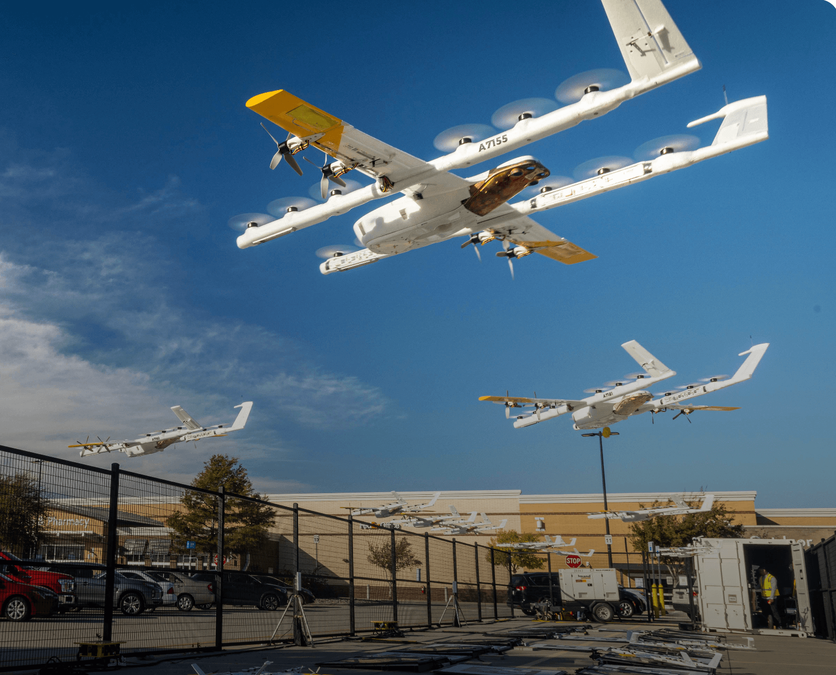
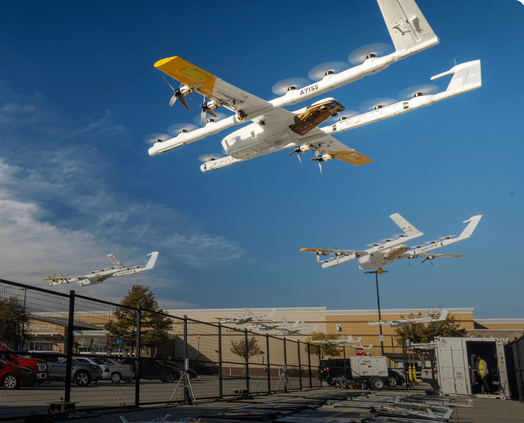
Walmart is expanding its drone delivery service.
The goal is to add 150 stores by next year to its network of 120 stores where you can have an item up to five pounds delivered within 30 minutes or less providing it is in the delivery zone that maxes out at 6 miles from the store.
About a quarter of Walmart’s Wing customers now use drone delivery three times a week.
Keep in mind this is just the tip of the proverbial iceberg.
Not only does Walmart have 4,600 locations, but they are not the only fish in the sea.
Add Target and endless others in the race to win the fastest delivery time contest and drones will be thicker in the sky than swarms of locusts blocking the sun.
Some may worry about how an increase in drones may disrupt birds or neighborhood peace.
Others might wonder how they should, or how they can, be kept from flying over private property other than the deliver address.
In defense of the Walmart-Wing partnership, their operations are pretty straight forward.
They take off from the Walmart with the first order of business going up basically vertically to a cruising attitude.
They routinely delivery the payload down by a cord that places it in a targeted area smaller than a picnic basket in a customer’s yard,
In reality, they are probably less intrusive than delivery vans.
But that is before you realize they aren’t replacing delivery vans. Given the light payload capabilities, they are in addition to delivery vans.
Put aside the annoyance factor, the extremely small risk for higher altitude collisions or malfunctions sending items gaining velocity to the ground where they aren’t supposed to go, and the equally small risk of theft.
The real concerns should be what it all says about where we are headed as a society and as people in general.
Walmart hawks it’s Wing delivery service as ideal for last-minute purchases such as ingredients for a meal or over-the-counter medicine except, of course, things like Sudafed where you have to show identification.
It makes sense, but if 25 percent of Wing customers use the drone delivery service three times a week it says a lot about either our growing inability to plan ahead or complete abandonment of patience in a “I-want-it-now world”, or both.
Three times a week you forget an ingredient for a dish you’re cooking?
Three times a week you realize you’ve run out of aspirin, have no Band-Aids left, or need toothpaste and you can’t wait for two-hour delivery?
One must wonder how many people in 2026 could survive living a century ago, let alone mid-1850s when going to the general store for supplies could be an all-day trip.
Of course, such convenience doesn’t come cheap.
The drone delivery from stores where it is operated and within the six-mile delivery radius is free for now as a promotional offer for Walmart+ members that fork over $98 a year.
For all other customers, it’s a $19.99 delivery charge each time.
The odds are unless Walmart is selling jewelry with drone delivery with a 30-minute or less delivery window for those that forget to buy a present, the $19.99 delivery charge is more expensive than what is being delivered.
Keep in mind this is taking place in a time where virtually everyone, including households with income in the six figures, is yapping non-stop about affordability.
Perhaps some of the affordability issues we encounter are a direct result of our impatience or inability to properly plan.
Wing, a division of Alphabet that also owns Google, along with Walmart, have declined to share how much the actual delivery cost is to the retailer.
It might cost less than a van and driver but at least that combo can deliver items heavier than five pounds and larger than what you can fit into a small Chinese food take-out container.
The price of that convenience will ultimately be collapsed into the price everyone pays for goods.
It is no different than a convenience store.
Sometimes in a 7-Eleven you can overhear someone complaining about a 20-ounce bottle of soda costing almost $3 each.
A 16-ounce version of the same soda can be bought on a per bottle basis for right around $1 at many grocery stores.
You pay for the convenience which is the entire idea behind a convenience store.
There is a price you pay for wanting things now and not later.
But why take any accountability for essentially your own actions.
Blame it on corporate greed.
Blame it on the government.
Blame it on the moon.
Blame it on everyone but yourself.
Walmart didn’t get to be Walmart by ignoring what impulses drive people to buy.
They may like to frame themselves as a low-cost retailer but they do so by selling a lot of wants and not just needs.
It is clear Walmart is not going after the same shopper in 2026 that Sam Walton did in 1970.
The Wall Street Journal and other publications report more and more “solid” middle class households are shopping at Walmart today because of “affordability.”
You’ve got to wonder how many of those “solid” middle class Walmart shopping converts are having drones deliver “last minute” purchase to their homes.
How people spend the money they earn is their business.
We all bellyache about the price of stuff.
But at the end of the day, if we can afford drone deliveries that easily double the price of what we are buying then we don’t have an affordability issue.
What we have is questionable judgment, bad financial decision making, or a bad case of victimhood.
But the one thing it isn’t is an affordability issue.
This column is the opinion of editor, Dennis Wyatt, and does not necessarily represent the opinions of The Bulletin or 209 Multimedia. He can be reached at dwyatt@mantecabulletin.com