Today is an odd day.
Any Californian who was around in 1973-74 fretting that gas would top $1 a gallon — it didn’t — remembered what an odd day meant.
You were allowed to buy gasoline on days that ended with an odd number if your license plate did as well.
Even days meant only those with license plates could pump gas if their vehicle license plate ended with an even number.
Those with personalized plates were considered odd.
Keep in mind in some areas of California, there was the added bonus of gas sales being maxed out at 8 gallons per customer in one trip to the gas pumps.
And what a trip it was.
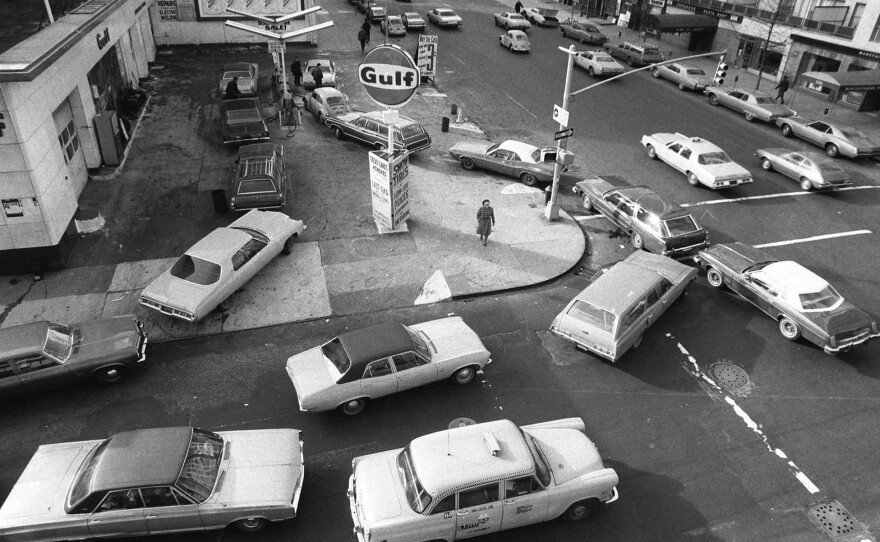
Gas lines — think how Chick-fil-A customers lined up for blocks in the drive-up queue line when they opened the East Yosemite Avenue location in Manteca in 2020 — were the norm.
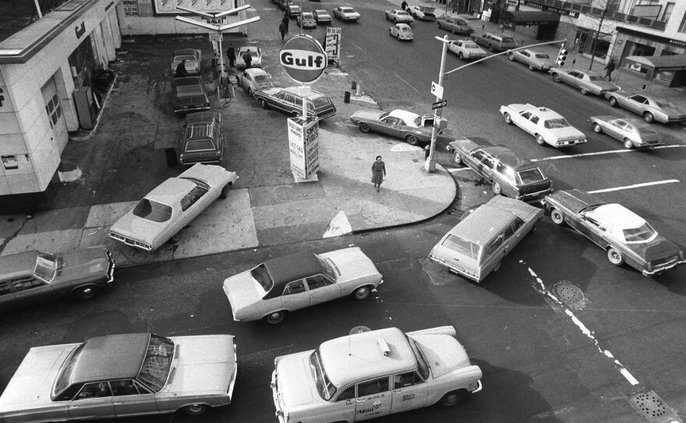
Lines would start forming before the crack of dawn.
Keep in mind this was before the advent of card lock pumps.
That meant the only gas stations open 24/7 were on freeways or major highways.
Some people literally would spend hours in line to buy gas.
They’d try to conserve what fuel they had by turning cars on and off as the waited to move forward in lines.
There were a few people that actually ran out of gas waiting for gas, forcing them to push their vehicle to the pumps.
It was when we went temporarily to year-round daylight savings time to save energy.
The maximum speed limit was dropped to 55 mph nationally.
And there was no 10 mph “cushion” allowed.
CHP issued tickets aggressively with the limit broken by single digits per mile earning a speeding ticket.
It was all thanks to the Yom Kippur War in the Middle East and the subsequent Arab oil embargo.
The oil rationing would be repeated in 1979.
By then, California owned the bragging rights for being the first state for gas to be selling gas in excess of $1 a gallon.
Gas, on average, rose 43 percent back in the 1973-74 time period over the previous year.
Californians today to experience the same price jolt would need to see the statewide gas price hit $6.55 a gallon. It was $5.26 as of Monday, compared to $4.58 a year ago.
And if gas matched the rate of inflation since the per gallon price reached $1 in California in the mid-1970s, drivers in the Golden State would be paying about an average of $5.75 a gallon today.
Gas is the daily Rorschach Test for most Californians.
We see what we want to see.
Gas, according to the Chicken Littles on social media that want to blame either Trump or Newsom, will soon get as high as $10 a gallon.
Newsom, by the way, should send Trump a generous McDonald’s gift certificate for providing him with a bit of cover for high gas prices that are widely believed to be a political Achilles heel in the governor’s 2028 presidential bid.
Not only do we see what we want to see, but our actual buying behavior when it comes to gasoline is counter to much of our squawking.
I bought gas for $4.79 a gallon in Manteca on Sunday at the chameleon station on East Yosemite Avenue east of Powers Avenue that has gone through three name changes in the past three years.
Down the street where you will find the likes of Shell and Chevron, people were filling up at 60 cents to 80 cents more per gallon.
Not that you need to do the math, but they are buying the same amount of gas for $6 to $8 on a 10 gallon fill up.
If gas price anxiety pumped up by the national media and the social media parrots zeroing on the highest gas prices in California — they were $7.58 per gallon in Bridgeport in the Eastern Sierra and $6.61 in Furnace Creek in Death Valley, both on Sunday — was anything but a piranha feeding frenzy on the Internet, then they’d be nary a whirl at a Chevron or Shell gas pump.
The Chevron station two blocks from where I bought gas on Sunday had twice the number of cars at the pump.
Keep in mind this is not a new phenomenon.
As much as it seems four-fifths of California drivers complain about high gas prices while laying the blame at the feet of their favorite bogeyman whether it is Newsom, the state legislature, Big Oil, or the green cabal, the majority of us don’t have gasoline buying habits that match our gripping.
If we did, Chevron would be pulling more than their headquarters out of California and trying desperately to find enterprising used car selling entrepreneurs to buy their boarded up gas station sites.
Gas could top $6 a gallon on average in the coming weeks or months, who really knows?
But with a statewide average of $5.52 reported by AAA on Sunday, it still has not reached the peak of $5.79 that the average gallon of gasoline sold for in October of 2023.
Making all of this even more bizarre — and making us all of appear like the proverbial snowflakes when it comes to gas prices — is what Americans went through during World War II.
There was gas rationing with A, B, C, X, et al, stamp/sticker system.
Those issues “A” stamps were allowed to buy three to four gallons a week.
Workers in jobs that supplied the military for “B” stamps for the ability to buy up to 8 gallons a week.
“C” stamps went to doctors and such that had much more generous allocations.
And “X” stamps — unlimited gas — were awarded to clergy, policemen, firefighters, and civil defense workers.
You also needed to prove and certify that you had a need for gasoline, but also that you had no more than five tires. Any tires in excess of five, were seized by the government due to an acute rubber shortage.
A lot of other items were rationed as well from tires to sugar.
The remaining inventory of new cars not sold at dealerships could only be bought by certain professions, such as doctors and clergymen.
As a side note, a national speed limit of 35 mph was imposed to save gas and rubber for tires.
Can you imagine what the howling in the vast hollowness of the Internet would sound like today if, for whatever reasons, consumer goods and prices — especially on gas — channeled World War II realities?
This column is the opinion of editor, Dennis Wyatt, and does not necessarily represent the opinions of The Bulletin or 209 Multimedia. He can be reached at dwyatt@mantecabulletin.com