Three times during the second grade we had nuclear attack drills.
Mrs. Ross would tell us we needed “to get under our desks now.”
As we were scrambling to seek cover, she’d remind us never to look toward the solid bank of windows from the top of the built-in cabinets to almost the ceiling on the north side of the classroom.
The reason, we were told, is we didn’t want to be permanently blinded by an atomic bomb blast.
There were many as the Cold War wore on that said subjecting kids to such drills was nothing but scare tactics and federal propaganda.
To be honest, we weren’t scared, but we should have been.
As second graders at Glen Edwards School in Lincoln, Placer County, we were far from being plugged into world politics.
Our biggest concern was whether they were going to serve tamale pie for the school lunch.
But in retrospect, we had plenty of reasons to be a bit concerned about an atomic war than most second graders.
The reason was simple.
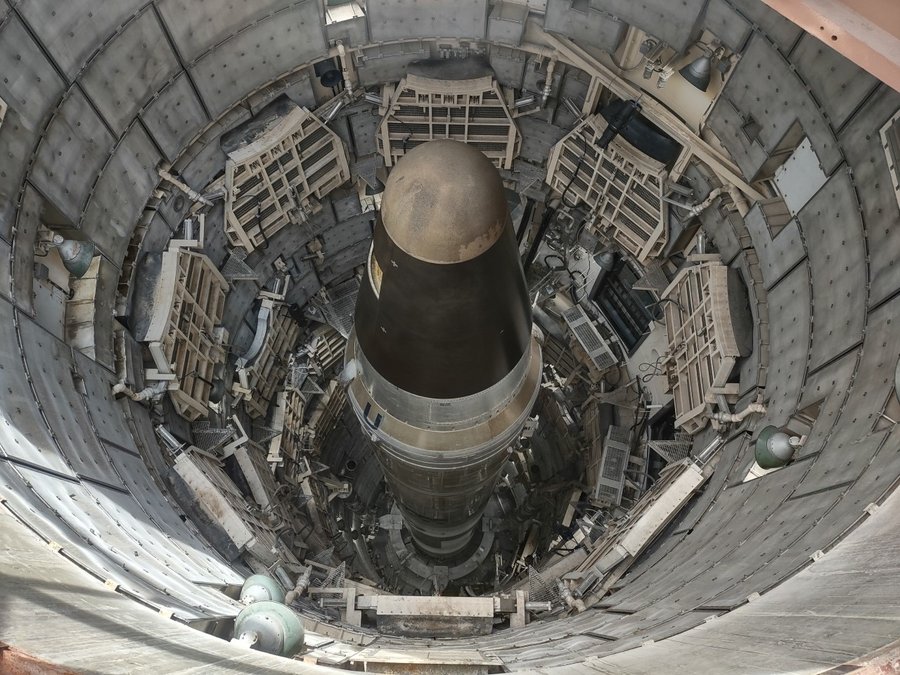
There were four 98-foot Titan 1 intercontinental ballistic missiles each with a nine megaton nuclear warhead in a 160-foot deep steel-and-concrete reinforced launch complex less than three miles from the school playground where we played dodge ball.
Nothing screamed preemptive attack target louder in the thought process of a Soviet Union military officer assigned to come up a first strike plan for the United States than four missiles that at the time carried the world’s most powerful nuclear warheads.
If that didn’t put us at ground zero as second graders, the fact 30 some miles slightly to the northeast of that bank of classroom windows was Beale Air Force Base, another prime target.
Not only was it home to a B-52 bomber squadron carrying nuclear weapons, but it was the only base for the world’s most advanced and fastest spy plane, the SR-71.
Then there was the issue of being within 10 to 40 miles of the state capitol, the massive logistic operations at McClellan Air Force Base, the Aerojet complex that produced rocket engines near Mather Air Force Base, and the Southern Pacific Railroad marshaling yard in Roseville that was the largest west of the Mississippi River.
Basically, Lincoln wasn’t exactly in an area where a steel student desk with a laminate top you opened to store your books and school supplies was going to afford you much practical protection for a good outcome.
The drills ended the following school year.
It’s not because grown-ups realized the futility of the exercises. Uncle Sam pulled the plug on the Titan I program and was replacing it with Titan II missiles.
The Lincoln silos — along with one near the Sutter Buttes by Live Oak and one near Chico — never went operational.
The missiles were brought into Lincoln via Highway 99 East, which is now Highway 65, on Feb. 28, 1962.
They made a turn on to McBean Park Drive (Highway 193) where there was a Shell gas station, Leavell Chevrolet, Jansen & Son Feed Co., and a fabrication firm.
They then rolled past my grandmother’s house and to the missile base just over a mile east of town at the base of the Sierra foothills.
They were installed and went through extensive “training” scenarios with the target to go online in 1964.
Instead, they were yanked out of the ground and taken to wherever the military dismantles missiles and removes nuclear warheads.
The government then issued a contract to strip the 160-foot deep silos to the concrete and steel.
So, what did they strip out?
Ninety miles of cable, 300 tons of piping, and 1,800 separate supply items.
Left in the ground was 32,000 cubic yards of concrete and plenty of steel.
The process had required the removal and then backfill of 600,000 cubic yards of rock and earth.
To understand how that was a different time, nobody squawked in 1958 when the government announced they were putting a missile silo with four nuclear warheads within two miles of downtown Lincoln.
There were not protestors lining the streets when the missiles rolled by, although a couple of people did snap photos with Kodak Brownie cameras.
No one questioned the decision to provide Lincoln a fallout shelter due to its close proximity to a missile base by designating the massive beehive kilns at Gladding, McBean & Co., where they made clay sewer pipe and roof tile, as the go to place in the event of a nuclear attack.
Forget the fact the kilns burned at 2,000 or so degrees and took 30 days to cool down completely.
For 23 months even though they were not yet operational, people in Lincoln went to bed with four nuclear warheads just two or so miles from where they rested their heads.
It clearly was more ho-hum than anything.
The only aspect of the Cold War that irked Lincoln residents back then was in January 1966 when the first SR-71s arrived at Beale Air Force Base.
Over the course of two days, periodic sonic booms rattled windows everywhere — especially at Glen Edwards School named after the Lincoln High graduate who was killed as a test pilot at the controls of the Flying Wing.
The massive Edwards Air Force Base in the Mojave Desert in Southern California carries his name. And anybody engaged in the immigration debate might be interested in knowing that Edwards, who was also the Lincoln High valedictorian in 1924, was a Canadian who became a naturalized citizen.
Pushback got authorities to change the SR-71 take-off and landing approaches so they’d take off to the east over the Spenceville Wildlife Area north of Camp Far West Lake. It was partly over land my grandmother had a working ranch before moving to Lincoln near the end of the Depression.
The Blackbird, as the SR-71 was known, has an operational speed at three times the speed of sound or 2,200 miles per hour.
It could be over Idaho in 15 minutes flying at reduced restricted speed from just outside of Marysville in Yuba County.
The first day the SR-71 zipped by Lincoln, I happened to be on the playground at Glen Edwards School. I didn’t see what some teachers and students described as a thin streak across the western horizon where rice fields dotted the countryside.
News reports of the day said the SR-71 at the time was operating below 500 feet.
All I know is the biggest playground topic for the rest of the morning wasn’t the fact sweet honey buns were on the lunch menu but how awesome the shaking everyone felt was.
No, we hadn’t stopped worrying and learned to love the bomb as Dr. Strangelove might say. It’s just that we never worried.
It was all part of the world we lived in.
That said, if anyone gave it much thought, the idea of nuclear weapons in the drone age is much scarier than a land based missile taking 30 minutes to travel from Russia to the United States, or vice versa.
No matter where nuclear weapons are located, they are clearly an issue that hits close to home.