PESCADERO, San Mateo County — Twenty-five miles south of Half Moon Bay, a low, rocky, windswept point juts out into the Pacific Ocean that is part of Ano Nuevo State Park.
This promontory was named Punta del Año Nuevo (New Year’s Point) for the day Don Sebastian Vizcaíno first sighted it on January 3, 1603.
Between December and late March, northern elephant seals come ashore to rest, mate, and give birth on the beaches, sand dunes, and nearby offshore island.
The sight of huge male elephant seals battling for mating rights is a unique and unforgettable natural spectacle that thousands of visitors come to witness each year.
The nearest town Ano Nuevo State Park is Pescadero, 13 miles to the north on Highway 1. Santa Cruz is a 20 mile drive to the south.
It is almost a two hour drive from Manteca via Half Moon Bay.
Park hours are 8:30 a.m. to sunset.
Entrance fees are $10 a vehicle.
Park history
When Sebastian Vizcaíno first saw what is now Año Nuevo Point, the area had already been occupied for thousands of years by the Quiroste people, a group of Ohlone Indians who lived here seasonally.
The Quiroste hunted, fished, and gathered abalone and other shellfish from the sea. They made spear and arrow points, knives, and scrapers from chert stone gathered on the beach.
The park’s Quiroste Valley Cultural Preserve safeguards the remnants of native Ohlone presence.
The Ohlone people’s first contact with non-natives came in 1769, when the Spanish military commander of the Californias, Gaspar de Portolá, traveled overland to the area north of today’s San Francisco Bay.
After the 1791 founding of Mission Santa Cruz, hundreds of Ohlone — including the Quiroste — were baptized and brought into the mission. Some Ohlone people who survived the Spanish mission system eventually mixed with the larger culture of Mexican California.
Today’s Ohlone people have kept their ancient cultural traditions alive.
Año Nuevo, used as pasture land by the missionaries, became a rancho in 1842 when Governor Juan Alvarado granted 17,753 acres to his uncle, Don José Simeon de Nepomuceno Castro of Monterey. American Settlers
In 1851, Castro’s heirs sold the rancho to frontiersman Isaac Graham. Ten years later, the land was bought by brothers Isaac, George, and Edgar Steele, whose dairy operated here for about 80 years. The barns and other historic buildings at Año Nuevo date from the Steele Brothers Dairy era.
After World War II, the dairy industry changed. Row-crop farming took the place of dairy cattle, thanks to new irrigation technology. Segments of the Monterey cypress windbreaks that the farmers planted still survive.
Geology
As ship traffic increased along the coast in the mid-1800s, the shoreline became recognized as exceptionally dangerous to shipping — particularly the foggy, rock-strewn area between Año Nuevo and Pigeon Point.
In 1872, the federal government installed a fog whistle on the island and added a five-story light tower in 1890. An automatic buoy replaced the light tower in 1948, eliminating the need for lighthouse staff.
The former keeper’s residence has been maintained in a state of arrested decay since 1948.
The State of California acquired Año Nuevo Island and a strip of mainland in 1958. To protect the wildlife that nests and breeds there, Año Nuevo Island is closed to the public.
In 1985, 2,980 adjacent acres of coastal mountains from the former Cascade Ranch were added to the park.
The surf-resistant rock that forms Año Nuevo Point is known as the Monterey Formation. Starting as sedimentary clay and silt laid down beneath the sea 12 or 13 million years ago, it has gradually changed into a thinly layered mudstone, common throughout the Coast Range.
The Monterey Formation was moved northward by tectonic activity along the San Gregorio Fault Zone, which cuts through the park. Small faults associated with the major fault zone are visible in the cliff face along the park’s south shore.
Año Nuevo Island is part of the marine terrace that enters the sea from below the Santa Cruz Mountains.
The terrace’s westerly portion is covered by sand dunes that are being driven from north to south by northwesterly winds. This 300- to 350-acre dune field is one of the few remaining active dune fields on the California coast.
Here at Año Nuevo, the dunes have been changing character as a result of naturally decreased sand availability.
Plant life
The diverse habitats at Año Nuevo enable various plant species to be successful.
Deeprooted willow thickets spring up amid grasses where drifting sand is trapped. The prevalent tree species — Monterey pines, coast redwoods, and Douglas-firs — thrive in this coastal environment.
Bushy perennials like mock heather, bush lupine, and lizardtail dot the sand dunes. Sand verbena, beach burr, and such colorful annuals as evening primrose and California poppies provide cover and food for mice, rabbits, insects, and other small life forms.
The Elephant Seals
The big attraction for visitors is the large colony of northern elephant seals that assembles here each winter. Named for their large size and their long, pendulous noses, elephant seals were slaughtered wholesale in the 1800s for the oil that could be rendered from their blubber.
By 1892, fewer than 200 individual seals existed, living on the remote island of Guadalupe off the coast of Baja California.
In 1922 the Mexican government gave protected status to the elephant seals, and the United States followed suit a few years later when the seals began to appear off the Southern California coast.
Año Nuevo Island’s first elephant seals arrived in 1955; the first pup was born there in 1961. Males hauled onto the mainland in 1965, and the first known mainland birth came 10 years later. The number of elephant seals breeding and giving birth on the mainland still grows. Since their protected status began, elephant seals continue to multiply. Their breeding range extends as far north as Point Reyes.
Elephant seals spend most of their lives at sea and come ashore only to molt, mate, and give birth.
The first males arrive at Año Nuevo in December. Weighing close to 2½ tons, huge bulls engage in violent battles to establish dominance. The successful bulls do much of the breeding; most of the responsibility falls on the “alpha” bull at the top of the social ladder.
In early December, 800- to 1,600-pound females begin to arrive and form “harems” on the beaches. Three to six days later, they give birth to the pups conceived the previous year.
One pup is born to each female, nursing for an average of 28 days. Feeding on its mother’s rich milk (up to 55% fat), the pup grows from about 75 pounds at birth to 250-300 pounds in less than a month. Females may mate several times before returning to the ocean, abruptly weaning their pups by deserting them.
By mid-March, most of the adult seals are gone, leaving the pups behind. The pups then molt their original black fur, which is replaced by a shiny new silver coat. Soon they begin learning to swim in the shallow offshore waters.
By the end of April, they have begun to head northward in the Pacific Ocean to forage for food.
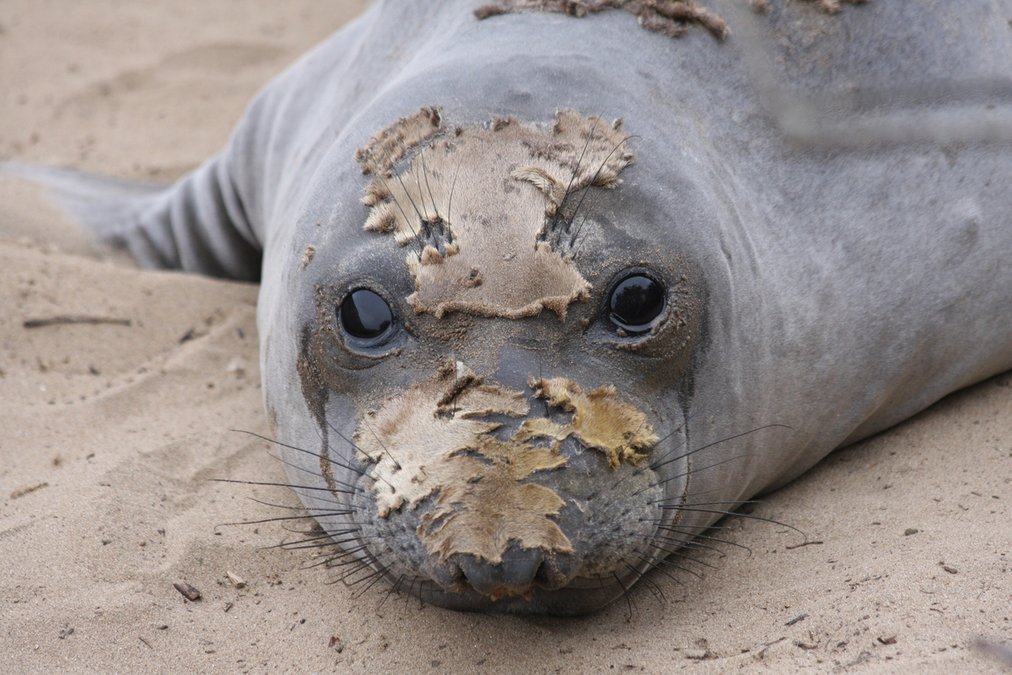
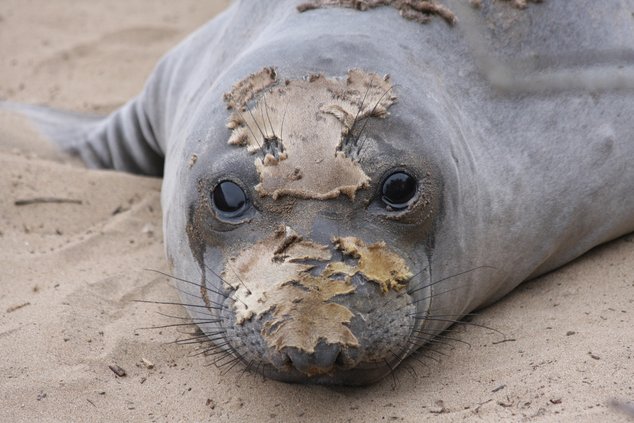
Between April and November, elephant seals return to the beaches of Año Nuevo in smaller numbers (based on their age and sex) to molt. This “catastrophic” molt takes approximately 30 days, during which the seal sheds its outer skin layer with fur and whiskers.
Other Pinnipeds
Pinnipeds are marine mammals with finlike feet or flippers. Año Nuevo is a vital rookery and resting area for more than the largest of the pinnipeds — northern elephant seals. Tawny brown Steller sea lions breed on the rocky outer portions of Año Nuevo Island.
Large numbers of dark brown California sea lions often haul ashore, but very few breed on the island. The incessant bark of male sea lions travels for miles. Harbor seals live on the island all year, breeding in April and May.
Their heads bob in the surf just off the park’s beaches. On offshore rocks, they are identifiable by the mottled pattern of their coats.
Other marine life
Throughout spring, the telltale 10- to 15foot spouts of California gray whales may be visible as they pass the point on their annual migration between their winter breeding grounds and their summer feeding range in the Bering Sea.
Visitors may spot sea otters offshore, diving for food or floating on their backs. Like elephant seals, otters are returning from near-extinction to reoccupy their former range.
Sea otter mothers and pups returned to Año Nuevo in the early 1980s — the first sea otters to enter this immediate area in more than a century.
Tide pools at Año Nuevo teem with more than 300 species of invertebrates, some quite rare. Common life forms include clams, abalone, limpets, hermit crabs, and anemones. Nutrients from seal and sea lion waste fertilize the lush aquatic plant growth that feed the rockfish and bottom fish offshore. Elephant seal pup with mother Año Nuevo Island is home to an abandoned lighthouse station, birds, and many pinnipeds.
About your visit
Seals are here year-round. In spring and summer, elephant seals return to molt. Females, juveniles, sub-adult males, and adult males visit from April to August.
Yearling seals haul ashore in the fall. From December 1 to 14, the restricted Natural Preserve area is closed to allow pregnant females undisturbed beach access. Breeding takes place from December through March.
From December 15 to March 31, you can see the elephant seals only on one of the regularly scheduled guided walks that minimize disturbance to the animals and their natural habitat.
The 2½-hour, three-mile walks are conducted by volunteer naturalists. Advance reservations are recommended and can be made as early as October. From April through November, hiking permits are required to enter the restricted areas at Año Nuevo Point and are issued first come, first-served at the park.
Elephant seal viewing requires a 3 to 4 mile moderate hike over varied terrain, including sand dunes.
Elephant seals are unpredictable and faster than they appear to be. Even on land, they are extremely mobile for short distances. The head, which is drawn back to the shoulders at rest, can be extended two or three feet for a quick bite, and their large canine teeth can inflict serious wounds. Battles for dominance between bulls are among the bloodiest of any species. Bulls can crush a person with their two- to three-ton weight.
Stay at least 25 feet away from all seals.
Driving to see seals is not an option. Sturdy shoes, layered clothing, water, and rain/wind/sun protection are recommended.
Visitors requiring mobility assistance are encouraged to make a reservation for an Equal Access Tour. For general information on the elephant seal walks, phone (650) 879-0227.
For seal walk reservations, phone (800) 444-4445.
The historic Steele Brothers Dairy barn is now the park’s accessible Marine Education Center. The educational and interpretive facility and nearby theater comprise 7,480 square feet of exhibit and classroom space with podcasts, webcams, and multi-media demonstrations of Año Nuevo’s rich natural and cultural history.