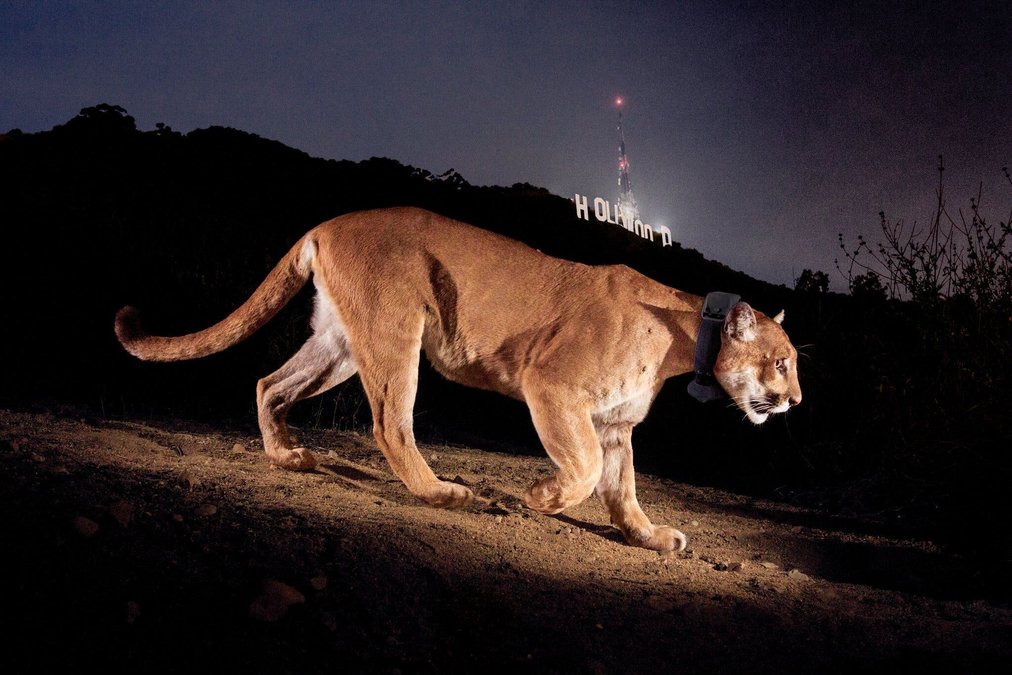
Here’s a shocker: Mountain lions kill deer. And where mountain lions and deer are near roads there are less deer versus vehicle collisions.
Therefore, mountain lions improve road safety in California and elsewhere.
No, Captain Obvious isn’t making a statement.
It’s a conclusion of a study on how mountain lions affect the behavior of deer.
And it was announced last week on Internet “news sites” with the clickbait headline, “Mountain lions improve California road safety, new study says.”
The study story, not the study, contends nearly 100,000 deer each year are hit by vehicles in California.
That is the conclusion the San Francisco Chronicle reached based on a “duh” research study conducted in the State of Washington.
That study said deer:
*are more active during the day.
*tend to dwell in areas away from the road and development.
*have figured out mountain lions have a hunting advantage at forest edges where roads and fields meet trees.
Based on five years of research using around 500 spots with camera traps and GPS collars around 60 mountain lions on the Olympic Peninsula in Washington over a five-year period, the conclusion was mountain lions in areas where deer are present led to a:
u67 percent drop in the likelihood of a deer versus vehicle collision.
u76 percent drop in the total number of such expected collisions.
This led to the following statement by ecologist Mark Elbroch, a study author with Panthera — an organization dedicated to wild cat conservation:
“When we talk about pumas (mountain lions, cougars), we often focus on the risks they pose. But we rarely stop to consider the main ways they benefit us as well. Living alongside large carnivores isn’t simply about protecting wildlife; it’s about protecting the many ways they protect us every day.”
Do not misunderstand. Mountain lions need protection.
That said it is counterintuitive that it would be a plus for mankind to have mountain lions lurking down Main Street in Ripon, on the prowl on River Islands Parkway in Lathrop or in the hunt on Yosemite Avenue in Manteca to prevent accidents.
Mountain lions are found throughout California except in the Central Valley where agricultural development eliminated their environment.
That said, in the last 30 years there have been rare sightings along the Stanislaus River near Ripon and in the Lathrop and Tracy area.
Manteca-Ripon-Lathrop is not an area today where mountain lions can live long and prosper. That goes for deer as well who are busy on the Coastals and Sierra — on either side of the valley as well as their respective foothills — trying to avoid being a meal for a mountain lion.
To be clear, reducing car-deer collisions was not the objective of the study. Panthera is also a steadfast organization that doesn’t value sensationalism and raving as they use data to pursue their goal to help 40 various wild cat species around the world survive and thrive.
Their effort is not helped by those that point “between 20,000 and 100,000 deer” are hit by vehicles in California every year.
The goal, of course, is to impress on the reader that more mountain lions hanging around California reduces the chance their $55,000 Tesla or $70,000 Ford F-150 will be totaled by striking a deer while driving.
They “condition” that assertion by saying various sources say the vehicle-deer strikes in California range “between 20,000 and 100,000” a year.
Strike a deer and your vehicle is going to sustain serious damage.
And unless you don’t have insurance, the odds are you are going to file a claim.
It just happens insurance companies in California report there are roughly 20,000 deer-vehicle collisions annually on Golden State roadways.
As such it would be a lot less hyperbole citing the numbers of the one entity that track such data and says “at least 20,000” deer-vehicle collisions take place annually.
Why make it sound five times as worse?
Is it to fit narratives seeking specific actions such as limiting deer hunting, trying to put in more wildfire crossings such as the one on Laurel Curve on Highway 17 in the Santa Cruz Mountains where 1,000 plus deer, skunks, bobcats, mountain lions and foxes are recorded using it a year, or is it to appeal to Bambi crowd to get more clicks?
Giving mountain lions carte blanche because they help reduce deer-vehicle collisions is not sound policy.
But neither is expanding deer hunting because studies show thinning the population that way allows for healthier deer thanks to less disease and less competition for food.
Mountain lions — and the now extinct California grizzly bear — are nature’s way in a world not dominated by mankind to keep the deer population healthy.
The obvious fact mountain lions feast on deer and therefore reduce the potential for deer-vehicle collisions is not in itself a reason to help the spread of mountain lions.