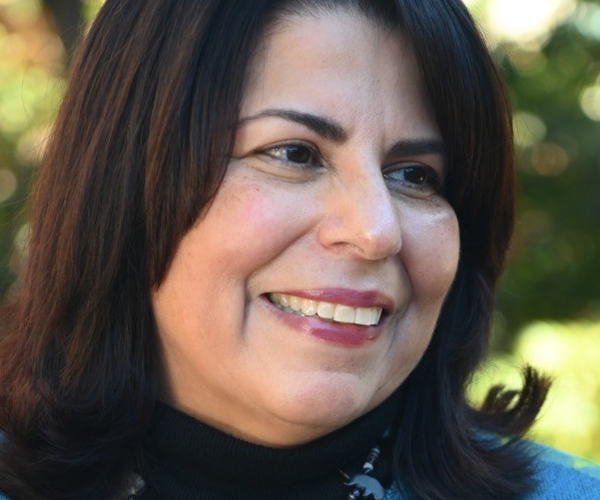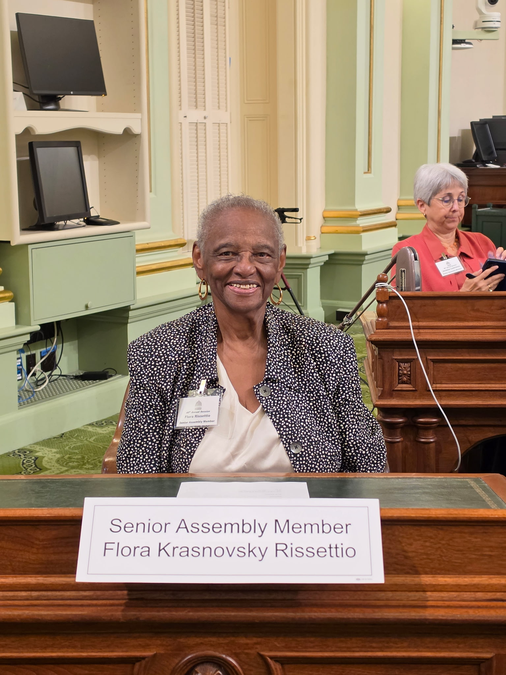
Flora Krasnovsky is part of the fastest growing demographic group in San Joaquin County — people over 60 years of age.
There are now 157,000 people 60 year or older among San Joaquin County’s 823,000 residents.
And their ranks are growing 10 times faster than those 59 years and younger.
As a retired healthcare specialized who has traveled the globe educating people in preventative care, Krasnovsky sees the demographic surge as both a challenge and an asset for Manteca, California and society as a whole.
“We are getting older and living longer,” Krasnovsky said.
Kronovsky is not just talking about California’s changing ppopulation dynamics. She’s doing something about it.
The Del Webb at Woodbridge resident and Tracy High graduate was sworn in as a member of the 80-member California Senior Assembly last month as a representative of San Joaquin County.
It’s part of the California Senior Legislature that also includes a 40-member senate version mirroring the actual State Legislature.
The bottom line of the 120 members is to propose legislation impacting seniors with the top 10 proposals being advanced to the California Legislature and the top four to Congress for consideration.
Among those on the docket that the advisory legislature is pondering that impact seniors:
*Expanding the ability to seniors throughout California to renew drivers licenses at senior centers through an outreach DMV program that is now available on a limited basis.
*Addressing the issue of the confidential marriage law to avoid caregivers of the elderly committing fraud by marrying those they are hired to assist in order to hijack inheritances.
*Seeking support of the establishment of a teaching medical degree granting school at the University of the Pacific in Stockton by 2030.
The medical school might seem to be a regional issue but it reflects a growing shortage of doctors statewide and across the United States.
And when it comes to doctors trained in geriatric medicine, the shortage is even more serious.
That’s a growing concern with each passing day as more and more people age. And no place in the state is the doctor shortage as acute as it is in the San Joaquin Valley.
There are five standing committees in the California Senior Legislature: Health, Finance and Insurance, State and Local Government, Housing and Transportation, as well as Social and Community Services.
It is the task of Krasnovsky and her colleagues to recommend legislation to lawmakers that address seniors needs in those five general areas that might otherwise be overlooked.
And one way Krasnovsky wants to do that is to identify and address those concerns and needs is through a survey of seniors.
It would be more than a yes or so survey. As such, she would like to enlist university assistance to provide students to conduct the surveys especially with those that may have hearing or sight problems.
“We are diverse,” Krasnovsky said, adding the question that needs to be answered is “how do we set about to live a good life” as seniors.
And that good life includes harnessing the wealth of knowledge and skills — as well as time — to benefit the community while enriching the lives of seniors.
She has made it her mission at Del Webb to encourage her neighbors to get involved in community mentoring endeavors. A recent example is a woman who is now teaching sewing at the Thomas Toy Teen Community Center.
Krasnovsky said she’ll often talk with fellow seniors about their skills and “what they’d like to do” and work to find channels that harness both that may not be obvious at first glance.
Her mother’s death from a heart condition at a young age prompted Krasnovsky to pursue a career in preventative health.
She wanted to be a medical doctor but at the time women were discouraged to do so.
Krasnovsky ended up going to the University of San Francisco where she studied epidemiology.
That lead her to being in the trenches during the 1980s to educate people about HIV prevention to stop the transmission of Human Immunodeficiency Virus (HIV).
She traveled around the world doing so. Kransovsky has also worked in pregnancy prevention efforts in the Bay Area.
Now her focus is helping seniors “live the best life they can.”
The roots of the California Senior Legislature goes back to 1982.
The 40 Senior Senators and 80 Senior Assembly members are selected in elections supervised by the Advisory Councils in the 33 Planning and Services Areas in California which were established by the federal Older Americans Act of 1965. The elections are in even-numbered years and the terms of office are four years.
Each October, the Senior Legislature meets in Sacramento to convene a model legislative session in the chambers and hearing rooms of the State Capitol.
Members participate in hearing testimony, debating issues, and voting to approve or disapprove legislative proposals.
During the October session of the Senior Legislature hearings on the proposals are held in policy committees of the Senior Senate and the Senior Assembly.
Senior Legislators seek state lawmakers to author at least 10 of the session’s priority proposals. They then work throughout the year to ensure adoption of these measures.
To contact Dennis Wyatt, email dwyatt@mantecabulletin.com