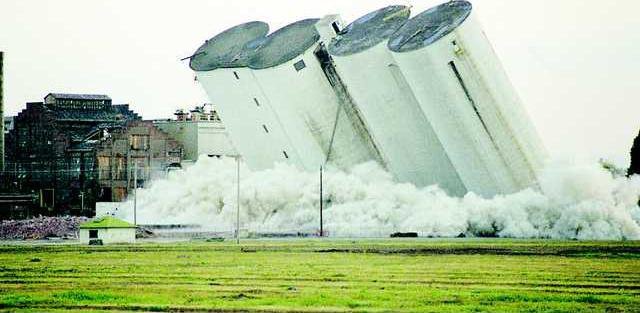
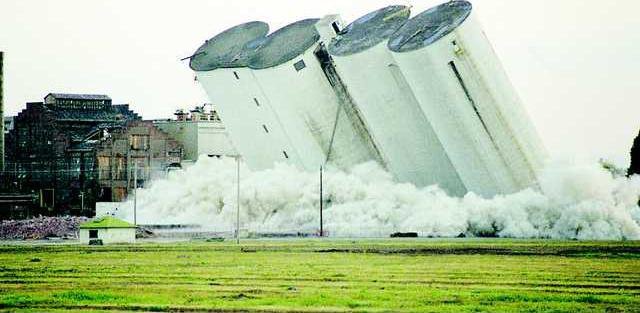
No one wanted to touch the shuttered Spreckels Sugar plant back in 1996 even with the proverbial 10-foot pole.
Not only did the city lose 120 full-time jobs as well as 100 or so reliable jobs during the sugar beet harvest season, but it also had the makings of a cancerous blight taking hold at the highest profile location in all of Manteca — the junction of the 120 Bypass and Highway 99.
It was a dark day, especially from the perspective of the city’s 47,000 residents.
uThere were 120 households taking a direct financial hit.
uThe community “psyche” took a hit as well, given Spreckels Sugar was “the” employer in Manteca for 75 years including a 45-year stretch it was the biggest source of private sector jobs.
uNo banks were willing to back up any private sector effort to redevelop the 362-acre Spreckels complex out of concerns with the unknown in the soil after three-quarters of a century of industrial use.
uThere was the added bonus that most potential developers had no appetite to demolish the five 15-story sugar silos.
The only semi-viable proposal was a private sector plan to keep the silos in place and build housing and a 9-hole golf course around it. But that too went south when the deep financial banking sources needed to make a project work were less than thrilled with investing in a housing development in the shadows of five abandoned 15-story concrete silos.
Spreckels Sugar was the prime example of problematic property — either odd-sized or having lots of baggage — in a solid location per se that couldn’t get traction.
As such, it was much like the IOOF Hall and adjoining parking lot in downtown Manteca the city bought earlier this year for $1.2 million that the city is in the process of seeking private sector partners to develop into a strategic gathering place — think restaurant — to drive downtown consumer traffic.
Also, in the same genre of the triangle-shaped 3.85 acres the city bought for $2.2 million two years ago west of Living Spaces were Atherton Drive curves to run close to the 120 Bypass.
The city has engineered two deals with that land.
One is selling 3.7 acres for $4 million to accommodate a Tesla showroom and service center.
The other is a lease for an LED billboard on 0.15 acres that will bring Manteca a minimum of $300,000 annually.
Both the IOOF Hall and Atherton Drive property — as well as two parcels in downtown along Sycamore Avenue (where the Mural Alley/parking lot and public safety annex are now located) — were bought using reserves put aside for economic development.
Spreckels became a reality because the city loaned the developer $8 million to bridge a gap in financing for upfront infrastructure needed before they could sell commercial or business park parcels for private sector projects.
Without the money secured through the city’s redevelopment agency, Home Depot, Target, Food-4-Less, Ford Small Auto Parts distribution center and dozens of more employers and retails would not have been built on the former sugar refinery site.
Not only was the $8 million repaid early and with interest, but it leveraged the development of a property tax base that put infrastructure in place to secure Stadium Retail Center, Costco, built the Big League Dreams sports complex, help partially fund 250 affordable units plus make two major interchange projects possible.
The state in 2010, to avoid slashing the bureaucracy in Sacramento, pulled the plug on redevelopment agencies throughout California. Money that went to addressing blight, help build affordable housing, and spur economic development went to cover the paychecks of proverbial state pencil pushers as cities had to cut back on manpower delivering essential public services.
The city eventually created an economic development reserve to replace, to a degree, the ability to spur redevelopment and economic growth.
Which brings us to the latest proposal being presented to the City Council to possibly acquire vacant parcels on the northeast corner of Union Road and Louise Avenue.
The potential purchase will be discussed behind closed doors as allowed by state law. That said, any action that is taken to move toward will need to take place at a public meeting.
The exact “design” for the property isn’t yet being disclosed.
The property in question roughly 40 years or so was set aside and zoned for a shopping center anchored by a supermarket.
That clearly isn’t going to happen nor is any use of the land for other purposes except for one — more housing. As such, that makes the property a tad problematic.
Rest assured the property’s zoning could be changed to residential and be developed for residential uses.
Yes, there are risks involved with economic development endeavors. But there is also a greater risk the land in question will never be maximized to its greatest potential to benefit the community.
The bottom line before the council Tuesday is simple just as it was with similar previous acquisitions: Is the opportunity greater than the risk?