Manteca garbage rates are going up $4.35 on Jan. 1, 2027.
It will take the monthly household charge up to $63.07.
The rate will have almost doubled since late 2023 when it was $34.33.
The same economic pressures that businesses and households deal with were behind the rise in the garbage rate: Increased fuel costs, the need to replace vehicles and equipment as they age and become unreliable, labor costs, health insurance premiums — you get the picture.
The city is now gearing up for another rate study addressing day-to-day operational costs, replacing $600,000 collection trucks, and adopting state mandates for disposing/recycling the waste Manteca’s 98,000 residents toss.
It will likely include — just as previous studies by the city have — a look at contracting out collection or keeping it in house.
At the end of the day — in order for elected leaders and top city brass to do their fiduciary duty for ratepayers — the monthly rate going forward must be based on efficient operation plans, cover all costs including labor, and state mandates.
More than a few folks during the local election cycle demanded the city arbitrarily lower its rates.
It would be reckless to do so.
That said, you would not be wrong if you pointed out Manteca’s monthly garbage rate has increased faster than the rate of inflation.
The monthly garbage rate went from $1.50 a month for a single weekly pickup to $2.25 on Jan. 1, 1970.
Rest assured, the Bulletin at the time duly noted city residents time howled about that as it reflected a 75 percent increase.
Based on federal Consumer Price Index data, $1 in 1970 now has the equivalent buying power of $8.68 today based on a total inflation rate of 768.5 percent over the past 56 years.
If that same inflation impact was applied to Manteca’s garbage rate, we should be paying $19.54 a month instead the $58.72 we are today based on the total inflation rate.
Times, though, have changed and for the better making what we pay for solid waste collection worth every cent.
How we dispose of the garbage every household creates is a prime example.
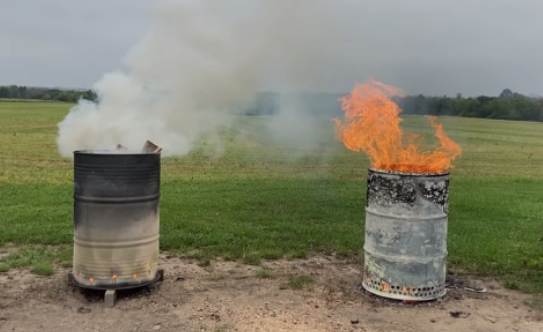
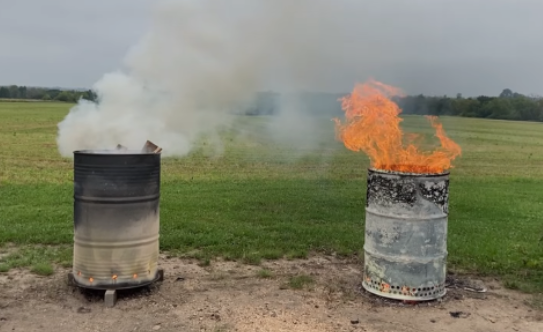
Back in the 1970s, residential burn barrels were still all the rage.
In communities from Bakersfield to Manteca and Lathrop to Redding, many households converted 50-gallon oil drums into a residential trash incinerator.
The people that used them typically did not want to pay additional for a second 32-gallon metal — or cutting edge aluminum — garbage can and the monthly collection charge.
Those in rural areas simply burned all of their household garbage.
And what garbage was collected, even as late as the 1970s, was taken by solid waste trucks and unloaded at city dumps.
There, they would be dumped into giant pits with no regards for the ground water.
Small towns such as Manteca, whose city dump in the 1960s was outside of town on land where the two-story municipal golf course clubhouse now stands along Union Road, had a cheap way to extend the capacity of the forerunners to modern landfills.
They burned much of the garbage.
Smoke from wildfires weren’t the big thing back then.
That’s because you enjoyed small scale residential garbage burning — and city dumps deliberately put ablaze along with agricultural waste burning — year round.
The worst wasn’t during fire season but during bouts of heavy tule fog in the winter.
It created a short-lived mini-version of the Great Smog of 1952 in London, estimated to have killed at least 4,000 people when windless cold air air trapped low-grade coal used to warm homes and fuel power plants.
Tule fog today — for the most part — fills your lungs with fresh brisk air.
You can get a whiff of what it was like not too long ago if you happen to pass a home burning wood in a fireplace on a winter day when it is not allowed as the smoke gets trapped close to the ground.
There was no such things as no burn days back then.
Every day was a burn day.
The move to start banning residential incinerators began in smog-laden Los Angeles County in 1957.
By the time other jurisdictions were aggressively cutting back on it, the valley air cleaned considerably.
The state didn’t impose a statewide 100 percent ban on burning residential garbage until 2004.
Curse “high” garbage rates and even catalytic convertors all you want, but they are the reasons since 1990 the population of the Central Valley has grown by more than 50 percent while air pollution in a number of categories has been cut almost in half.
The move to ban residential incinerators, the mandate for higher mileage vehicles that reduced gas consumption and in turn cut air pollution, catalytic convertors, and reformulated gasoline for summer driving, has been effective by any standard.
All of this queues up what will be a universal experience for Manteca households when Jan, 1, 2027 rolls around — solid waste bills that will be $63.07 a month.
Some believe this is highway robbery.
Given the air we breathe today, it is actually a bargain.