Putting in place 200-year flood protection for the Mossdale Tract — all of Lathrop outside of River Islands, southwest Manteca, the Weston Ranch portion of Stockton and county areas — is going to cost $230 million.
One way part of the money can be generated to cover that tab is through an enhanced infrastructure financing district (EFID) overlayed on the entire Mossdale Tract.
Basically, it would siphon a percentage of future incremental property tax increases from new construction, resales, and Proposition 13 annual adjustments to go toward retiring bonds.
Since it would only be assessed on those properties within the state designated 200-year floodplain, property owners elsewhere in the respective cities will not be footing the bill.
At the same time those whose property tax increases are being tapped to pay for the improvement to protect their property and families will not feel an additional pinch in their tax bills.
However, buyers of newly constructed homes and those building commercial property have flood mitigation fees for the project collapsed into the purchase price or their homes or financing of their commercial or business park project.
It does mean that the general funds of Manteca, Lathrop, and Stockton will be denied a cut of the property taxes they collect to finance day-to-day services such as police and fire until the bonds are paid off in 2061.
That means the cities would have to find a way to supplement the lost revenue given property tax is the No. 1 source of general fund support in all three cities.
The development fees in place and proposed EFID are among proposed funding mechanisms. As it stands now, the $230 million is being funded almost 100 percent with local funds. Efforts are being made to secure possible state and federal dollars.
The Manteca City Council will conduct a special meeting Monday at 12:15 p.m. at the Civic center, 1001 W. Center St., to review the proposed EFID.
Frequency of flooding
threats are picking up
The potential for flooding is expected to become more frequent now that hydrology is changing in the Sierra due to the return of nature’s cycle of mega droughts coupled with climate change.
Experts anticipate a shrinking snowpack in the coming years will be replaced with more rain in the upper and lower elevations. That would increase runoff and raise the potential for more frequent flooding.
That is on top of development covering more land each year with non-permeable surfaces such as rooftops, roads, parking lots, and sidewalks.
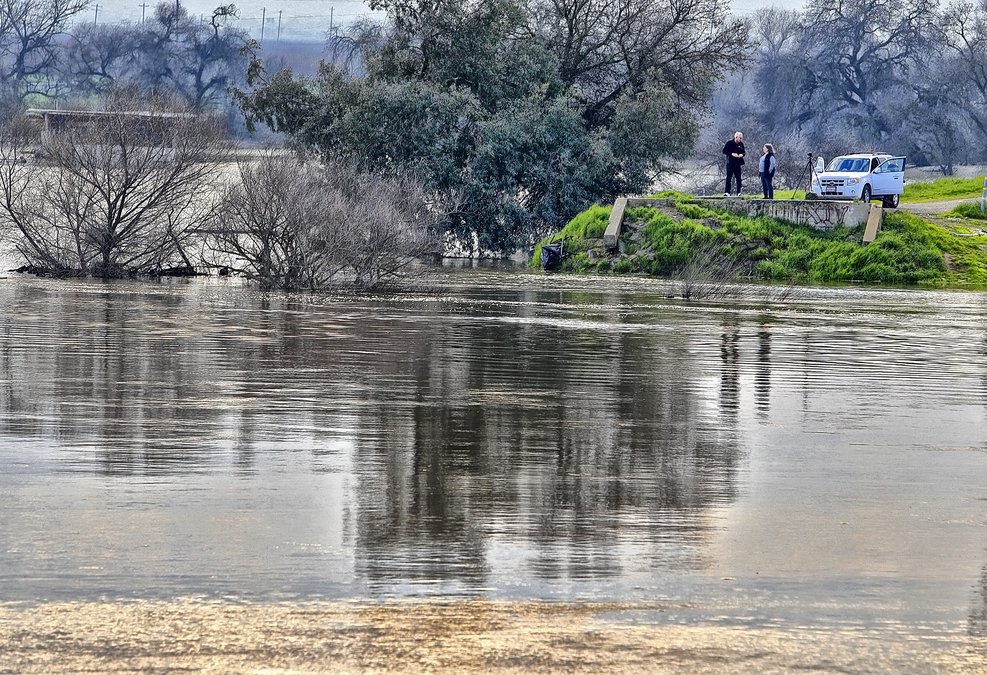
The area south of Manteca has flooded 11 times since 1929. The most flood-prone is the area nestled against the banks of both the San Joaquin and Stanislaus rivers.
Should a 200-year flood occur with multiple levee failures along the Stanislaus and San Joaquin rivers south of the Interstate 5 bridge before the merger with the 120 Bypass, engineers have indicated it would among other things:
*Flood 5,000 existing homes with 3 feet or more of water.
*Endanger and force the overall evacuation of 52,000 residents in Lathrop outside of River islands, Weston Ranch in Stockton, southwest Manteca, and rural areas
*Force the evacuation of San Joaquin Hospital — the county’s major trauma center — as well as the county jail.
*Force first responders at five fire stations, and the county sheriff to abandon their stations and key communication centers in the middle of a major emergency.
*Lathrop High and Weston Ranch High would have water flowing through their campuses as would six other Manteca Unified elementary schools.
*Force the closure of portion of Interstate 5 — the major West Coast freeway running from Mexico to Canada — and the 120 Bypass.
*Water would swamp the wastewater treatment plant serving 88,500 existing Manteca residents and more than 14,000 of Lathrop’s nearly 30,000 residents.
*Disrupt Union Pacific Railroad train movements as well as damage tracks that Altamont Corridor Express relies on.
And that’s just for starters. Modeling shows a number of existing homes would likely suffer water damage in fringe areas that could receive upwards of three feet of flood water.
To contact Dennis Wyatt, email dwyatt@mantecabulletin.com