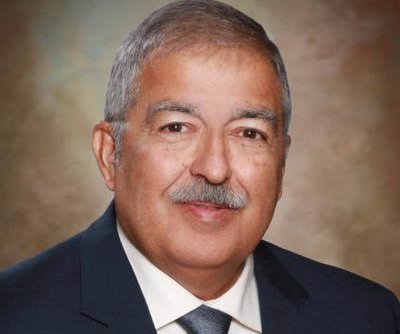
Ray Collado is not an alarmist. He’s a realist.
It is why he is among the citizen volunteers of the Manteca Community Emergency Response Team.
The primary mission of CERTs organized nationwide under the umbrella of the Federal Emergency Management Agency is to have trained volunteers ready to augment emergency response agencies.
Collado, who serves as the Manteca CERT commander, notes many assume a disaster won’t happen in Manteca whether it is a devastating earthquake, large train derailment, major wildfire, or massive flooding.
In the last 37 years, Manteca has had two major disasters;
*80 square miles in January of 1997 were covered with floodwaters southwest of the city due to multiple levees failures along the Stanislaus and San Joaquin rivers that, during a 72-hour period, threatened to breach a dry levee parallel to Woodward Avenue.
That prompted state Office of Emergency Services to order the McKinley underpass on the 120 Bypass plugged with 8 feet of dirt covered with plastic tarp to protect the Airport Way corridor north of the Bypass should the dry levee fail. The area south of the Bypass at the time did not have tract homes.
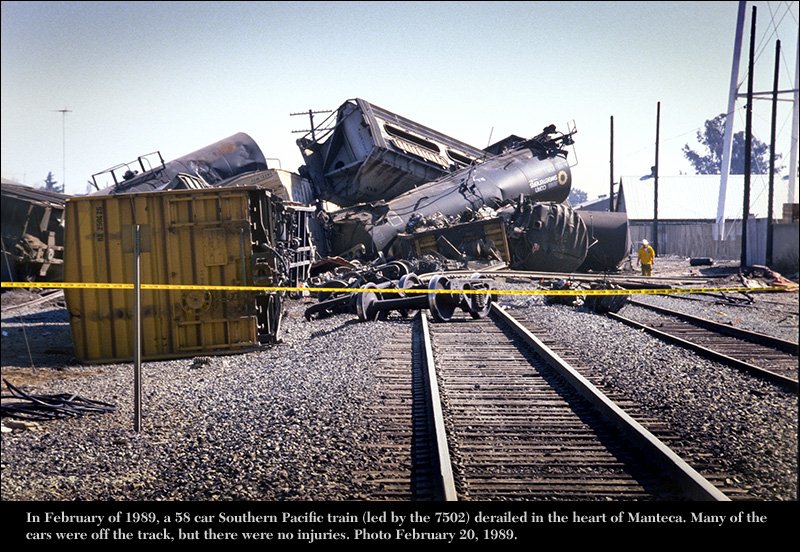
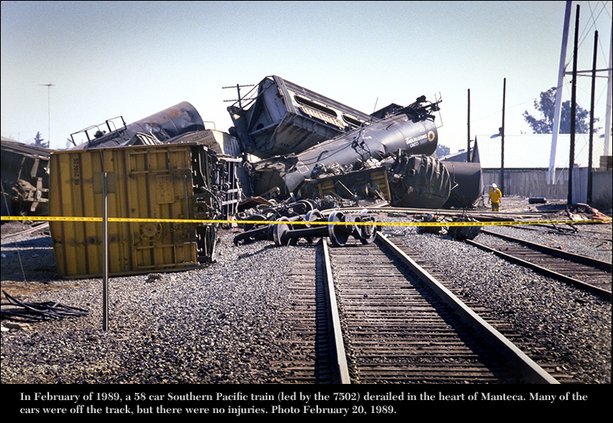
*58 cars of an 82-car train hauling explosives, hazardous chemicals and other freight through downtown Manteca derailed in February of 1989 due to a broken rail with the worst part of the mess on the track section between the 120 Bypass overcrossing and Manteca High.
That led to the evacuation of 200 people living in the Powers Tract neighborhood and took two days to clean up. There were no injuries and no property damage except for the train and its contents.
“There are a lot of trains that go through Manteca daily and who knows what they are carrying,’ Collado told the Manteca Rotary last week.
There are currently between 30 and 45 train movements daily on two rail lines passing through Manteca between Union Pacific freight and ACE commuter trains
Federal data indicates there is an average of least 1,100 train derailments annually in the United States.
Most — roughly 70 percent — are minor affairs involving several cars at slow speeds usually in rail yards.
Occasionally there are major derailments.
Collado notes CERT volunteers are part of the Manteca Fire Department volunteer groups such as Fire Explorers and the Manteca SAFE — Seniors Assisting Fire Effort.
The CERT volunteers initially go through 20 hours of training. After that, they train periodically with the Manteca Fire Department.
CERT volunteers are educated about hazards they may face and are trained in lifesaving skills so that they are better prepared to respond to emergency situations in their communities.
The CERT program is designed to get Manteca residents working together with City staff and the Fire Department to help themselves, their neighbors, and the community in the event of a disaster such as a major earthquake, flood, or fire.
All participants are trained in basic disaster preparedness, light search and rescue, disaster medicine, and firefighting.
This training is provided at no cost.
And while CERT is constantly seeking volunteers to join their ranks, Collado urged people not interested in becoming part of the team to still take steps to prepare their families in the event they may have to go multiple days without water, electricity and such.
Blackout cut power to
Manteca for 8 hours
He pointed to the Western North America blackout in 1996 that knocked out power to 4 million people including Manteca.
It happened in afternoon on Aug. 10 as temperatures were soaring past the century mark.
The city was on 100 percent well water at the time meaning water could not be pumped from underground. The lone water “tank” at the time was the Wetmore tower that functions primarily to pressurize the system.
People went outdoors to cool off and turned on the water for their kids. That prompted Manteca Police to dispatch SHARP volunteers along with city employees to drive the streets with public address devices urging people to stop cooling down with water to preserve pressure — and water — in the event of a fire.
Collado said for the first few hours things were fine and then some people started panicking pounding on the shuttered stores such as the former Kmart on Northgate Drive trying to buy bottled water and other supplies.
Power was out to Manteca for nearly eight hours.
Earthquakes are also a concern, Collado noted.
There are four nearby faults the United States Geological Survey classifies as active:
*The Vernalis fault that starts near Dairy Road south of Highway 132 in Stanislaus County then runs north eventually paralleling Kasson Road, passing by the shuttered Deuel Vocational Institute and Banta before ending near the Old River northeast of Tracy.
*The Tracy-Stockton fault that runs under Stockton. It had significant shaking in 1881 and 1940. The epicenter of both was in Linden. The 1940 event was 4.0 on the Richter scale. By comparison the 1989 Loma Prieta quake registered at 6.9 on the Richter scale.
*The San Joaquin Fault that runs along the base of the Coastal Ranges from east of Newman to east of Tracy.
*The Corral Hollow fault southwest of Tracy a scientist discovered in 1991.
The Vernalis Fault at one point near the Airport Way bridge is within several hundred yards of the San Joaquín River south of Manteca.
And while massive damage from the faults is not considered an issue from the USGS, the fact Manteca — in the event of a quake even worse than the 1989 Loma Prieta tremblor — is likely to be a major evacuation area.
Even if its not, enough people commute from Manteca to Bay Area jobs where it could severely impede their efforts to return home.
It is why after the 1989 quake, a number of commuters to the Bay Area started carrying emergency water supplies and other items in their vehicles and made it a point for years not to cross the Altamont Pass unless their gas tanks were topped off.
Collado noted CERT is called on to help police and fire from time-to-time with major incidents in Manteca.
Back in 2004, a Manteca team traveled to Florida to assist in the aftermath of a major hurricane.
For more information about Manteca CERT, go to their Facebook page, email mantecacert@gmail.com or call 209-612-7506.
To contact Dennis Wyatt, email dwyatt@mantecabulletin.com