In the hunt for a free phone?
Try the 100 block of South Main Street.
Interested in wine barrel furniture?
Checkout Woodward Avenue and South Main Street.
Want a fruit drink after dark?
You might get lucky and tonight could be one of the nights you can do so on Yosemite Avenue just down the sidewalk from Lincoln School.
Street vendors are everywhere in Manteca.
And there isn’t anything the City of Manteca can do about it except regulate them within state allowed parameters.
That’s because Senate Bill 946 passed by the California Legislature and signed by former Gov. Jerry Brown went into effect on Jan. 1, 2019.
Dubbed the Safe Sidewalk Vending Act, the law decriminalized sidewalk vending in California but allowed local authorities to adopt non-criminal laws to protect public health, safety and welfare.
The intent of SB 946 authorized by State Senator Ricardo Lara (D-Bell Garden) is to aid in the “important entrepreneurship and economic development opportunities” street vending may bring to low-income and immigrant communities.”
The Manteca City Council, in an effort to bring a sense of order to sidewalks, on Tuesday adopted the first reading of changes to the municipal code section regulating sidewalk vending.
The reason for the move is making sure the city isn’t out of compliance with state law is to cover obvious issues and those that are less obvious.
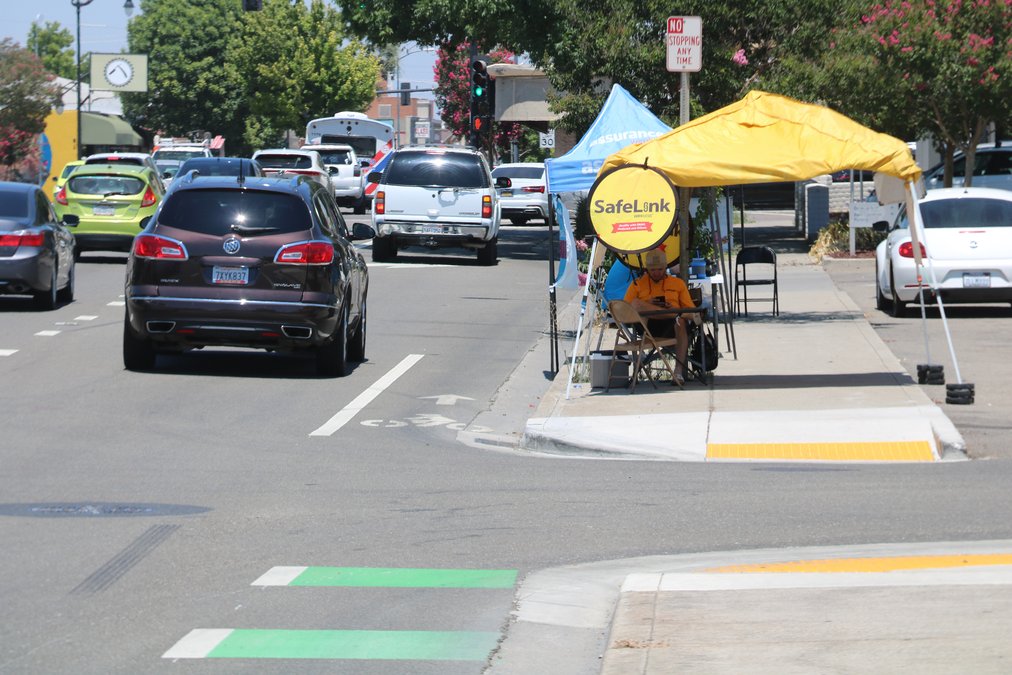
It isn’t unusual, for example, to see a trio of vendors offering free phones crammed together with pop-up tents, tables, and chairs occupying parts of the 100 block of South Main from curb to the back of sidewalks.
There are times when the tents block the sightline for motorists turning off of Mikesell Avenue onto South Main.
Sometimes — but not often — chairs and tables as well as legs of pop up tents are placed in a manner than can impede people using wheelchairs.
The non-visual issues are required permits, especially if a vendor is selling food and prepared drinks.
Health permits assure proper safety procedures are followed and subject the vendors to inspection just like brick and mortar enterprises as well as food trucks to assure public safety.
Many vendors apparently aren’t properly permitted by the city. As such, they may not have secured required health permits given that is part of the municipal checklist.
It also would be an attempt to make sure the proper state and local sales taxes — where applicable — are collected. That would mean vendors will need to have the proper state Board of Equalization permits.
Whether the taxes are actually collected is an issue for the state just as whether health inspections take place is a county issue.
The ordinance updates sets the permit fee at $100.
The city describes it as a “cost recoverable rate” for staff time required to process and issue permis. It is also set “at a price point intended to not be cost prohibitive to sidewalk vending.”
That last point is important as any higher costing permit will risk the city running afoul with state regulators. The law specifically is aimed at keeping the barrier for start-ups as low as possible to encourage immigrant and low-income entrepreneurship.
The actual effective date for permits being required will be set at a later council meeting. That is being done to give staff time to implement the permit system.
The permit will allow sidewalk vendors to operate anywhere in the city and use vending equipment as part of their business subject to a list of restrictions by the city that are designed not to violate state laws.
Roaming versus
stationary venders
The ordinance differentiates between roaming and stationary sidewalk vendors.
The city is using its authority allowed under SB 946 to ban stationary vendors from residential areas.
The city can restrict the time and such of roaming vendors in neighborhoods but cannot outright ban them.
Roaming vendors — those that only stop to make a sale — are allowed in residential areas between 8 a.m. and 6 p.m..
Sidewalk vendors can operate in non-residential areas from 8 a.m. to 6 p.m. — or the hours imposed on other businesses in the same block, whichever is least restrictive.
That means the fruit drink vendor on the edge of a car lot that operates some nights after dark in the 800 block of East Yosemite can do so as there is a 24-hour 7-Eleven across the street.
Stationary vendors are prohibited from operating on any sidewalk less than six feet wide. That is so the city can comply with the American with Disabilities that must allow adequate safe passage for the handicapped.
On wider sidewalks, vendors can’t place obstructions that would reduce the passage area remaining on the sidewalk to less than four feet.
Distance restrictions
The minimum distance restrictions applying to sidewalk vendors aimed at preventing conflicts and safety problems are as follows:
*18 inches from curbs.
*15 feet from fire hydrants, fire lanes, and emergency facilities.
*15 feet from marked or unmarked crosswalks, curb, ramps, entrances or exits to buildings and parking lots.
*15 feet from bike and shared use paths such as the Tidewater.
*15 feet from outdoor dining areas.
*15 feet from transit shelters or benches.
*15 feet from an ATM.
*15 feet from another sidewalk vendor.
*50 feet from a farmers market or special city event.
*100 feet from police or fire stations or where a first responder is actively performing their duties or service to the public.
*250 feet from places of worship when people or arriving or departing from services, ceremonies, or events.
*250 feet from schools from 7:30 a.m. to 6 p.m. on days when school is in session or a daycare facility where children are present.
Vendors also will need approval for the recreation department to operate in city parks.
Vendors are also required to obtain written permission of private property owners whose land they may encroach upon.
The amended rules — once they go into effect after a second reading — will enable the city legally to take actions against vendors when the public safety issues arise without running afoul with state law.
To contact Dennis Wyatt, email dwyatt@mantecabulletin.com