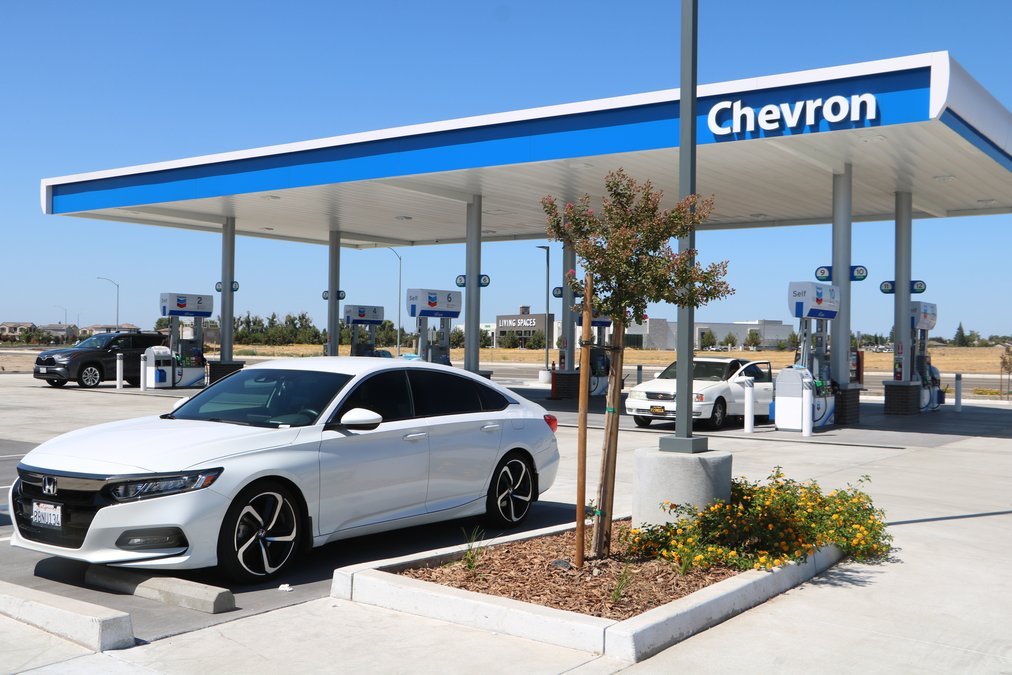
Future applications for fueling stations could be banned from areas zoned neighborhood commercial, prohibited from going within 500 feet of an existing gas station, as well as be subject to stepped up architectural design standards among other things.
Those are the highlights of Fueling Stations Development and Performance Standards being weighed Thursday when the Manteca Planning Commission meets at 6 p.m.
The City Council when they meet Aug. 18 will consider the commission recommendations as well as an urgency ordinance to suspend accepting additional gas station applications on a temporary basis while new standards are put in place.
Whatever new restrictions are involved, they will not affect any of the nine gas station projects currently in the entitlement process.
The biggest changes to city policy would involve where gas stations can be established.
They would no longer be allowed in neighborhood commercial or manufacturing commercial zones in addition to the existing ban in the mixed use downtown district.
Also, instead of requiring a minor permit as is now the case to locate in general commercial zoning, gas stations will require a conditional use permit in order to do so.
Among the proposed future restrictions for gas station site development are:
*Fueling stations must be 500 feet apart, however, two fueling stations would be allowed at the same intersection.
*Gas stations will only be along arterial and major collector roadways at signalized intersections designed to accommodate high traffic volumes, or at intersections determined by the City Engineer to safely accommodate projected traffic volumes.
*Parcels where gas stations are located must be at least 0.5 acres.
*Access points for gas stations must be a minimum of 150 feet from intersections and a minimum of 300 feet from the property line of any parcels zoned for residential use.
*Where a fueling station is located adjacent to residential zoning, a masonry wall with a minimum height of seven feet shall be constructed.
*A fueling station shall provide no less than six double-sided fuel dispensers.
*A minimum of 20% of the lot area shall be landscaped. Of that, a minimum of 70% of the landscaped area will be covered with a combination of live landscaping, such as lawn, ground cover, trees, or shrubs, and not more than 30% can be covered with impervious materials.
*Primary buildings will utilize high-quality architectural materials, including brick, stone, decorative concrete, architectural metal, glass, and stucco.
*Building will incorporate projections and recesses, changes in wall plane, parapets of varying heights, gables, canopies, awnings, recessed entrances, tower elements, decorative trim, cornices, pilasters, columns, changes in exterior materials or colors, public art, decorative lighting, and other architectural features that provide visual interest and avoid long, uninterrupted building facades. Blank wall lengths exceeding 40 feet are prohibited.
*Fuel dispensers, fueling canopies, underground storage tanks, and associated fueling equipment shall not be located within 300 feet of any adjoining property zoned for a single-family residential use.
The gas station project at Pillsbury Road and Woodward Avenue that prompted Mayor Gary Singh in December to originally call for the council to consider a gas station moratorium of some sort, has been officially withdrawn.
The site — zoned neighborhood commercial — would be off limits for a future fueling station should the proposed rules eventually be adopted by the City Council.
If the council on Aug. 18 does adopt a temporary moratorium on accepting new gas station applications until new rules are in place, it would go into effect for 45 days. The council would have the ability to extend it once for a maximum of 10 months and 15 days.
There are already 33 gas stations in place, five with entitlements needed to build and four others in the planning process
Manteca, in the past three years, has seen five new gas stations open plus a major expansion of the fueling pumps at Costco.
That brought the number of gas stations to 33.
It translates into 3.5 gas stations per 10,000 residents versus 3.62 per 10,000 in Modesto.
The area average is 2.6 per 10,000 residents while the state average is 2.65 per 10,000.
And if the five entitled stations and the four that are in the planning process are built and the city’s population does not increase, the ratio will jump to 4.3 per 10,000.
To contact Dennis Wyatt, email dwyatt@mantecabulletin.com