Manteca Unified is gearing up to start the transition to electric school buses.
California has mandated the state’s 997 public school districts transition to 100 percent zero emission school buses by 2040.
It won’t be a cheap proposition.
A full-size electric bus costs roughly $400,000. That’s $150,000 to $200,000 more than a diesel powered bus.
In order to minimize the financial impact on Manteca Unified the district has:
*submitted a $4,025,151 grant application request to help fund the development of charging infrastructure and needed solar generation through the San Joaquin Valley Air Pollution Control District. The district match is $277,433.
*an application being processed for the PG&E EV Fleet Program that includes funding for the necessary utility side infrastructure improvements for EV charging.
*landed a spot on a state list making it eligible for the state’s Zero-Emission School Bus and Infrastructure program for funding to support purchasing 47 buses over a five year period.
The grant to purchase the actual buses, should MUSD be approved, will cover 50 percent of the cost.
A condition of the grant requires that a diesel bus be taken out of service for each new bus the district buys.
District Superintendent Clark Burke said the district refrained from jumping on the proverbial band wagon when the programs first became available.
That is because Manteca Unified wanted to thoroughly exam the needs and impacts of such a conversion endeavor while allowing technology to evolve a bit more to address unanticipated hiccups.
For example, it was determined EV chargers that will be placed at the district office complex will have the capability to switch, when needed, to a charging mode to handle medium duty vehicles the district uses for maintenance and operations that will eventually need to be zero emission as well.
The zero-emission endeavor is part of an overall holistic game plan regarding energy needs districtwide and finding ways to reduce the costs or address potential issues.
As an example, even though EV buses would be charged at the district office plans call for chargers with the capability to charge them at various campuses, especially high schools.
It is a nod to the fact under optimum conditions new batteries have an optimum range of 100 to 120 miles on a full charge.
Things such as running air conditioning, colder temperatures, and aging batteries can lower the range.
School placement of EV chargers means buses used by visiting teams could recharge during games before departing on the return trip.
Also, some buses operated in-district on any given day based on multiple routes or extracurricular trips may need a charge away from the district office.
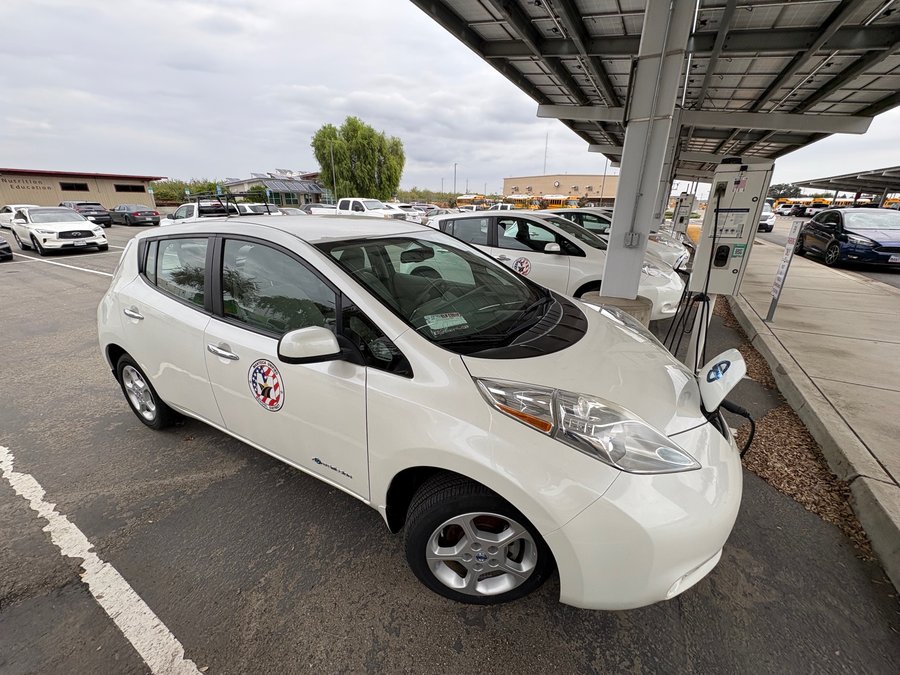
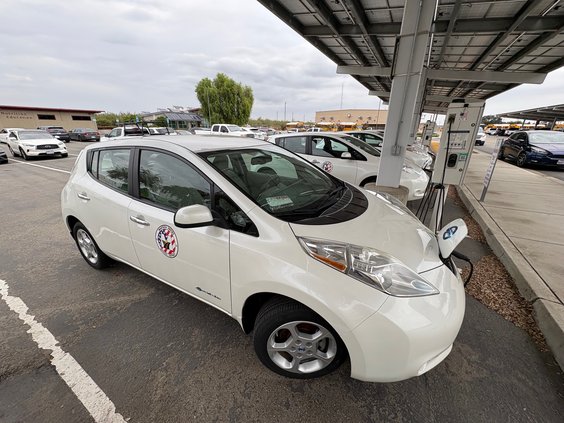
The first electric vehicle charging infrastructure was put in place nearly a decade ago to allow the use of five Nissan Leaf vehicles used by district office personnel traveling between campuses spread out in the 193 square mile district.
The first elementary schools to be wired for electric vehicle chargers will be Brock Elliott School and Joshusa Cowell School as part of Measure A school bond work.
EV charger wiring is now a state mandate when new construction takes place at schools.
Both schools will be also getting battery storage systems, another state mandate for new school construction
The battery storage mandate went into effect this year.
An energy consultant is identifying ways of further reducing energy costs for Manteca Unified.
In addition to the audit, the consultant was tasked with examining existing solar systems.
Included was calculating whether additional solar — along with batteries — at Manteca and East Union high schools will pencil out financially.
Some of the Measure G work that wasn’t subject to the new solar standards that went into effect for schools statewide last year — such as the recently built large gym at Manteca High — were plumbed for solar by the district.
The analysis is determining whether solar power generation in conjunction with battery storage could effectively make various Manteca Unified sites less reliant on PG&E.
The goal is to lock in power generation costs to avoid being subjected to future PG&E rate hikes.
The impact of rising power
costs on educating students
The reason for being less dependent is reflected in figures provided last year by the district.
PG&E costs borne by Manteca Unified soared by $1.4 million in the 2022-2023 school year or enough to cover the annual pay and benefits for 21.5 entry level teachers.
And it could have been worse.
The 2013 decision to go solar at 26 elementary schools and five high schools froze kilowatt usage at that time at $1.9 million annually.
That $1.9 million annual cost has been constant for the past 10 years.
And when that $1.9 million that is repaying the cost of borrowing to install solar is paid off in 10 years, it will free up that money.
Some of it will be plowed back into the micro invertor solar panel systems in place as they lose their effectiveness over time. The district intends to make upgrades on a staggered basis to keep those costs below $1.9 million each year.
The strategy eventually means MUSD will be paying even less for the amount of kilowatt hours they used in 2013.
But it is growth in kilowatt usage and PG&E rate hikes since 2013 that have sent the district’s PG&E bill soaring.
It was budgeted at $3.5 million for the start of the 2022-2023 school. That reflected anticipated increases.
But due to additional rate hikes granted to PG&E and increased usage to accommodate growth — both for electricity and natural gas, the district ended up writing checks to PG&E totaling $4.9 million last school year.
The district through March of 2023-2024 school year spent $5.4 million on PG&E. That reflects a 10 percent increase over the previous year.
A desire to prevent future PG&E increases from cutting into spending in the classrooms is what prompted the school board to authorize a district wide energy audit.
MUSD wants to be able to generate — and store — as much electricity as they can afford to do so to avoid relying as much as possible on PG&E to power transportation services.
To contact Dennis Wyatt, email dwyatt@mantecabulletin.com