It was a train wreck in the making.
From the start it was plagued with problems.
Some elected leaders were hesitant because it would cost money to maintain.
More than a handful of residents living nearby were fearful the city was creating a haven for druggies, rapists, and the homeless.
There was even a group advocating to abandon the project altogether and build a four-lane expressway in its place.
And what unfolded after it was built was a microcosm of what had been —and apparently still is — inflicting the team work approach needed between elected and bureaucratic leaders to follow through to complete projects.
It also represents what can happen when the community steps up and city leaders listen to mid-level and frontline workers to get them out of jams and not just consultants to make Manteca a more pleasing place to live.
Tidewater impasse created
$15,000 tumbleweed removal bill
Along the way the unsung heroes at city hall and in the field came up with solutions to overcome political infighting that threatened to torpedo the project. And the council majority finally stood fast to assure the project would be functional for years to come although it never has quite reached its most glowing vision.
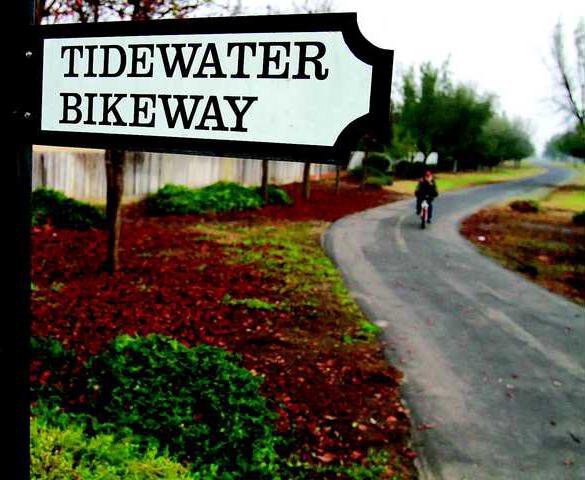
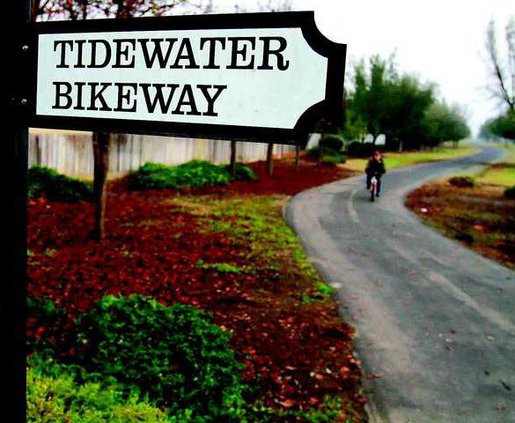
The project is the 3.4-mile long Tidewater Bikeway officially “completed” 22 years ago.
The word completed is in parentheses because it was never really completed given there is a list of trail components never done and the fact the paved trail itself wasn’t officially turned over to the city for almost a year even though people had been using it for months. The reason was due to a dispute over whether the contractor installed paving to city specifications.
The most bizarre outcome of that impasse was what happened because no one was maintaining the areas along the trail for a year. As a result, nature literally created hundreds of tumbleweeds.
They choked sections of the trail and were blown into nearby neighborhoods.
The city ended up spending $15,000 in tipping fees other costs after enlisting the help of community work crews supervised by the San Joaquin County Sheriff’s Department to load garbage truckloads of the tumbleweeds for disposal.
Staff not outside consultant
came up with Tidewater idea
The Tidewater Bikeway was an idea not suggested by a consultant, but by city staff working in conjunction with the council.
The Tidewater and Southern Electric Railway that was launched to compete with Southern Pacific Railroad a decade after the dawn of the 20th century built a spur into Manteca in 1918 from a point on its mainline a mile north of French Camp.
The Tidewater was envisioned to run the length of the entire San Joaquin Valley but never got much farther south of Stockton where it originated and tied into water shipping than a point near Turlock.
The spur to Manteca ended along Moffat Boulevard just a 100 or so feet north of the present day 120 Bypass. It handled shipments from canneries and Spreckels Sugar. From 1918 to 1932 interburban passenger cars powered by overhead electric lines moved passengers from Stockton and Modesto with trips down the spur into Manteca included.
Western Pacific bought the system, dropped the passenger service, and switched to steam.
Tracks and crossing arms were still in place through Manteca in the 1980s although trains hadn’t run for years when the city decided to do something about the blight through the heart of the town. They bought the right of way.
Some adjoining property
owners had extended their
backyards into right-of-way
What to do next was a point of contention. More than a few folks whose homes backed up to the right-of-way extended yards into it including one that built a swimming pool.
The city as property owner was coming under increased pressure to do something. This might sound familiar but the corridor became a haven for illegal dumping, graffiti, abandoning vehicles, drug users, general mischief, and homeless encampments. All of it was on a much smaller scale but blight did exist in Manteca 40 years ago. The homeless were significantly smaller in numbers and were a bit more discreet in the visibility of their encampments.
City staff hatched a holistic solution. Turn the lemon in a 34-acre linear urban park that was landscaped complete with frequent plazas with benches and a bike path down the middle with a few bends and jogs to create a pleasant experience.
The lemon was the aging tracks on a gravel bed in a corridor devoid of trees that was flat and barren except for weeds and the ability to generate countless tumbleweeds each year.
The opposition started immediately. Some nearby viewed the proposed bike path as a crime magnet that would devalue their property and jeopardize the safety of their families.
One councilman member latched onto the dissent and started pushing for the city to build a four-lane expressway between Lathrop Road and Main Street.
The city went ahead and hired a consultant to design the bike path. Due to a lack of money they had it broken down into phases. After securing Measure K sales tax receipt for transportation projects to put in the initial phase, the council and city did what they are often guilty of today when it comes to follow through. They made no commitment or identified a revenue source to actually complete the project as envisioned.
That included landscaping on the Moffat leg as well as another plaza. The most high profile half done feature in place also represents the waste of $10,000 was the Tidewater kiosk in downtown on the Tidewater plaza south of Yosemite Avenue.
What looks like a jungle gym/abstract iron structure was supposed to display a map of the Tidewater and what could be accessed near the trail as well as the rest of the city’s separated bike path as it was developed, rules for use of the trail, and a potential “bulletin board” component to promote community events.
City proudly displayed
unfinished kiosk on
cover of budget document
The lack of institutional knowledge of what Manteca had previously planned and failed to follow through on led to the city hall staff for several years to use an image of the unfinished kiosk on the cover of the annual city budget document. They unwittingly promoted to Manteca icon status a kiosk that represented the city’s failure to follow through.
The bike path issues that developed reflect the danger of blindly accepting advice of consultants when they venture into areas where city staff that has boots on the ground know what is best.
The first misstep was the landscaping. Consultants who never spent a summer in Manteca pushed for — and without opposition from elected and bureaucratic leaders — lush grass and landscaping requiring a lot of water in the valley heat. The consultants assumed wat worked in the climate of Pleasanton and San Jose so it would work in the valley.
It was a disaster. Landscaping died, much of it when the city was unable to secure a replacement part for a key pump. The grass, where it survived, was a challenge to maintain. Irrigation using potable drinking water from the city system was expensive.
Staff came up with the solution. They replaced the forced landscaping with wildflowers and shrubs that had better survival rates based on Manteca’s climate and soil.
They put in place a shallow well requiring much less electricity that was dedicated to the Tidewater landscaping that tapped into a water table that was not drinkable.
They secured a federal grant to plant more than 300 trees along the barren Moffat segment that the council was going to reject because they didn’t want to spend city money to plant them.
The trees not only were a bid to beautify the linear park but to provide a sound and visual buffer to passing trains.
Staff salvaged the grant and got the trees planted thanks to the volunteer labor of Crossroads Community Church. Not only did their “Taking it to the Streets” endeavor get the trees planted but they committed to — and followed through — on watering all of the trees for the first three years to allow them to get established
Elected leaders, to enhance safety, used unrestricted development fees levied on new growth 20 years ago to place traffic signals at crossing on Louise Avenue and Northgate Drive after a series of accidents involving cars not yielding to pedestrians and bicyclists.
Tidewater seen as spine
to citywide bike path system
The Tidewater was seen as a spine of what eventually is hoped to be a 24-mile plus separated bike path encircling a large chunk of the city making it possible to bicycle or walk to schools, employment centers, commercial areas, and amenities.
Segments of that vision are in along Atherton Drive with spurs to Woodward Park and a leg that runs to Woodward just west of Moffat. That leg is supposed to one day continue south and connect with Ripon’s bike system to allow people to pedal into Salida via the bike bridge crossing of the Stanislaus River.
The Tidewater now crosses Lathrop Road. It was a development requirement for Union Ranch and Del Webb that included traffic signals where it crosses Lathrop Road. The bike route/path north of Lathrop Road reaches Airport Way.
New projects proposed north of Lathrop Road are expected to continue the bike path toward French Camp along the abandoned railroad right of way.
There is also a spur that reaches Yosemite Avenue along Spreckels Avenue.
The Tidewater is unique as most separated bike paths are designed primarily for recreational purposes.
Except for crossing city streets occasionally the Tidewater and its extensions in place today go by and accesses Northgate Park, the skate park and the adjoining neighborhood park, downtown, the library and adjoining park that serves as the de facto town plaza, the transit center, Manteca High, the BMX park, and Woodward Park.
Within a half mile are Neil Hafley School, East Union High, the North Main commercial corridor, the Spreckels Park employment center and retail area, as well as the Manteca Industrial Park.
To contact Dennis Wyatt, email dwyatt@mantecabulletin.com