The dwindling water supply from the Colorado River could eventually have a ripple effect on Manteca.
It’s because Southern California between the seven states with a straw in the Colorado River Basin gets the largest share of water at 4.4 million acre feet annually.
With the water levels at the two biggest reservoirs on the Colorado — Lake Mead and Lake Powell — at historic lows and dropping closer to the level where power generation will cease, SoCal water agencies will be looking elsewhere for replacement water.
More water recycling/aquifer recharging and desalination plants require significant lead time.
Tapping into more local groundwater on a large scale is being taken off the table by state regulations.
There are only two sources outside of even tighter conservation mandates or outright rationing to secure more water in a short time frame. Both — the State Water Project and the federal California Water Project (CVP)— are in Central and Northern California.
The CVP plays a role in what flows onto farmland around Manteca, Ripon, and Escalon and through faucets in Manteca, Tracy, and Lathrop.
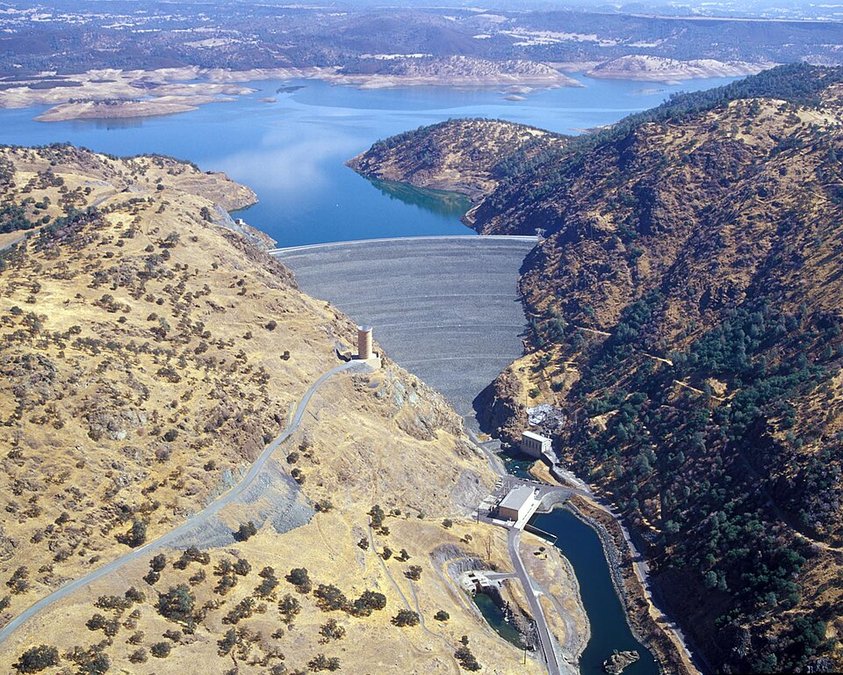
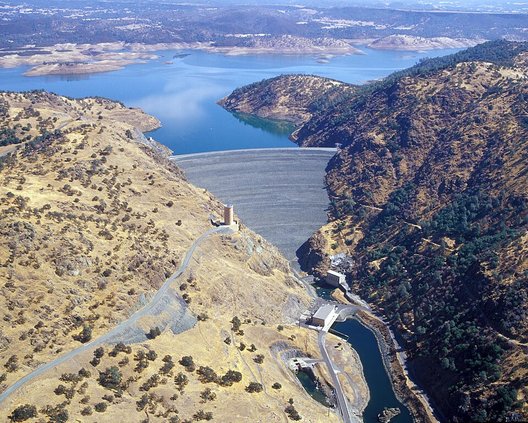
That’s because New Melones is a CVP component that is the largest reservoir on the Stanislaus River and the fourth largest in California.
While South San Joaquin Irrigation District and Oakdale Irrigation District equally share historic and legally adjudicated rights to the first 600,000 acre feet of runoff annually in the Stanislaus River water basin, they rely on the 2.4 million acre foot reservoir for carryover storage.
The elaborate Rubik’s cube that is the storage and conveyance of surface water in California regulated to various degrees by no less than a half dozen agencies on the state level alone coupled with juridical orders for fish flows means a “raid” on CVP or state water project water supplies to backfill losses SoCal incurs in deliveries from the Colorado will reverberate throughout the central and north state.
SSJID and OID jointly have three dams — Donnells, Beardsley, and Tulloch — on the Stanislaus.
Original Melones dam built in
1926 in response to drought
In 1926, as part of their partnership, voters in the two districts encumbered property owners with $2.2 million in bonds to build the original Melones Dam.
The original 211-foot high concrete arch held back a maximum of 112,000 acre feet.
It was enough to cover a year’s worth of irrigation deliveries for the two district.
A disastrous drought in 1925 that laid waste to farming operations set the dam project in motion.
The $2.2 million price tag a century ago was less than the $3.2 million the City of Manteca paid for its overall Woodward Park splash pad feature project completed this year.
In the 1940s, the two districts toyed with raising Melones to store more water.
But then floods that inundated Oakdale, Riverbank, and Ripon as well as surrounding farmland promoted Congress to pass the Federal Flood Act of 1944.
The project that supported was a proposed 355-foot replacement dam.
But it took the 1964 Christmas floods that did wide-spread damage along the Stanislaus River for the project to move forward by Congress authorizing the actual construction funding.
By then, it has become more than just a local flood control project.
It had morphed into a hydro project, addressed minimum river flows and would provide irrigation water for the CVP to commit to other users.
Given SSJID and OID owned the original dam and have adjudicated pre-1914 water rights to the first 600,000 acre feet of runoff, an agreement was made that put the two districts first in line for runoff but created a somewhat complicated set of rules governing carry over storage.
The carryover storage dynamics for New Melones — if and when SoCal makes a move to replace Colorado River water by looking north —could end up impacting local farmers and urban customers alike.
Keep in mind it would not be a “direct assault” so to speak given taking water from one source to go toward another end user is a trickledown effect even if takes until minimum river flows in the Delta or on specific rivers such as the Stanislaus come into play.
The carryover storage is what cushions SSJID and OID most effectively against dry years.
Similar issues on Colorado & the
Stanislaus when it comes to dams
Although Lake Mead and Lake Powell are 250 miles away from Manteca, they have similar “short-sighted assumptions” made by dam planners.
New Melones, by contrast, is some 60 miles from Manteca.
The runoff potential for both dams were modeled on what hydrologists now agree was a wetter than normal 80 to 100 year stretch.
That led to water being “committed” to end users that was significantly below an average operating year. In New Melones’ case, it has been argued that the Bureau of Reclamation committed water it had to know would never materialize except in extremely wet years.
Hydrology does matter.
Using historical hydrology data on the Stanislaus River Basin between 1922 and 2019:
*Based on current regulatory rules, New Melones Reservoir would have fallen between 250,000 acre feet of storage in three of those 98 years.
*Hydrologists point to data that indicated the period between the mid-1700s and the mid-1990 was abnormally wet in the area we refer today as California and the Southwest.
*The return to the natural megadrought cycle punctured with a year or several strung together with normal or above normal precipitation was not taken into accounts in models using hydrology data gleaned between 1922 and 2019 on the Stanislaus River Basin.
*New Melones is the most overcommitted CVP component in terms of water deliveries.
The water promised in federal contracts in the 1970s was far more than the hydrology of the basin historically could deliver.
The Bureau estimated the additional storage on the basin created by New Melones beyond the exiting reservoirs such as Beardsley, Donnells and the original Melones was 335,000 acre feet of water a year. The yield has actually been closer to 200,000 acre feet.
Climate modeling regarding perception in the Central Sierra in the coming years has it being slightly lower.
The big problem is where precipitation will be falling. Less will be falling as snow in the higher elevations and more will fall as rain in the lower elevation.
That will weaken New Melones’ storage effectiveness of annual precipitation given it relies on the Sierra snowpack that is the de facto reservoir for more than 30 percent of California’s water needs.
The dead pool status concern
The loss of hydropower from the Colorado is a real concern that could happen this year on the Colorado as the water level keeps dropping to the point it will no longer flow into intake pipes for the turbines.
That would set off a scramble for replacement electricity.
Dead pool status is another 110 or so feet lower.
That is when water would stop flowing into the outlet to the river.
At New Melones, power generation would cease when the water level drops to 785 feet above sea level.
Dead storage would occur at 543 feet leaving what has been estimated to be a little over 60,000 acre feet of water in the 2.4 million acre foot capacity reservoir.
The reservoir fell to a record low of 83,631 acre feet or 3.5 percent of capacity on Oct. 1, 1992.
In 2015 during a period of drought the Bureau toyed with possible scenarios such as using dynamite to punch a hole into the submerged old Melones dam to allow water to keep flowing for a period of time to reach the intake pipe in the New Melones Dam.
While that is not out of the realm of possibilities in the coming years, the concern that would occur first is a return to 1991 when storage slipped below 300,000 acre feet.
Not only would power generation facilities start going off line, but the “cold water pool” would be nearly depleted meaning releases into the Stanislaus would start going through the lower intakes instead of the upper intakes.
The warmer water would start killing fish below the dam.
It is why the Department of Water Resources requires a 65-degree river temperature below Goodwin as the river flows past Knights Ferry, Oakdale, Ripon, and Caswell Park south of Manteca.
New Melones now at
128 percent of normal
As of Tuesday, water storage at New Melones was at 1,983,000 acre feet or 128 percent of normal for the date of Aug. 1.
SoCal’s impending search for replacing Colorado River isn’t going to pose an immediate effect on regional water supplies.
But as drier precipitation years return and more of it is in the form of rain at the lower elevations instead of snow at the higher elevations coupled with any effort to replace Colorado water, the need for SSJID and OID to contend with growing pressure for the state to “commandeer” water will grow.
To contact Dennis Wyatt, email dwyatt@mantecabulletin.com