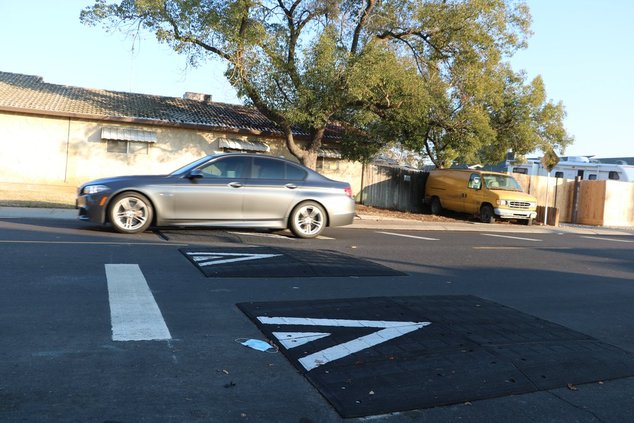
North Walnut Avenue residents have had it with speeding.
The street they live on — given it is the only north-south railroad crossing between Main Street and Union Road — has become a popular shortcut over the years.
That’s because it extends into Hacienda Avenue to provide a connector between Yosemite Avenue and Louise Avenue to bypass Main Street and Union Road traffic to travel to and from commercial and office areas.
On Tuesday the Manteca City is being asked to approve a pair of speed lumps on North Walnut on each side of the railroad tracks midway between the train crossing and the intersections with Davis Street — where the DMV office is located — and Alameda Street.
And if those don’t have a ripple effect and slow traffic down between Davis Street and Center Street, staff has indicated they may come back for permission to install a third traffic lump on North Walnut midway between Center Street and Davis Street.
Speed lumps are part of the City of Manteca Traffic Calming Program adopted in 2018.
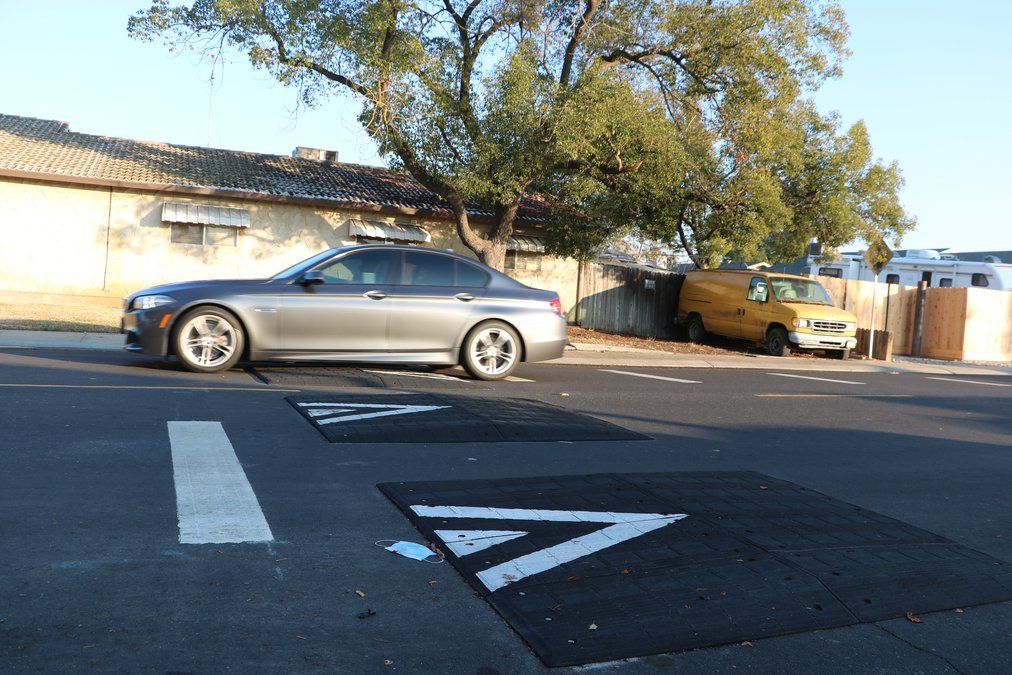
The speed lumps — basically four smaller speed humps spaced to allow buses and emergency vehicles to straddle them by going down the middle of the road or toward the side of the road — are placed in such a manner that fire trucks, with a wider wheelbase, can avoid going over them.
There are pavement markings alerting motorists to the speed lumps ahead. That is in addition to signage that reads “Speed Lump” and “15 mph”.
Manteca’s first speed were deployed midway on Hacienda Avenue between Orchard Way and La Mesa Way.
As second set of speed lumps was installed south of Graystone Avenue in a straight stretch between two relaxed curves before Hacienda Avenue reaches Alameda Street. The work was done after speeding continued in that area after the initial speed lump installation successfully slowed down traffic further to the north.
Speed lumps and other passive measures are designed as 24/7 measures to address areas of documented speeding happening on a routine basis. Solutions tailored to specific road types such as residential, collector, and arterials are different based on use the road was designed to serve as well as the type of safety issue being addressed.
Residents along North Walnut followed the protocols outlined in the Manteca Traffic Calming Program. involves the following steps:
*A request for a study made by residents.
*Developing a traffic calming plan by identifying criteria, determining hotspots, analyzing data, and identifying appropriate traffic calming measures.
*Approval process with public participation.
*Implementation and evaluation.
If the initial effort doesn’t deliver the desired results a second stage takes place. That involves looking at applicable measures, a community meeting, and then securing department or City Council approval before implementing. That is where the North Walnut request is now at when the council considers it Tuesday at 7 p.m.
Those involved in the approval process besides impacted neighbors are the fire department, police department, ambulance services, local and regional transit, Manteca Unified School District, public works (garbage, street sweeping, and maintenance), Community Development Department, postal carriers, and delivery services.
Key thresholds have to be met specifically for speed limits and stop signs.
One example for speed limits would be if 85 percent of the driving on a roadway that is not an arterial is traveling at speeds above 32 miles per hour then the street would be eligible for traffic calming.
Examples of thresholds that would be needed for stop signs include if an intersection has a significant number of automobile-pedestrian collisions or a high potential for them to happen, an intersection with a history of correctable traffic collisions, and a series of warrants that must be met to protect the city’s future liability.
Residents seeking to address speeding issues in their neighborhoods can inquire about the traffic program through the city’s public works department.
To contact Dennis Wyatt, email dwyatt@mantecabulletin.com