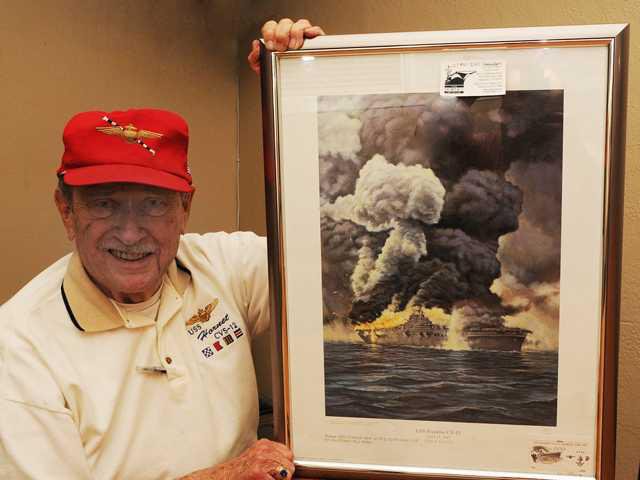
Lee Almquist was on a bomber crew that returned from a mission and found that they couldn’t land on the home ship — the U.S.S Franklin aircraft carrier (CVS-13) — because it was engulfed in flames after a three plane Japanese Kamikaze suicide attack.
Almquist who lived in Manteca and Tracy for years after World War II remembers the day well. Only 15 of the 17 planes returned from a mission having been sent to destroy an enemy submarine repair facility in Sasebo, Japan, hidden in the mountains with a covered access channel from the sea.
That fateful day was April 3, 1945 when crew members were blown off the ship and into the water while others jumped over the side in an effort to save their own lives. There were some 300 men on the ship when it was attacked.
Almquist, who rode in the second seat of his bomber, was its radio operator and gunner – having also been trained to fly the fighter bomber that could reach speeds of 400 miles an hour. Remembering that spring day, he said they could see the plumes of heavy black smoke from their ship some 50 miles away – as well as smoke from other ships that had been hit by torpedoes and kamikaze suicide aircraft.
He said they had to fly through heavy black smoke for miles to land on the Hornet Aircraft Carrier CVS-12 that is now docked in Alameda. The Hornet is now a retired Navy warship for the benefit of the visiting public. Almquist has long served as a docent on the Hornet, leading tours through the decommissioned carrier.
Almquist said the other pilots returning from the raid landed on the Enterprise, the Hornet and a Japanese landing strip that had been taken over by American troops in Yonabiu. A day or two before that fateful Kamikaze attack, he remembers climbing a ladder coming out of a hold where he and his shipmates were bunked as a bomb struck his ship knocking him off the ladder.
He recalled signing up when he and a group of his buddies walked away from their St. Paul Minnesota high school – five in all – and went to the Marine Recruiting Office at the post office wanting to join the war effort. The Marines’ office was closed but two of them made a decision to walk over to the Navy booth – signing up in the last year of the war. The three who finally got into the Marines weren’t as fortunate and didn’t return home after the conflict ended.
Almquist got out of the Navy in 1945 when he was told of the B-12 Program that he could attend at the University of Minnesota – passing its test he was on his way to flight school. It was five years later in 1950 that he was married and called back into the service to go to Korea – all in 10 days.
He had gone into the Navy as an apprentice seaman and rose to second class petty officer and finally to the rank of Lieutenant Commander when he retired after 20 years.
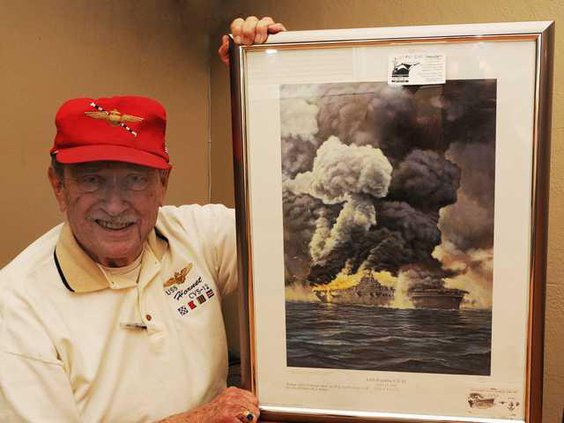
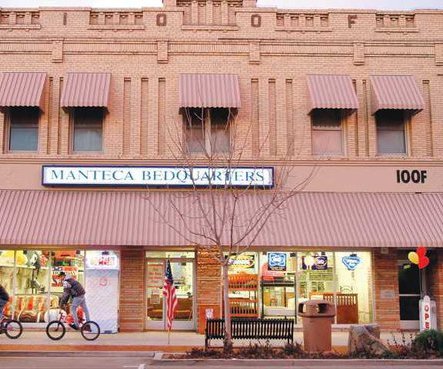
An artist’s rendering of his ship being attacked is going to grace the wall of the new Manteca Veterans Center on Moffat Boulevard so that all might remember what sacrifices the crew of the U.S.S. Franklin endured to keep the country free. Jimmie Connors Veterans of Foreign Wars Post Commander Carlon Perry is expected to be presented with the historic piece of art within the next few weeks.
Along with serving as a docent on the Hornet, he also belonged to a Kiwanis Club in Tracy where he started a “Stamp Program” for the veterans at the Livermore Veterans Hospital – giving the guys a way to pass their time by saving stamps. That program spread to VA facilities in Los Angeles, Washington and Oregon.
Almquist was the franchise owner of the Western Auto Store in Tracy and spent many mornings at the Village Sandwich Shop in Manteca with his friends.
Remembering WWII tragedy
Painting will grace wall of new Veterans Center