One wonders what John Jay — the first Chief Justice of the Supreme Court — would think of how the United States’ legal system has been co-opted by silliness.
No, this has nothing to do with trying to use lawsuits to circumvent the political process.
Instead, we’re talking about shakedown litigation thinly disguised as personal injury or fraud.
Here are three of the worst examples:
McDonald’s and Wendy’s are being sued by a New Yorker who contends ad images of their respective burgers are much bigger than what they were served.
An irked diner is suing Taco Bell after he bought a Mexican pizza that did not look like those taken in the fast food chain’s slick advertising photos.
A Florida woman is suing Hershey’s because novelty Reese’s such as pumpkins, Christmas trees, ghosts, footballs, and such don’t reflect what is on the packaging.
There, of course, is truth in the basic premise of their lawsuits.
We see images on TV, on displays when we walk into taquerias, in slick magazine ads, and even on influencer postings of food that often look more appetizing than what we get served.
Yes, hamburgers may appear smaller than they do in ads.
And imagery on packaging may not accurately depict what is inside.
But are they offenses that should trigger lawsuits?
Pick up a box of Duncan Hines cake mix.
You see a photo perhaps of yellow cake with vanilla frosting.
Yet, all that is inside is a bag of cake mix and no frosting.
And, to make matters worse, not only is it not ready to eat, but what you end up creating after following the directions doesn’t look as perfect nor as appetizing.
Most people with common sense wouldn’t be outraged and file a lawsuit.
But then again, most people don’t go into a store with a phone that has Jacoby & Meyers on speed dial.
Not that Jacoby & Meyers would take such a case.
Take a look at the candy rack the next time you go to the store.
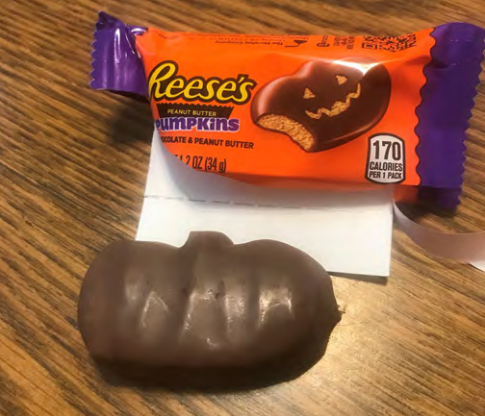
Look for a seasonal promotion using Reese’s Peanut Butter Cups molded into other shapes such as pumpkins.
Cynthia Kelly — who hails from Tampa in Florida — was so incensed at what she saw in terms of what was inside the package compared to the imagery on it, she just had to file a lawsuit.
The offense that she thought was deceptive and therefore criminal was the fact the Reese’s inside did not have all of fine detail as on the packaging.
The pumpkins, as an example, that are sold for Halloween did not have the shape nor eyes.
She was so incensed and “injured” that she has filed a class action suit against Hershey’s for $5 million.
That’s because she was expecting a cute Reese’s pseudo Jack-o’-lantern complete with eyes and mouth.
But here’s the $5 million question: If she was deceptively led to believe the packaging imagery was a 100 percent accurate reflection of what was inside, why did she buy it?
Take a closer look at the Reese’s packaging for pumpkins.
It has a good-sized piece already eaten to give you an idea of the peanut butter center.
Who in their right mind would buy half eaten candy?
Remember, the litigant contends the packaging is misleading and needs to be 100 percent representative.
A reasonable person would conclude with the candy partially eaten it wasn’t a true depiction.
That means if you believe exactly what you see is exactly what you get, then you are making a conscious decision to buy partially eaten candy.
And why bother to sue?
If she believes what you see is what you get, then she should be thrilled she got a whole Reese’s peanut butter and chocolate Jack-o’-lantern and not seven-eighths of one.
Why not just not buy another Reese’s product and bad mouth it every chance you get?
Of course, you wouldn’t do that because it would get no traction.
People tend to buy candy for what it tastes like and not because it looks exactly like what it looks like in the packaging.
If the bar for deliberate deception is being set that low, people who post primary photos on dating apps that are from a younger day or much nicer than they look in person on a first encounter, would that be fair game to sue just on that basis.
If the deception bothers one that bad and you can’t get past it, most would be one and done and not looking up a lawyer that would take your beef on contingency as a class-action suit hoping to line up others that the poster of the profile misled.
Keep in mind the Reese’s lawsuit has yet to get past a judge.
We are told, of course, by the litigant’s lawyer who could win the lottery if the lawsuit gets traction that his client is seeking the equivalent of social justice.
After all, she must put an end to advertising injustice in the world.
One can’t have big bad corporations lure children to candy aisles with the promise of cute little peanut butter and chocolate shaped half-flatten football with pseudo laces apparently made from what appears to be white chocolate in order to take their hard earned allowance.
But then kids know what they want.
They want candy, not the equivalent of a visual knickknack to be placed on a shelf next to participation trophies.
Meanwhile, we have adults acting like children.
Strike that.
We have greedy adults acting as if their innocence has been shattered by Hershey’s.
After all, you never know if the next chocolate bar you unwrap is your golden ticket to a pot of litigation gold.
This column is the opinion of editor, Dennis Wyatt, and does not necessarily represent the opinions of The Bulletin or 209 Multimedia. He can be reached at dwyatt@mantecabulletin.com