City Manager Toni Lundgren was right.
The Manteca City Council made a bold decision.
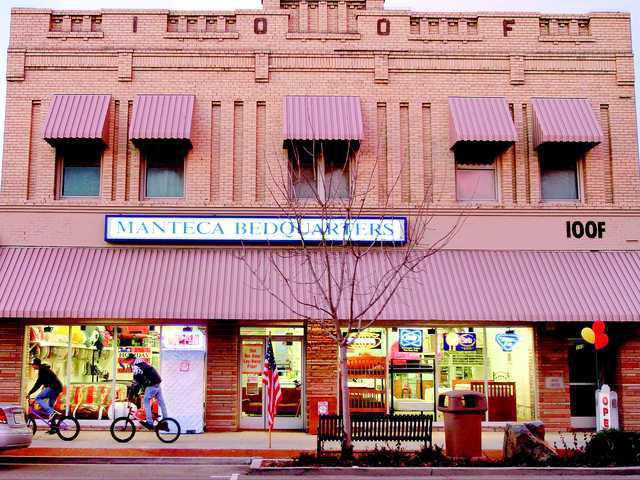
She was referring to the council’s decision to spend $1.12 million to purchase the iconic historic IOOF Hall building in downtown Manteca.
Before going on, let’s clear one massive misnomer being circulated in the toilet bowl that social media can be thanks to the human factor of people engaged in a race to the bottom of the cesspool.
Steve Lewis was not forced by the city to sell.
Lewis approached the city.
After more than 30 years running the successful Manteca Bedquarters, Lewis was ready to retire.
They agreed on what was determined to be the fair market price.
It should be noted that Lewis over the years has been a downtown and community supporter.
He never hesitated to allow others to use the private parking lot on the corner of Main Street and Yosemite Avenue that was included in the $1.2 million purchase price.
That included customers of other businesses, the Chamber of Commerce and Sunrise Kiwanis during their respective street fairs, Manteca Rotary for their Santa Hut, for more than 24 years for the parking of the Flags Over Manteca storage trailer, and more.
Manteca Bedquarters also supported non-profit and school groups with items for fundraisers.
Lewis’ decision to approach the city means the next act for the IOOF Hall will likely be a do-over that will cement its location as “the” building in downtown.
Although it is far from clear what the end use will be, the city has put $1.2 million of Manteca’s tax dollars on the line in a bid to make the IOOF Hall a transformational building for the downtown’s future.
There is also the strong likelihood Manteca may need to invest more money into the building per se as part of endeavor to secure an end user for the vision they ultimately will adopt for the IOOF Hall.
That brings us to the point that needs to be made.
Manteca’s leaders have made it clear they have no intention of “going into business.”
It’s a smart position to take.
What also is a smart position is not to be asleep at the wheel in the role as a landlord, on the good chance the IOOF Hall odyssey doesn’t led right away to a sale of the end transformation.
Let’s be clear.
What you are about to read has nothing to do with the current administration and, by extension, the current council.
This is ancient history.
But if you fail to understand history, it has a nasty tendency to repeat itself.
Close to 40 years ago, the City of Manteca wrote the first of several chapters of the book on what not to do in a public-private sector partnership.
The city was hell-bent back in the late 1980s to create a “statement”, or some would say Taj Mahl, for Manteca’s public golf course.
Other municipal golf courses in the area had a basic pro shop and a snack bar.
Elected city leaders wanted a golf course with a country club style clubhouse.
That led to the two-story clubhouse you now see with the vision the second floor would be a desirable dinner restaurant location.
One little problem.
It wasn’t.
The city never bothered to ask the people who were the experts — commercial real estate experts and restaurant owners with a proven track record — whether the location made sense.
Well, that’s not exactly true.
The city did seek professional private sector advice, four years after the clubhouse was completed and they still couldn’t find a restaurant tenant for the second floor.
The Coldwell Banker professional they consulted them told the location was atrocious. It met none of the criteria for any sit-down chain restaurant. Ditto for independents.
It was too far from heavily trafficked arterials.
There wasn’t enough lunch activity to sustain a sit-down restaurant.
It seems the general rule of things was that a restaurant needed a steady lunch crowd to assure they could cover the bills. After that, the dinner crowd is what ultimately makes or breaks a restaurant.
The city then added mistake No. 2.
They decided to be landlord and “business partner.”
Their first effort resulted in a partnership where they agreed to finance tenant improvements given what was installed in the second-floor kitchen 10 years prior was determined to be inadequate and outdated.
The city ended up being fleeced out of more than $50,000.
How did it happen?
They issued advance checks for the tenant to make the upgrades. They were never done.
Chapter No. 3, was a double down on Chapter No. 2.
But that time, the problem wasn’t an investment for equipment that was never spent but a lack of a thorough background check on financials and other worthiness records.
It wasn’t until the city realized the tenant hadn’t been paying municipal utility bills for sewer, water, and garbage for six months that they discovered they had been had.
The tenant ran up bills as well.
The only other one the taxpayers got stuck with was a sizable PG&E bill that had accumulated over the course of months as the City of Manteca’s name was also on the account.
The city finally wised up and listened to the late Frank Guinta Jr. who had owned several successful gas station/convenience stores in Manteca. He owned successful restaurants.
He understood what would work; a banquet hall and not a sit-down restaurant.
The second-floor restaurant — and downtown snack bar — has been a success ever since.
Guinta was the city’s savior.
The city is different today.
The culture is different.
The people are different.
The altitude is different.
That said, the city needs to remember history.
With two successful and effective business people on the council — Mike Morowit and Gary Singh, the odds of the staff going astray is highly unlikely.
Councilman Charlie Halford built a reputation when he was police chief as a hard-nosed budget manager.
Council members aren’t slouches when it comes to making sure the city management stays on course.
That said, they need to make sure going forward that the city doesn’t veer from a position that takes them to the point they exit stage left once the IOOF Hall is transformed into a high profile “entry” gathering place that sets the tone for downtown’s future as returns to private ownership.
This column is the opinion of editor, Dennis Wyatt, and does not necessarily represent the opinions of The Bulletin or 209 Multimedia. He can be reached at dwyatt@mantecabulletin.com