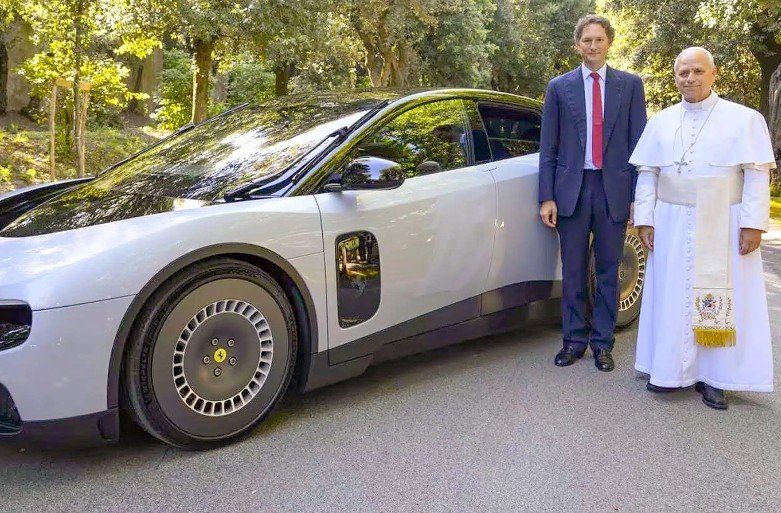
Ferrari has rolled out is first ever electric vehicle.
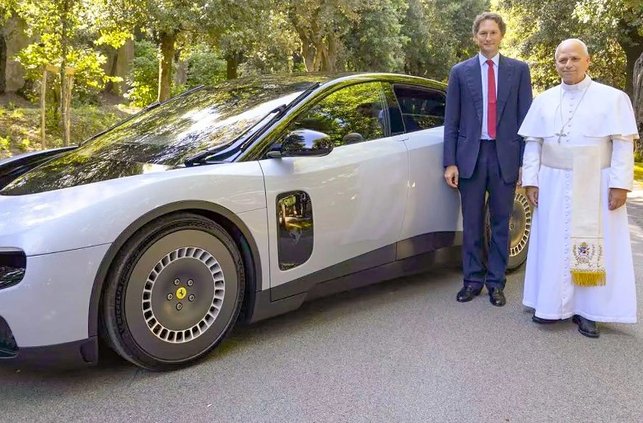
Dubbed “Luce”, the Pope himself posed with one after he was gifted a Luce steering wheel by Ferrari Chairman John Elkann at the papal residence at Castel Gandolfo in May.
It’s quad-motor powertrain delivers over 1,000 horsepower, goes from 0 to 60 mph in 2.4 seconds (0 to 124 mph in 6.8 seconds), seats five, tops out at 193 mph, and has a battery range of 329 miles.
It can be yours for $640,000.
The Luce is definitely snazzier than the famous Popemobile.
That said, if you buy it and drive it around, be prepared for a bit of mocking.
Some critics say it looks like the mutant offspring of a Toyota Prius and Dodge Charger Daytona.
Others are even more underwhelmed by the body design saying it looks like it copied a Nissan Leaf.
There was a time when looks — or what passed for them — drove car sales.
With the need for fuel efficiency — or in the case of the Luce, the need for speed — those days are a way back in the rearview mirror.
Mercedes SUVs aiming for the luxury market look like something Detroit or Kia would design for soccer moms and vice versa.
The other day stopped at an intersection, a parade of sedans and SUVs passed by from at least a dozen different manufacturers yet they look like they came out of the same design center.
It was a point my passenger lamented.
But a few blocks later when we passed two Cybertrucks — including one with an interesting frozen urine color, the same person commented how odd the Tesla pickups looked.
In all honesty, if a vehicle personality as defined by what others see when cars and pickups are driven down the road, the Cybertruck emulates the daring golden age of American vehicle body designs.
The 1950s gave us more oddities that makes the stainless steel Tesla pickup design seem orthodox in comparison.
Post World War II exuberance gave the world items such as tail fins, the Edsel horse grille, and Dagmar bumpers that were popular on Cadillacs.
The conically-shape chrome Dagmar bumpers — also called bullet bumpers — were named for a buxom television personality from the early 1950s.
It was a time when cars were getting away from basic transportation.
And in doing so, it created more drag that would put a smile on the face of the Texaco Man — the man who wore the star on a uniform complete with either necktie or bow tie — as he listened to the sound of the pump whirling as cars sucked up gasoline selling for 27 cents a gallon.
That, by the way, in inflated dollars would be $3.30 a gallon today.
It also involves a lot of protruding metal that would give a safety engineer today with the National Safety Transportation Safety Board a massive coronary just looking at them.
The 1980 Datsun 280ZX two-seater T-top I once drove definitely turned heads.
I can’t say the same for the 2018 Ford Focus sedan I now drive.
That said, if you put them side by side you could argue the Focus looks sleeker as long as your assessment isn’t clouded by the nostalgia of driving the 280ZX some 46 years before you started collecting Social Security.
The ZX had 132 horsepower and averaged a combined 22 miles per gallon. The Ford Focus has 160 horsepower with a combined 33 mile per gallon.
I’m not too sure why we have a tendency to judge cars by how the steel is shaped — or in the case of Corvettes, a nice mixture of aluminum, fiberglass, carbon fiber and such.
But by and large mass produced automobiles in today’s utilitarian world have created a sameness that channels the days when Henry Ford flooded America’s roads with the Model T.
Someone willing to spend $640,000 on a car probably cares as much about what you can’t see as well as what you can.
Still, one might not want what you’re driving being mistaken for a Toyota Prius on steroids.
Ferrari honchos have endured a storm of criticism since rolling out their long anticipated foray into electric vehicles. They have dismissed stock plunging 8.5 percent the day after they unveiled the Luce saying Ferrari purists that have the cash to buy will come around.
They opted not to do what Chevrolet did which was come out with an E-Ray that looked like the standard Corvette model but sports the quick acceleration of an electric.
Still, it’s kind of hard to believe that people who will fork out $640,000 for a car have egos able to withstand a 2026 Prius with a panoramic glass roof pulling up next to them at a red light.