Ray Okerson was definitely old school.
He was the guy in charge of the city’s seven-man public works crew that did everything including collecting Manteca’s garbage.
That was back in the late 1950s when Manteca had 7,000 residents.
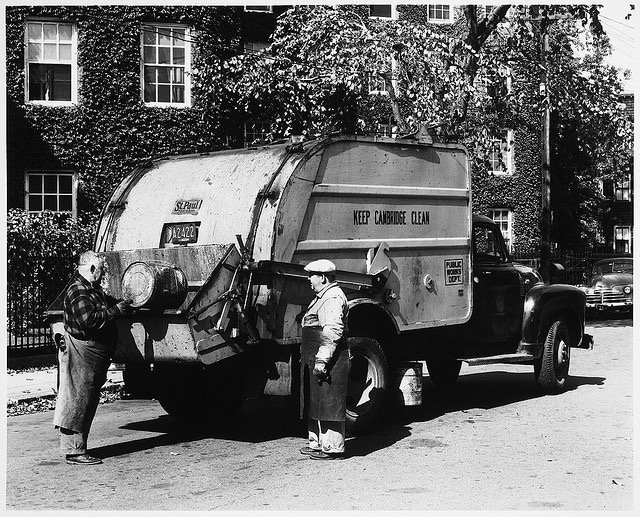
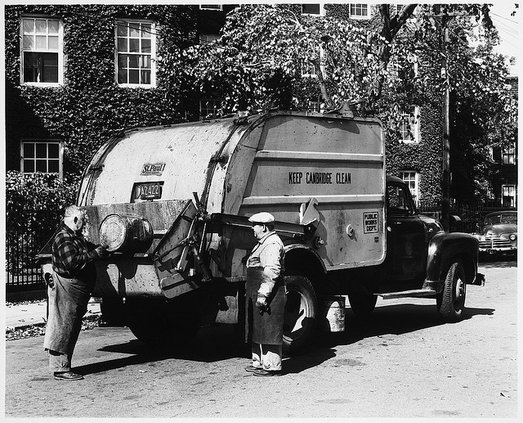
It was a time when young men going to college worked as summer crew assistants on the municipal garbage truck.
They’d go into backyards, pick up 35-gallon metal cans, and dump the contents into the back of the garbage truck.
Among those on the crew for five summers was a 1958 Manteca High graduate by the name of John Harris.
Years ago in an interview, Harris called the back breaking job “fun”, noting at $1.17 an hour it paid better than being a gas jockey.
It was a time when gas was 17 cents a gallon and self-serve was a rarity.
Harris did a stint as a gas jockey at 97 cents an hour at Tom Looman’s gas station on the southeast corner at Union Road and Yosemite Avenue that was at the edge of town.
He pumped gas, checked water levels in radiators, checked the oil level and air pressure in addition to pumping gas.
A lot has changed since then.
You’re thrilled today when gas is below $4 a gallon and the filling station actually has clean water and a squeegee that doesn’t look like it went 30 rounds with a Doberman.
Garage is no longer buried at the city dump on Union Road where Manteca’s two-story golf clubhouse sits atop trash buried decades ago.
No longer is dumping a garbage can a 100 percent manual undertaking.
Harris happened to be elected to the council in 1998, several years after the city ended its bottomless trash collection policy — basically if you bagged it in 30-gallon plastic bags, tied them and stacked them next to your garbage cans they’d haul it away.
It was also when the city put into service its first solid waste collection truck equipped with a joy stick to operate hydraulic arms used to do the heavy lifting and tipping of carts.
Garbage is no longer simply buried or burned in an open pit.
Green and food waste makes their way to composting operations.
Some of the trash stream is recycled and the rest ends up being buried at “Mt. Stockton” rising up along Austin Road north of Manteca and to the east of Stockton Metro Airport.
Residential burn barrels — typically used 55-gallon oil drums with one end removed — were still common back in the 1950s as a way to get rid of paper debris.
Brilliant marketing gurus hadn’t stumbled on the right mixture of fear and hype to convince what seems like 90 percent of the population to eschew tap water in favor of paying exorbitant-squared prices per ounce for plastic bottles of it that adds to the garbage we generate.
A number of Manteca’s solid waste trucks are powered by biogas produced at the municipal refinery — better known as the wastewater treatment plant — from methane gas extracted from sewage and food waste.
And now the day is coming when you’ll need an app to take out the trash.
Actually, that’s not exactly true, but you will be able to download an app on your smartphone or tablet to keep tabs on your trash issues.
It also will eliminate excuses that you don’t know which of your three carts to put a specific item into as the answer will be at your fingertips via an app.
The city has placed a lot of dimes on the assumption that techies can make your municipal garbage experience less stressful, more effective, and seamless.
Over the course of three years between hardware, software, and such the city is investing $1 million not just to improve your garbage experience but to make the 45 solid waste trucks that are used on routes and even random bin pickups more efficient.
Keep in mind, the reoccurring monthly subscriptions for both the truck hardware and software as well as the apps is almost $22,000 a monthly.
Rest assured there will be hardware upgrades down the line. And they won’t be cheap.
Not trying to channel a Luddite, but hopefully it’s not another take on the “Emperor’s New Clothes” fable that you can argue our addiction to bottled water has become.
It might be too much to ask, but in order to assure ratepayers that Manteca didn’t just buy the Brooklyn Bridge with the Golden Gate Bridge tossed in for good measure, is there some type of tracking mechanism that will tabulate the financial savings?
Based only on the $17,666 a month for the subscription needed to make the truck routes more efficient to save fuel and increase workload efficiency that translates into more bang for personnel expenditures; the city needs to realize $17,666 a month in savings and/or cost avoidance to justify the money they will be transferring from our collective pockets as solid waste costumers to Routeware.
Then there is a question whether the app “experience” for customers is quantifiable and not simply be caught up in the techie thrill of using it.
Let’s be honest.
Most of the city’s 32,000 households manage to get their garbage out to the curbside each week without the aid of an app.
They aren’t the problem.
What is are the people who routinely violate basic rules of recycling by contaminating recyclables with garbage.
The working theory, of course, is the app will address all of that.
Just like the city providing printed materials in monthly statements was supposed to take care of the problem.
Not only do people have to download the app, access it, and actually follow it, but they need the right mindset which is to follow the rules that are for the good of the community and not their own personal convenience.
One might wonder what an 18 year-old back in 1958 would think of the fact the city is investing $1 million to make solid waste collection more efficient.
And for the rest of us forking over $50.92 a month for solid waste service — with additional rate hikes in place to ratchet it up to $63.07 a month by 2027, time will tell.
This column is the opinion of editor, Dennis Wyatt, and does not necessarily represent the opinions of The Bulletin or 209 Multimedia. He can be reached at dwyatt@mantecabulletin.com