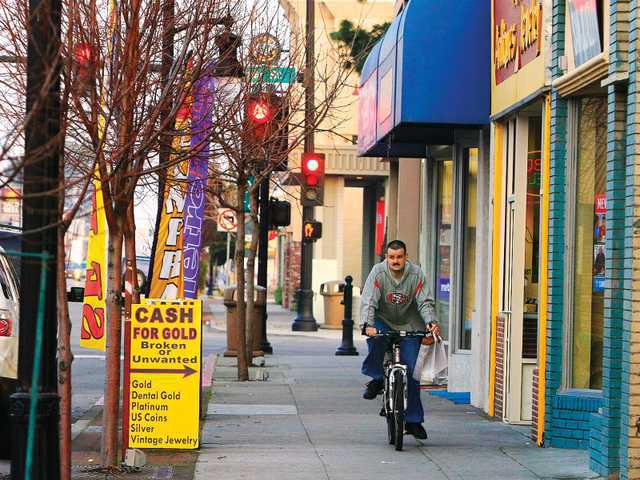
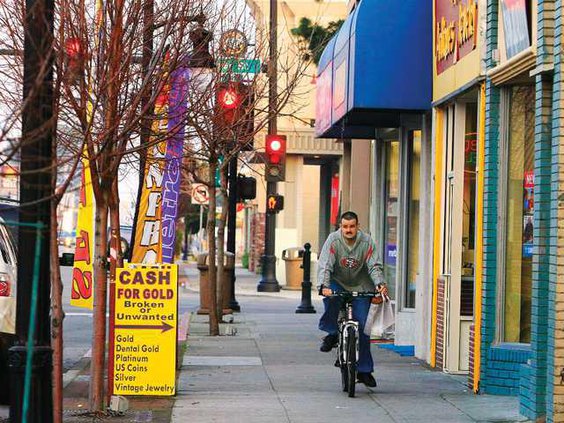
Manteca’s image and the safety of its residents are at the heart of a proactive campaign being launched this month by municipal code enforcement officers.
Illegal A-frame signs, flags and banners – some blocking the view of motorists exiting driveways on busy streets– along dangerous substandard structures and unsecured properties are the focus of the crackdown.
Through the spring months the business community and public will be made aware of the rules and regulations for several months prior to the issue of any citations.
Code enforcement supervisor Scott Cunningham explained that the city now has the tools to review substandard structures within the city and demand upgrades for the sake of the Manteca citizenry.
“We need to start changing the image of the city to a more positive one and still remain economically friendly with the businesses, because certainly without them the city as a whole is sunk,” Cunningham said. “We have to start to do something about (signs) blocking the public rights-of-way.”
He explained that his code enforcement department would be in an outreach mode soon to inform and educate the public through the Manteca Chamber of Commerce as well as through the Central Valley Hispanic Chamber of Commerce. The goal is to give citizens “an extremely generous amount of time” to comply with the city code mandate.
As for signs, flags and banners, merchants are being given 60 days to comply followed by a non-threatening letter that will be sent out further explaining the sign enforcement program. Following that, code enforcement staffers are scheduled to make personal calls on foot first -- walking from store to store – talking first with downtown business owners to make sure they understand the city code.
It is only then that administrative enforcement citations will be issued. Cunningham said. Administrative citations will only be used as a last resort.
“We are to a point where people are beginning to ask why we aren’t doing something. The last thing we want to see is somebody getting hurt or killed because they can’t see around a sign,” he said.
In addition the city can now recoup lost funds expended in boarding up abandoned houses that have required as much as $3,000 to keep vandals and vagrants from occupying the residences. Those costs will now be levied against the actual owners, a problem in past years when properties were often in a state of flux between lenders and former owners.
Cunningham said his office handled over 1200 violations last year with 1,184 of them resolved. Only 20 administrative citations were issued for all of 2010.
“It’s not a punitive thing, but the city has been out of the funds to manage these unsecured homes and now we are starting to see the fruits of our labors,” he said.
He noted that so far this year, in contrast with 2010, the city has already issued 50 administrative citations for code violations.
“It’s becoming a great tool to gain compliance (the administrative citation) and to cover the costs,” he said.
In the past the city has had to take violators to court to recover its costs. If violators agreed to take care of the problem, the cases were often dismissed by a judge, Cunningham added.
The city has also established a “Responsible Property Owner Ordinance” in their effort to further improve the image of the city, improve safety and eliminate breeding grounds for crime.
“If you have a house where there has been gang activity, dope, alcohol as a persistent problem – and it is a rental – we are holding the property owner responsible to take some course of action,” Cunningham said.
This is not the old form of code enforcement that involved an upset resident complaining about a neighbor not mowing his lawn or having a boat or truck or trailer parked in the front yard or at a curb, but rather about criminal activity, Cunningham said.
“It is requiring the owner to take some form of action, to eliminate the problem. It puts the burden on the owner. If it doesn’t get resolved then we go down the administrative citation process,” he added.
Those citations are designed to levy a fee of $100 on the first service. If the problem isn’t corrected within a stated amount of time, the second citation amount is set at $250 while the third is $500. The time sequence can be as little as a day but it will be based on a more reasonable time frame, he said.
As for the illegal banners, flags and A-frames, Cunningham said they have become a cancer in the community and are multiplying at a fast pace. He said they are more of a problem in the downtown area but noted they extend all over town.
While noting the city wants to remain “business friendly,” the signs and flags have brought in numerous complaints from citizens claiming that they block their view at intersections and also impede wheelchair access on public rights-of-way in violation of Section 17 of the Manteca Municipal Code.
Cunningham said the signs and flags have created an “overall blight” in the city, adding, “People are just getting tired looking at them.”
Areas of prime concern include the Yosemite and Main Street intersection and at a fitness center near Louise and Main Street where there are some five flags across the front of the building in addition to A-frame signage. There is also a furniture store on Yosemite Avenue where a 10-foot-high air-generated advertising feature is used to gain advertising response – with an electric cord running across the sidewalk, he said.
Enforcement officer Greg Baird said that the three- square-foot hand-held signs have gone beyond what is reasonable and have become bigger and bigger. It seems like some are realizing they have gotten away with the smaller signs and have moved on to larger ones.
Baird added that from a safety standpoint – corners like Louise and Main streets – it’s distracting to motorists with hand-held signs on all four corners.
“The whole idea is they want drivers to see the signs, but we don’t want drivers looking. We want them to pay attention to traffic and to the stop light ahead of them and not looking at the guys on the corner.”
Baird said he can foresee a time when the hand-held signs will also have to be regulated by the city.
Illegal A-frame signs, flags and banners – some blocking the view of motorists exiting driveways on busy streets– along dangerous substandard structures and unsecured properties are the focus of the crackdown.
Through the spring months the business community and public will be made aware of the rules and regulations for several months prior to the issue of any citations.
Code enforcement supervisor Scott Cunningham explained that the city now has the tools to review substandard structures within the city and demand upgrades for the sake of the Manteca citizenry.
“We need to start changing the image of the city to a more positive one and still remain economically friendly with the businesses, because certainly without them the city as a whole is sunk,” Cunningham said. “We have to start to do something about (signs) blocking the public rights-of-way.”
He explained that his code enforcement department would be in an outreach mode soon to inform and educate the public through the Manteca Chamber of Commerce as well as through the Central Valley Hispanic Chamber of Commerce. The goal is to give citizens “an extremely generous amount of time” to comply with the city code mandate.
As for signs, flags and banners, merchants are being given 60 days to comply followed by a non-threatening letter that will be sent out further explaining the sign enforcement program. Following that, code enforcement staffers are scheduled to make personal calls on foot first -- walking from store to store – talking first with downtown business owners to make sure they understand the city code.
It is only then that administrative enforcement citations will be issued. Cunningham said. Administrative citations will only be used as a last resort.
“We are to a point where people are beginning to ask why we aren’t doing something. The last thing we want to see is somebody getting hurt or killed because they can’t see around a sign,” he said.
In addition the city can now recoup lost funds expended in boarding up abandoned houses that have required as much as $3,000 to keep vandals and vagrants from occupying the residences. Those costs will now be levied against the actual owners, a problem in past years when properties were often in a state of flux between lenders and former owners.
Cunningham said his office handled over 1200 violations last year with 1,184 of them resolved. Only 20 administrative citations were issued for all of 2010.
“It’s not a punitive thing, but the city has been out of the funds to manage these unsecured homes and now we are starting to see the fruits of our labors,” he said.
He noted that so far this year, in contrast with 2010, the city has already issued 50 administrative citations for code violations.
“It’s becoming a great tool to gain compliance (the administrative citation) and to cover the costs,” he said.
In the past the city has had to take violators to court to recover its costs. If violators agreed to take care of the problem, the cases were often dismissed by a judge, Cunningham added.
Responsible Property Owner ordinance gives city more enforcement tools
The city has also established a “Responsible Property Owner Ordinance” in their effort to further improve the image of the city, improve safety and eliminate breeding grounds for crime.
“If you have a house where there has been gang activity, dope, alcohol as a persistent problem – and it is a rental – we are holding the property owner responsible to take some course of action,” Cunningham said.
This is not the old form of code enforcement that involved an upset resident complaining about a neighbor not mowing his lawn or having a boat or truck or trailer parked in the front yard or at a curb, but rather about criminal activity, Cunningham said.
“It is requiring the owner to take some form of action, to eliminate the problem. It puts the burden on the owner. If it doesn’t get resolved then we go down the administrative citation process,” he added.
Those citations are designed to levy a fee of $100 on the first service. If the problem isn’t corrected within a stated amount of time, the second citation amount is set at $250 while the third is $500. The time sequence can be as little as a day but it will be based on a more reasonable time frame, he said.
As for the illegal banners, flags and A-frames, Cunningham said they have become a cancer in the community and are multiplying at a fast pace. He said they are more of a problem in the downtown area but noted they extend all over town.
Manteca may have to regulate hand-held signs
While noting the city wants to remain “business friendly,” the signs and flags have brought in numerous complaints from citizens claiming that they block their view at intersections and also impede wheelchair access on public rights-of-way in violation of Section 17 of the Manteca Municipal Code.
Cunningham said the signs and flags have created an “overall blight” in the city, adding, “People are just getting tired looking at them.”
Areas of prime concern include the Yosemite and Main Street intersection and at a fitness center near Louise and Main Street where there are some five flags across the front of the building in addition to A-frame signage. There is also a furniture store on Yosemite Avenue where a 10-foot-high air-generated advertising feature is used to gain advertising response – with an electric cord running across the sidewalk, he said.
Enforcement officer Greg Baird said that the three- square-foot hand-held signs have gone beyond what is reasonable and have become bigger and bigger. It seems like some are realizing they have gotten away with the smaller signs and have moved on to larger ones.
Baird added that from a safety standpoint – corners like Louise and Main streets – it’s distracting to motorists with hand-held signs on all four corners.
“The whole idea is they want drivers to see the signs, but we don’t want drivers looking. We want them to pay attention to traffic and to the stop light ahead of them and not looking at the guys on the corner.”
Baird said he can foresee a time when the hand-held signs will also have to be regulated by the city.