Polls have shown a lot of potential California voters in the June 2 primary have no inkling who Troy K. Thurmond is.
The odds are extremely high that even less know who Thunder Parley is.
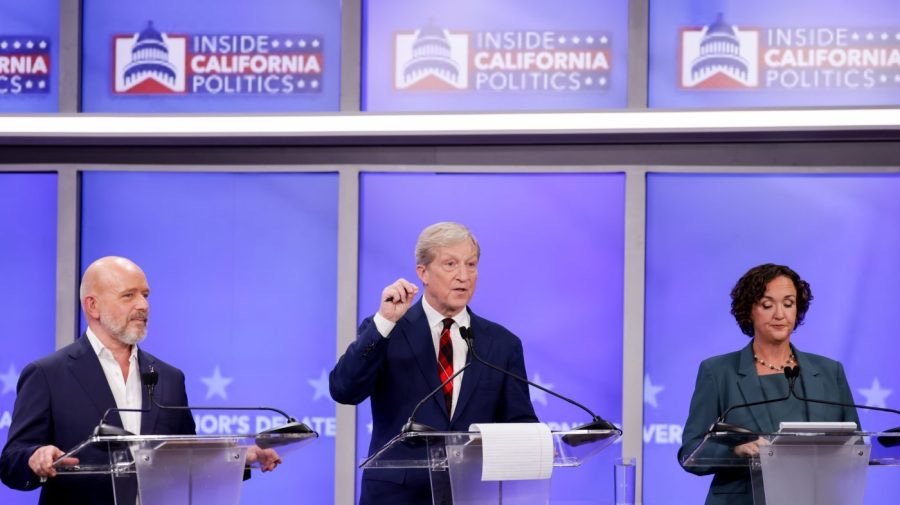
As for Katie Porter, her name recognition is higher thanks to a somewhat combative political career and her tendency to throw what might politely be referred to as tantrums.
There are three of the 61 names on the ballot for governor.
That’s right, 61 candidates — 24 Democrats, 12 Republicans, a Libertarian, a Peace & Freedom candidate, and the rest with no party preference.
You might be pleased to note one candidate — whose legal name is “Livingforgod Andcountry Demott” — is neither a Democrat or Republican as he is nonpartisan.
Not since the recall election of 2003 when Arnold Schwarzenegger emerged from a field of 135 candidates as governor to replace incumbent Gray Davis, has there been so many names squeezed on a California gubernatorial ballot.
By the luck of a draw of the alphabet by the Secretary of State, Thurmond, Parley, and Porter appear in succession on the ballot.
Based on political pundits and polling, Porter is a top 7 candidate as defined by CNN, Thurmond isn’t really in the fray, and Parley is a nobody.
The ballot lists Thurmond as the California State Superintendent of Public Instruction, Parley as a market analyst, and Porter as a consumer protection advocate.
Porter is actually much better known as a former member of Congress.
Given how much Californians bellyache about schools and the fact California is a statewide school system and not a thousand autonomous free-standing districts, you’d think whoever is the public superintendent would be a household name but that almost never happens.
All three, by the way, are Democrats.
You might be wondering by now why there are 61 names on the ballot.
All one needs is to be 18 years of age, a United States citizen, a resident of California five years prior to running, and a registered voter in the Golden State.
And you pony up a filing fee of $4,918.58 or, in lieu of that, collect 6,000 signatures of valid California registered voters.
It might sound like an odd amount, but state statute requires the filing fee be two percent of the first year’s salary of a statewide constitutional office that one is running for.
That said, if you believe Thunder Parley or Livingforgod Andcountry Demott have a prayer in Sacramento of being one of the top two finishers June 2, then you’ll also believe Alexandria Ocasio-Cortez and Donald Trump are going to dump their respective spouses, marry, and move to a commune in the heart of the Northern California Emerald Triangle and sell Trump bobbleheads to tourists.
There is little doubt all 61 of the people on the ballot believe they are serious candidates.
But should there be 61 people on the ballot?
Yes, this is America where everyone — if they meet the bare minimum requirements — can grow up and become president.
It goes without saying they have to put in the work to do so which means persuading enough voters to make it happen.
But should that the threshold simply be writing a check and your name appears on the ballot?
If you run for a City Council seat in a general law city in California the state requires you pay a filing fee and collect the signatures of at least 20 valid voters residing within the jurisdiction you want to represent.
Certainly, if you are required to show at least 20 registered voters are willing to cast a ballot for you to elect you to set sewer rates, you should be able to demonstrate 6,000 valid California registered voters are likely to cast ballots for you to run the government for what is essentially the world’s fifth largest economy.
Of the 135 candidates in the race for governor in the 2003 recall for governor, only 15 earned more than 6,000 votes.
Sixty-five collected less than 1,000 votes.
If you want to govern a state of almost 40 million people you should need to demonstrate at least 6,000 people support you.
Earning a spot on the ballot to run for governor should take more than writing a check for $4,918.58.
It should also be paid in the currency that has value that matters — signatures of valid California registered voters.
If you can’t convince 6,000 of your fellow Californians to support your run for governor by lending their signatures to a petition to do so, then you have no business gumming up the process even on a minuscule scale by paying your way onto the ballots of 57 counties to either simply stroke your ego or feed your delusions.