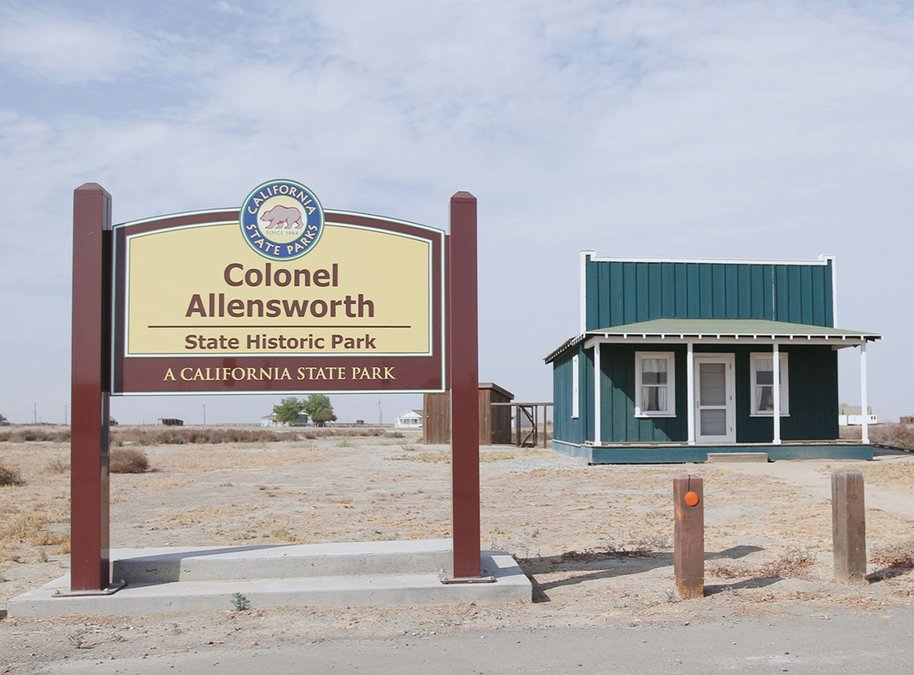
ALLENSWORTH, Tulare County — In the southern San Joaquin Valley, a modest but growing assemblage of restored and reconstructed buildings marks the location of Colonel Allensworth State Historic Park.
A schoolhouse, a Baptist church, businesses, homes, a hotel, a library, and various other structures symbolize the rebirth of one man’s dream of an independent, democratic town where African Americans could live in control of their own destiny.
On the horizon stretch level farmlands, county roads, and the seemingly endless tracks of the Santa Fe rail line. In this part of the valley, summer temperatures can reach 100 degrees or more, but winters are generally mild.
The state park is a 189 mile, three-hour drive from Manteca.
It is open daily from 10 a.m. to 4 p.m.
There are no park fees although there are per night fees for camping — $30 with hookups and $20 without hookups.
Allen Allensworth — A visionary
Colonel Allen Allensworth — Army chaplain, educator, orator, and town co-founder — was born into slavery in Louisville, Kentucky, on April 7, 1842.
Intelligent and eager for knowledge, he was encouraged by his mother to learn to read and write by playing school with the master’s son.
At 12 he was sent away for violating the law that prohibited the education of slaves.
In 1862 he fled slavery to join the Union Navy and was honorably discharged as a chief petty officer. After the Civil War, the Colonel achieved the formal education he had been denied.
In 1877 he married Josephine Leavell, a schoolteacher, a music teacher, and gifted musician, and they raised two daughters.
In 1886, with a doctorate of theology, Allensworth became chaplain to the 24th Infantry, one of the Army’s four African American regiments. He retired as a lieutenant colonel in 1906 — the first African American to attain such high rank. First Baptist Church (restored)
The Town of Allensworth
Retirement found the Colonel lecturing throughout the eastern and midwestern states, promoting Booker T. Washington’s philosophy of African American self-reliance. They both firmly believed that, through education and hard work, African Americans could rise above the effects of slavery, attain greater social stature, and more fully realize their potential as a people.
The Allensworths settled in Los Angeles, and in 1906 the Colonel met Professor William Payne, an educator whose family had recently moved to Pasadena.
With a mutual desire to live in an environment where African Americans could live free from discrimination, they merged their values with those of other pioneers of like mind to establish an independent, self-sufficient colony.
They formed the California Colony and Home Promotion Association in 1908 and purchased 800 acres along the Santa Fe rail line from the Pacific Farming Company, at a rail stop called Solita.
In 1909 the colony of Allensworth began to rise from the flat countryside — California’s first town founded, financed, and governed by African Americans. The name and reputation of Colonel Allensworth inspired African Americans who were looking for a better life.
People from all over the country, including many who were already settled in California, came to populate the town. In some cases, people who never lived in the town purchased property sight-unseen to help the cause.
The town of Allensworth enjoyed great success and was the focus of considerable interest.
On July 29, 1909, the Tulare County Times ran an article headlined, “Negro Colony at Solita Prosperous.” Other newspapers described Allensworth with such headlines as, “Allensworth Folks Great Readers” (Visalia Delta) and “An Ideal Negro Settlement” (Los Angeles Times).
By 1910 residents had built a small school. Two years later, Allensworth became California’s first African American school district, and in 1914 the town became a judicial district. When rapid growth necessitated the construction of a larger school, Mrs. Allensworth turned the old school building into the Mary Dickinson
Reflecting his love for education and his desire to share it with others, Colonel Allensworth donated his extensive private book collection to the library. Later, Tulare County made the library part of its free system, supplying 50 books per month.
Water
Soon after settlement began, it became obvious that water would be a problem.
In 1913 residents formed the Allensworth Rural Water Company and took control of the water system from Pacific Farming Company.
Unable to raise the funds necessary to drill more wells or improve their existing system, Allensworth had a seriously lowered water table by 1914.
The decline
The year 1914 was a difficult year for the town. When the Santa Fe Railroad moved its rail stop from Allensworth to Alpaugh that July, much of Allensworth’s economic base was lost.
On September 15, 1914, the town suffered its most significant setback — the tragic death of their inspirational leader.
Colonel Allensworth was in Monrovia, California, preparing to preach at a small church. As he crossed a street, he was struck by two men on a motorcycle.
After the Colonel’s death, the struggle to survive became more difficult.
Drought, poor crop yields, and a failing water supply became hopeless obstacles.
When an economic slump followed World War I, residents left in search of a better living.
The town’s decline gathered momentum. In 1966, arsenic was found in the water supply; then, Allensworth was scheduled for demolition. By 1973 it was no longer on the state map.
A town revived
However, the dream of Colonel Allensworth was not dead.
The spark has been rekindled by a group of dedicated individuals — including some former residents — who continue to advocate for the growth and development of this vital cultural resource. The town became a state park in 1974.
Events scheduled throughout the year bring the town to life and inspire a new interest in returning Allensworth to its glory days as a vibrant, successful town.
About 70,000 visitors come annually from all over California and from out of state to experience this unique and historically important town.
This annual celebration gives park users and supporters an opportunity to renew their commitment to the park and its symbolic representation of African American self-determination.
Old Time Jubilee Every year following the harvest, the town of Allensworth held a big party when the carnival came to town. The Old Time Jubilee recreates this festive atmosphere.