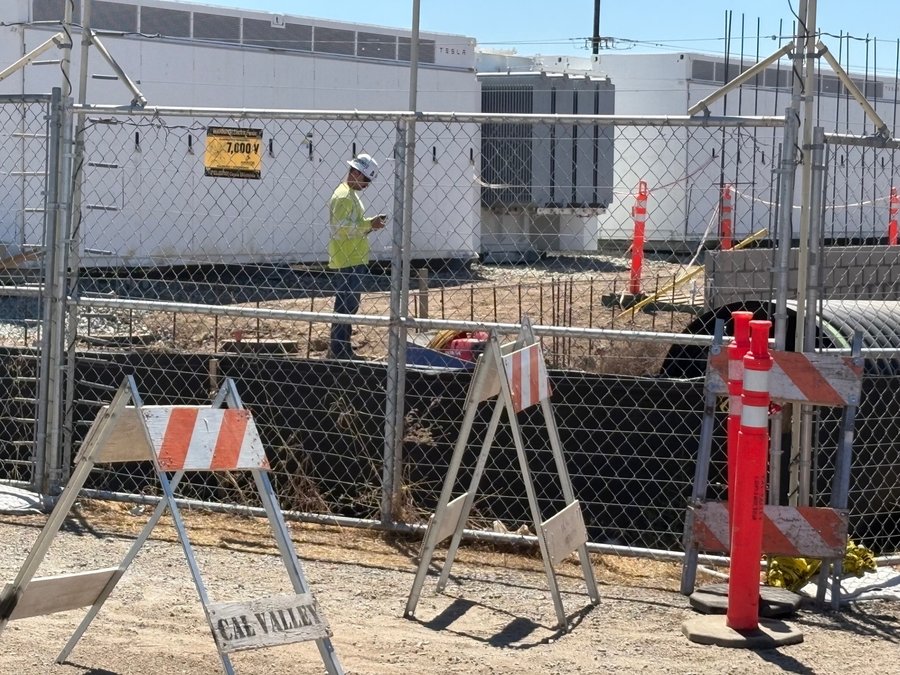
The battery storage complex now under construction in Ripon is the second of three such complexes being built in San Joaquin County.
With the ability to store 100 megawatts, it is the smallest of the three.
It is, however, the highest profile as it is snuggled against Highway 99 adjacent to a PG&E substation and the Flying J Travel Plaza.
A 132-megawatt battery storage owned by PG&E went operational near Linden in 2023.
The third is a 400-megawatt project south of Tracy that received final approval from the California Energy Commission on May 26.
The combined 632 megawatts will be capable of storage electricity than can supply 474,000 homes a day based on peak demand.
As such, the three battery storage facilities could theoretically provide electricity to run all existing households in San Joaquin County and then some for 24 hours.
The California Energy Commission and state public utility groups frequently cite 1 MW as roughly equal to the concurrent demand of 750 homes during peak usage conditions.
The Noosa Energy project in Ripon is on a 4.9-acre triangle next to the PG&E substation.
It will consist of battery storage cabinets, transformers, inverters, a main step-up transformer along with an interconnection line to the Ripon PG&E substation.
Tesla mega battery packs — or similar batteries — are being placed in 11 rows. Eight of those rows will go the width of the property with eight feet between rows. The longest row will approach 600 feet in length.
Three shorter rows of battery packs will be placed east of the Ripon substation.
The Tesla mega packs contain arrays of lithium-ion batteries that would be charged by alternating current energy from PG&E's grid, used when the supply of energy exceeds the demand.
Battery storage farms are needed in order to save excess electricity generated when the sun is out and the wind is blowing for use when solar panels and/or wind turbines aren’t generating power.
As such, one day it could store electricity needed to help power homes and businesses in Manteca, Ripon, and Lathrop as California moves toward a goal of 100 percent “clean” energy by 2045.
The 100-megawatt will store electricity generated at optimum times of the day when energy production exceeds demand.
The proposed 400 megawatt storage facility would tie into PG&E’s Tesla substation near the Alameda-San Joaquin county line. It will be on land 22 miles to the southwest of Manteca.
The Korda Energy Storage project will consist of 500 free standing batteries that are each 20 feet long, 8 feet wide, and 9.5 feet tall.
It will be one of the largest, if not the largest, battery energy storage farm in California when it becomes operational.
The county project being proposed is south of Tracy along Patterson Pass Road some 2,000 feet south of Midway Road.
The 40-acre Korda site with be about 9/10th of a mile east of Interstate 580.
The Linden battery storage complex is 23 miles northeast of Manteca.
To contact Dennis Wyatt, email dwyatt@mantecabulletin.com
The battery storage complex now under construction in Ripon is the second of three such complexes being built in San Joaquin County.
With the ability to store 100 megawatts, it is the smallest of the three.
It is, however, the highest profile as it is snuggled against Highway 99 adjacent to a PG&E substation and the Flying J Travel Plaza.
A 132-megawatt battery storage owned by PG&E went operational near Linden in 2023.
The third is a 400-megawatt project south of Tracy that received final approval from the California Energy Commission on May 26.
The combined 632 megawatts will be capable of storage electricity than can supply 474,000 homes a day based on peak demand.
As such, the three battery storage facilities could theoretically provide electricity to run all existing households in San Joaquin County and then some for 24 hours.
The California Energy Commission and state public utility groups frequently cite 1 MW as roughly equal to the concurrent demand of 750 homes during peak usage conditions.
The Noosa Energy project in Ripon is on a 4.9-acre triangle next to the PG&E substation.
It will consist of battery storage cabinets, transformers, inverters, a main step-up transformer along with an interconnection line to the Ripon PG&E substation.
Tesla mega battery packs — or similar batteries — are being placed in 11 rows. Eight of those rows will go the width of the property with eight feet between rows. The longest row will approach 600 feet in length.
Three shorter rows of battery packs will be placed east of the Ripon substation.
The Tesla mega packs contain arrays of lithium-ion batteries that would be charged by alternating current energy from PG&E's grid, used when the supply of energy exceeds the demand.
Battery storage farms are needed in order to save excess electricity generated when the sun is out and the wind is blowing for use when solar panels and/or wind turbines aren’t generating power.
As such, one day it could store electricity needed to help power homes and businesses in Manteca, Ripon, and Lathrop as California moves toward a goal of 100 percent “clean” energy by 2045.
The 100-megawatt will store electricity generated at optimum times of the day when energy production exceeds demand.
The proposed 400 megawatt storage facility would tie into PG&E’s Tesla substation near the Alameda-San Joaquin county line. It will be on land 22 miles to the southwest of Manteca.
The Korda Energy Storage project will consist of 500 free standing batteries that are each 20 feet long, 8 feet wide, and 9.5 feet tall.
It will be one of the largest, if not the largest, battery energy storage farm in California when it becomes operational.
The county project being proposed is south of Tracy along Patterson Pass Road some 2,000 feet south of Midway Road.
The 40-acre Korda site with be about 9/10th of a mile east of Interstate 580.
The Linden battery storage complex is 23 miles northeast of Manteca.
To contact Dennis Wyatt, email dwyatt@mantecabulletin.com