The drought appears here to stay for at least another year.
The driest back-to-back consecutive January and February on record in more than 100 years put a huge dent in December’s snowpack that was 160 percent of average.
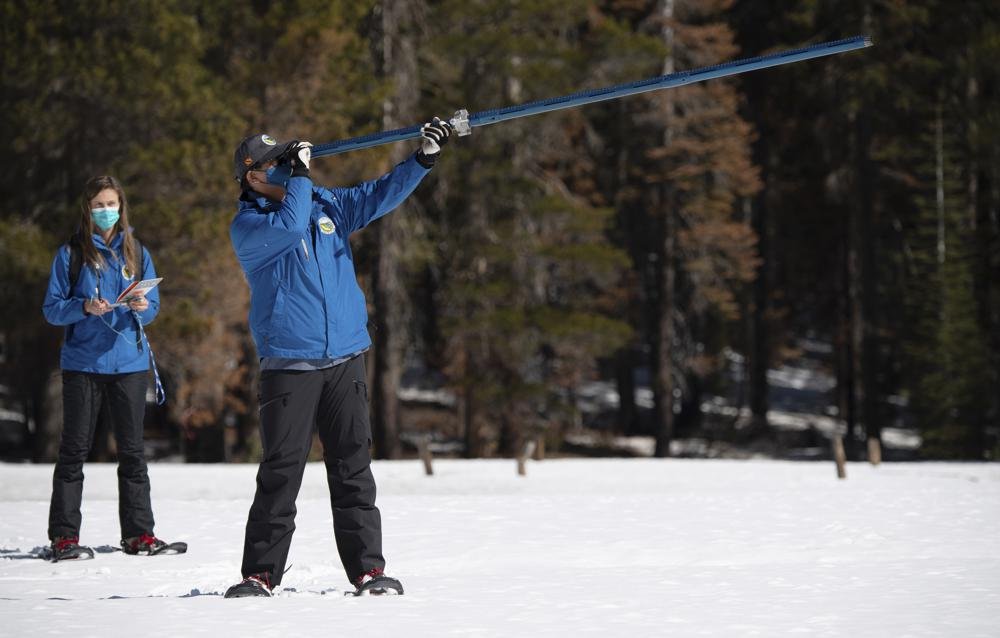
As a result, the Department of Water Resources survey for March 1 revealed the snowpack is 63 percent of normal for the date with the all-important water content projected at 66 percent of average.
And while the Climate Weather Prediction Center predicts better chances for more snow and rain in the Northern Sierra in March, there is low confidence that the Central and Southern Sierra will see that same benefit.
The Central Sierra snowpack supplies the Stanislaus, Tuolumne and Merced watersheds that the Northern San Joaquin Valley is dependent on for much of its farm and urban water needs.
Storage in the 2.4 million-acre-foot capacity New Melones Reservoir that plays a major role in water for the Oakdale Irrigation District plus the South San Joaquin Irrigation District that serves farms as well as the cities of Manteca, Lathrop, and Tracy, was at 984,394 acre feet or 68 percent of normal storage for March 1.
Don Pedro Reservoir with a 2 million-acre-foot capacity on the Tuolumne River that supplies the Modesto and Turlock irrigation districts was at 80 percent of average for March 1 with 1.18 million acre feet in storage.
The 1 million-acre-foot McClure Reservoir has 294,327 acre feet in storage or 57 percent of its average capacity for March 1.
SSJID, which is scheduled to start its irrigation season today, anticipates with careful use of water even if March — the final month of the traditional wet season — will be OK for the balance of the water year that ends Sept. 30. That’s because modeling shows at least 600,000 acre feet of runoff is expected on the Stanislaus watershed even with the dismal outlook. That represents the water they have the legal rights to each year.
All of the Central Valley as well as the Central and Southern Sierra are in severe drought based on the United States Department Drought Monitor. There is no part of California that isn’t in drought.
It is why state water officials Tuesday were imploring Californians to conserve water when they announced the result of the latest snow survey.
"(There’s) not enough to fill up our reservoirs, and without any significant storms on the horizon, it's safe to say that we'll end this year dry and continue on into the third year of this ongoing drought," said Sean de Guzman, manager of the department's snow surveys and water supply forecasting section.
Statewide reservoir storage is at about 73% of average, and the largest reservoir, Lake Shasta, is only 37% full.
Snowmelt from the Sierra and other mountains normally provides about a third of the state's water supply.
Gov. Gavin Newsom has been calling for Californians to reduce water consumption by 15% from 2020 levels since last summer. California snowpack far below normal after dry winter months
There was some melt during warm February weather, but the bulk of the current snowpack should remain intact for several weeks.
Historically, December, January and February are California's wettest months, delivering over half of annual precipitation, and the snowpack reaches its peak on April 1.
To contact Dennis Wyatt, email dwyatt@mantecabulletin.com