Los Angeles, San Jose, Chicago, New York, and other big cities are lightweights when it comes to commuting.
They aren’t even in the same league as Manteca, Lathrop, Tracy, and Mountain House.
Those four cities have between 12.6 percent and 17.5 percent of their workforce that have achieved supercommuter status.
That’s defined as those that commute 90 plus minutes each way between work and home.
It is based on a regional analysis conducted by the University of the Pacific of the Census Bureau’s American Community Survey data collected from 2020 to 2024.
The work was prepared for the San Joaquin Council of Governments.
It is the same data that shows Stockton as the top of the heap among large cities in terms of the highest percentage of its workforce — 9.2 percent or 11,280 — that qualify as supercomputers.
The next closest at 6.9 percent is New York in No. 2 with 226,730 such commuters.
Only two other California cities make the top 10.
Los Angeles is No. 5 at 3.1 percent or 47,470 of its workforce.
San Jose is No. 7 at 2.3 percent or 9,310 supercommuters.
But even Stockton, in terms of percentage, pales compared to the South County that might just qualify as the cradle of American supercommuters.
*Lathrop has 17.5 percent of its workforce qualifying as supercomputers.
*Mountain House is at 17 percent.
*Tracy is at 13.8 percent.
*Manteca is at 12.6 percent.
San Joaquin County as a whole comes in at 10 percent.
Other supercommuter stats show:
*California overall is at 3.8 percent
*Ripon is at 4.3 percent.
*Lodi is at 3.1 percent.
*The United States is at 2.7 percent.
*Escalon is at 2 percent.
Keep in mind the 90-minute commute is based on time, not distance.
It is why it is highly likely — even though the data processed doesn’t include miles covered — given time and the geographic location Manteca, Tracy, Lathrop, and Mountain House commuters also cover the most miles by car.
25 percent plus of all South
County are long haul commuters
Given the number of supercommuters, it is no surprise the South County is among the highest regions when it comes to long-haul commuters defined by 60 minute commutes each direction.
*Mountain House is at 35.4 percent of all its commuters being defined as long haul, including supercommuters.
*Lathrop is at 33.9 percent.
*Tracy is at 32.6 percent.
*Manteca is at 25 percent.
*San Joaquin County as a whole is at 20.1 percent.
*Stockton is at 16.5 percent.
*Ripon is at 13.3 percent.
*California overall is at 11.1 percent.
*The United States is at 8.6 percent.
*Escalon is at 8.5 percent.
*Lodi is at 7.9 percent.
Qualifying as long-haul commuters by transportation mode in San Joaquin County:
*18.7 percent of those driving alone are long haul commuters
*27.1 percent of those that carpool.
*76 percent of those that use public transit.
*94.3 percent of those that use long-distance train or commuter rail.
In terms of average one-way commute times regardless of supercommuter, long haul commuter, or short commuter status:
*Mountain House is at 49.6 minutes.
*Lathrop is at 45.2 minutes.
*Tracy is at 42.5 minutes.
*Manteca is at 37.6 minutes.
*San Joaquin County as a whole is at 34.1 minutes.
*Stockton is at 31.7 minutes.
*California overall s at 28.7 minutes.
*Ripon is at 26.8 minutes.
*The United States is at 26.4 minutes.
*Escalon is at 24.1 minutes.
*Lodi is at 24.1 minutes.
The top five counties for supercommuting in California are all in the 209 region:
*San Joaquin County at 10 percent or 30,240 commuters.
*Mariposa County at 9.7 percent or 630.
*Merced County at 9.4 percent or 9,790.
*Stanislaus at 8.6 percent or 18,330.
*Calaveras County at 8.5 percent or 1,310.
For California, it is 8.5 percent or 574,250 and the United States it is 2.7 percent or 3,680,300.
When it comes to long-haul commuting, San Joaquin County drops into the No. 3 spot at 20.1 percent or 60,400 commuters behind San Benito County at 25.6 percent or 7,810, and Contra Costa at 21.2 percent or 92,090.
In California, 11.1 percent or 1,689,100 people are long-haul commuters while in the United States it is 8.6 percent or 11,616,160.
Summary and policy
implications of the data
*One in 10 San Joaquin County commuters travel 90 minutes or more each way to work.
*One in five travels at least 60 minutes.
*The county’s strongest external labor-market connection is with the Bay Area.
The commute burdens associated with that connection are concentrated in Bay Area-facing communities along the I-205, I-580, and Highway 120 corridors, especially Mountain House, Lathrop, Tracy, and Manteca.
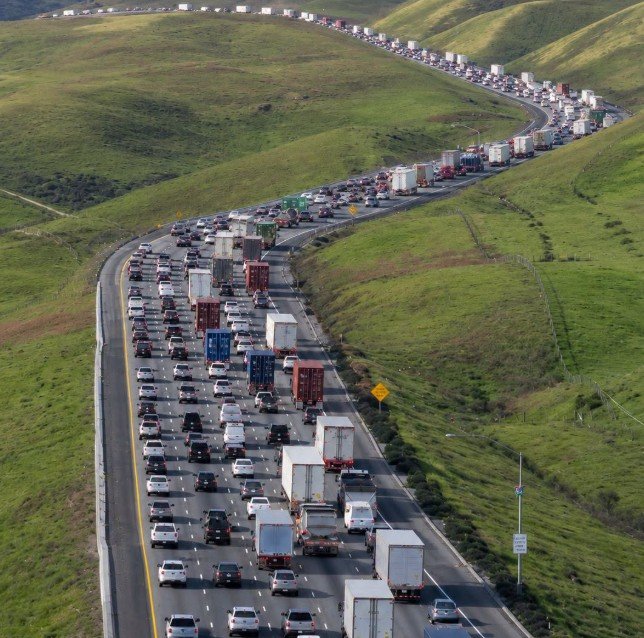
*Pre-dawn departures are unusually common in corridor communities, consistent with workers leaving early to cross the Altamont Pass before peak congestion.
The figures place San Joaquin County among the nation’s most extreme long-duration commuting counties; more than twice California’s rate and nearly four times the national average.
The commute burdens also carry human costs.
Long commutes consume time that could otherwise support family life, rest, caregiving, civic participation, and social connection.
For workers making these trips daily or several times per week, the burden is not only in travel time but also the stress, uncertainty, and household tradeoffs created by long and often unreliable journeys.
Long-duration commuting therefore affects not only transportation systems and labor markets, but also the wellbeing of workers, families, and communities.
The UOP study notes policy responses should operate on two levels. First, the region should reduce the immediate costs of long-distance commuting by improving reliability, safety, and travel options along major interregional corridors.
That includes corridor management, carpool and managed-lane strategies, commuter rail connections, and first- and last-mile access for workers who rely on transit.
Second, the region should reduce the structural need for long commutes over time by expanding access to higher-quality employment within the Northern San Joaquin Valley itself.
To contact Dennis Wyatt, email dwyatt@mantecabulletin.com