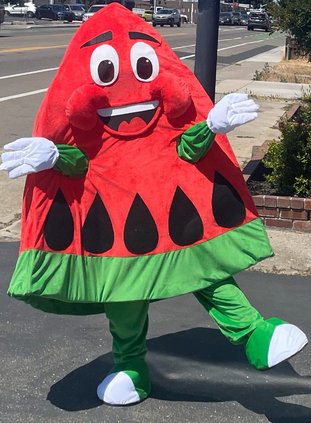
Manteca was known for watermelons long before it was incorporated as a city in 1918.
It is why it is only fitting the biggest “block party” of summer — actually multiple blocks in downtown — is this Saturday and Sunday in Manteca.
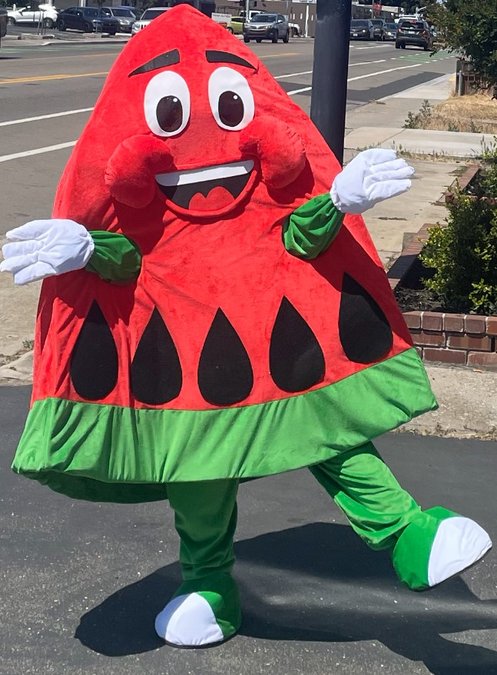
The 30th annual Crossroads Watermelon Street Fair is from 10 a.m. to 5 p.m. Saturday and Sunday.
It celebrates Manteca’s undisputed title as the biggest watermelon growing region in California.
And it all started in 1905 by Ed Powers who was dubbed “The Watermelon King.”
More about that later. First, details about the street fair taking place Saturday and Sunday.
All 275 vendor spots have been sold.
That means plenty of crafts, art, knick-knacks, jewelry, information displays, food, music, classic cars, sweet watermelon and more for the event being staged by the Manteca Chamber of Commerce.
And it also means fun and games for the kids — including watermelon rolls, watermelon relays, water balloon tosses, and — of course — a watermelon eating contest. The watermelons are courtesy festival sponsor George Perry & Sons.
There is also an adult watermelon eating contest both days at noon and 2:30 p.m. There is no registration. Just show up at the registration booth at the beer garden. `
The free games will take place under the shady canopy of the sycamore trees at Library Park.
There is also free live music near the beer garden at Wilson Park behind the Post Office.
On Saturday, DJ Mitch Zottie is from 10 to 10:30 a.m., No Way Nack performs from 12:30 to 2:30 p.m., and George Towne is on stage from 3 to 5 p.m.
Sunday starts with DJ Mitch Zottie from 10 to 10:30 a.m., then the Retrofitz Band is on stage from 12:30 to 2:30 p.m., while Gunpowder & Lace performs from 3 to 5 p.m.
There will also be a car show on Sunday.
The street fair takes place in the downtown triangle formed by Main Street, Center Street, and the railroad tracks.
Manteca is California’s
epicenter for watermelons
San Joaquin County — specifically the fields around Manteca, Tracy, and Ripon — is the largest watermelon growing region in California.
There are 1,880 acres planted in watermelon within the county. Those acres in 2024 yielded 43,800 watermelons or 36.7 of California’s overall production.
Manteca-Ripon is home to the two most well-known purveyors of watermelons — Perry & Sons, as well as Van Groningen & Sons that broker under the moniker Yosemite Fresh.
California is the third largest state for watermelon production following Florida in first and Georgia in second.
Ed Powers got Manteca
rolling as watermelon region
Ed Powers was a 24 year-old when he arrived in Manteca with a dream.
He wanted to raise watermelons.
Most, though, thought he was a bit crazy. After all, the sandy loam was exhausted from over farming.
Powers persisted.
He was sure deeper cultivation combined with water from the Tulloch Ditch would provide ideal ground for watermelons.
It wasn’t a vision shared by landowners who repeatedly turned him down as a dreamer or simply a poor risk when he asked to rent land.
The landowner who finally rented land to Powers was Joshua Cowell — the man who founded Manteca by walking from Nevada’s Carson Valley over the Sierra in 1863.
Cowell made a deal with Powers. He rented him 80 acres at $5 an acre as well as a third of the crop up to $10 an acre.
Powers shipped his first crop of melons to commission houses in the Northwest. His freight bill for the first crop in 1905 was $8,000. It increased in 1906 to $12,000. Other farmers started switching to melons.
Soon Manteca was dubbed the “Watermelon Capital of the World” while Powers was referred to as California’s Watermelon King.
Powers started farming barley and then sunflowers.
He wasn’t content to just farm.
Powers soon joined the Board of Trade — the predecessor to the Manteca Chamber of Commerce that is conducting this weekend’s street fair/watermelon festival — and served as its president a number of times.
He joined the effort to build the community’s first grammar school in 1913 after the old East Union School burned.
Powers led the charge to establish Manteca Union High School to eliminate the need for Manteca students wanting a secondary education to travel to Stockton High.
Powers launched the city’s first telephone system. Lines to rural subscribers were strung along fence posts.
The young dreamer who bicycled into Manteca from Lathrop to resettle is credited with inducing Spreckels Sugar to build a factory here after company representatives investigated the possibility of growing sugar beets in the Manteca district.
Other endeavors Powers is credited with:
*expanding the Manteca Canning Company that was located on Oak Street after taking the operation over in 1919.
*helping organize the First State Bank of Manteca in 1911.
*serving as the first president of the San Joaquin Farm Bureau in 1914.
* serving as the agent for Western Union, Southern Pacific and Wells Fargo Express.
*owning and farming 27 ranches at one time in the greater Manteca area as late as the 1950s.
Powers also was a true pioneer when it came to Manteca’s post World War II growth.
He developed Powers Tract in 1946 to make home sites available for returning servicemen. Many of the homes are California flat-tops that were popular in the early 1950s.
To contact Dennis Wyatt, e-mail dwyatt@mantecabulletin.com