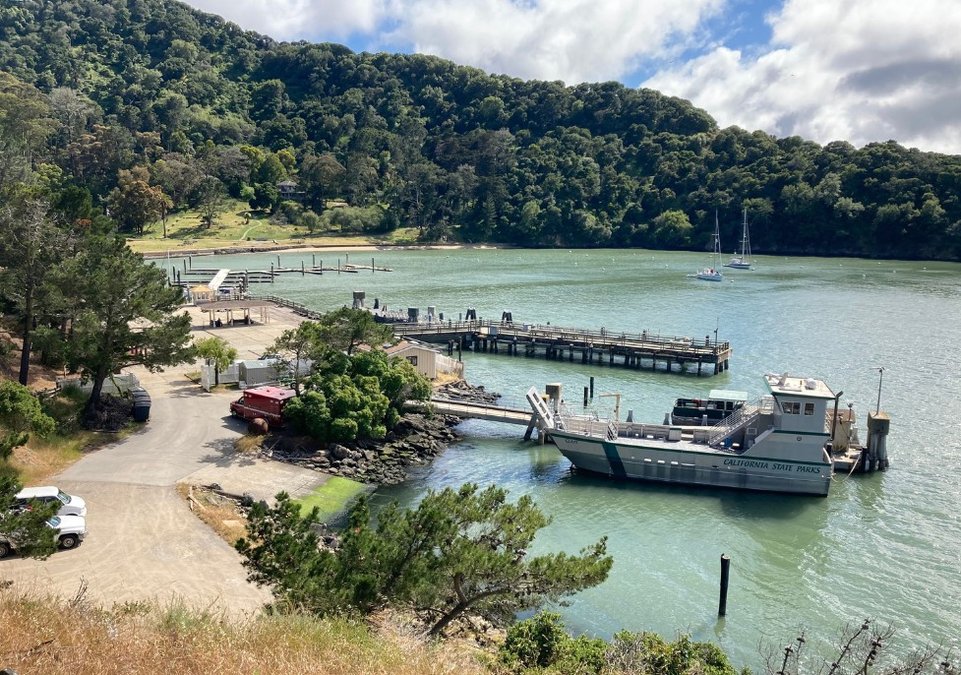
ANGEL ISLAND — It isn’t as famous as “The Rock” but Angel Islands in San Francisco Bay is arguably one of the most unique units in the California State Parks system.
And — if you opt to use the Golden Gate Ferry service to get there via the Ferry Building in San Francisco — it will include soaking in spectacular views on the 30-minute water crossing prior to arriving.
There is a shorter 10-minute option out of Tiburon in Marin County.
Why go to Angel Island?
That’s easy: For the views, for the history — it served as a West Coast point of entry for immigrants for years — the fairly easy hikes, and a low-key appreciation of the fact there is more to the San Francisco Bay than the San Francisco-Oakland-San Jose triangle.
Angel State Park is the second largest natural island in the overall Bay after Alameda.
It’s highest point is Mount Caroline Livermore at 788.76 feet.
The land mass is 1.2 miles.
Keep in mind, that is slightly bigger than the square mile contained with the street grid of Main Street, Louise Avenue, Airport Way, and Yosemite Avenue in Manteca. As such, it oozes walkable.
And if you’re looking for spectacular camping sites for $35 per night plus processing fee of $8 its tough to beat the options on Angel Islands including the Ridge campsite that gives you stunning views of the San Francisco skyline and the Golden Gate Bridge.
Ferry service out of San Francisco will cost adults ages 19 to 69 a $15.50 ticket while the price from Tiburon is $19.08.
Before you go for the less expensive, Tiburon — while a farther trip to reach by car — has less of a hassle parking. It also can avoid San Francisco traffic if you opt to take the San Rafael Bridge around the north bay to get there.
Then there is the after hike consideration. While you can’t top San Francisco for sheer variety and numbers, Marin County’s offerings are far from shabby.
The actual access to the state park is an entrance fee of $3 for an adult and $2 for a youth.
Ferry service will take you to Ayala Cove where almost a million immigrants first stepped on United States soil between 1910 and 1940.
They came from 80 countries and included Chinese, Japanese, Sikh and Filipino immigrants.
Harbor seals often greet visitors arriving today at Ayala Cove on the docks in front of the park’s visitor center.
Visitors can tour the preserved detention barracks, and a new museum, housed in the former Public Health Service Hospital, contains historical exhibits and draws parallels to contemporary immigration debates.
The U.S. Immigration Station can be reached via trail featuring 140 steps.
Hikers have 13 miles of trails and roadways, while cyclists have access to nine miles. Foot trails and Mount Livermore are closed to cyclists.
Natural history
Angel Island 10,000 years ago was part of the mainland.
It was created by rising oceans at the end of an ice age.
In the 1800s, cattle grazing and wood harvesting eliminated much of the native oak woodland and coastal brush habitats covering Angel Island.
The U.S. Army and the Immigration Service planted many non-native trees, such as eucalyptus and Monterey pine.
Since the creation of the state park in 1963, oak, bay, madrone, and other native trees and shrubs are reclaiming their habitats.
Wildflowers cover the island in spring.
Deer and raccoons, both excellent swimmers, are the only large land mammals on the island. Harbor seals and California sea lions often sun on the rocks. Birds include scrub jays, hummingbirds, flickers, hawks, and owls. Near the coves, visitors may find egrets, grebes, blue herons, and brown pelicans.
The Angel Island mole, endemic to the island, is not found anywhere else in the world.
Cultural history
Coast Miwok began visiting the island about 2,000 years ago.
These indigenous people established camps and used the island primarily as a fishing and hunting site.
In 1775, Lt. Juan Manuel de Ayala, a Spanish navigator, sailed the San Carlos into San Francisco Bay and anchored in what is now Ayala Cove. With his pilot, José de Cañizares, he developed one of the first maps of San Francisco Bay.
They christened the isle Isla de Los Angeles (Angel Island).
The Army on Angel Island
In 1863, during the Civil War, the U.S. Army established Camp Reynolds on Angel Island to protect San Francisco Bay.
The island later became a garrison for infantry companies, including troops serving in campaigns against American Indians in the West.
The Army designated the entire island Fort McDowell and renamed Camp Reynolds the West Garrison in 1900. The East Garrison at Quarry Point evolved from a detention camp for soldiers returning from the Spanish American war to a service discharge depot.
During World War I, East Garrison served as a recruitment and replacement depot and a discharge point for returning troops.
Angel Island was an embarkation site for World War II soldiers headed toward the Pacific war zone and a processing facility for prisoners of war.
When troops returned, a 60-foot sign with the illuminated words “Welcome Home, Well Done” greeted them from the island.
In July 1946, the Army abandoned the island, declaring it surplus property.
The Army returned in 1954, during the Cold War, to build a Nike missile site. By 1962 the system had become obsolete, and the Army decommissioned the base and left the island. Most of the island was turned over to California State Parks in 1963.
The U.S. Immigration Station
From 1910 to 1940, the United States Immigration Station, nicknamed “the
Guardian of the Western Gate,” processed nearly a million immigrants from more than 80 countries.
Immigration staff ensured that new arrivals were healthy and self-sufficient.
European immigrants and first-class passengers faced only an inspection aboard ship and were detained infrequently.
Chinese persons were specifically excluded from immigrating to the U.S. by the Chinese Exclusion Act of 1882.
Most of the 175,000 Chinese who arrived at Angel Island were detained for a few weeks — some were detained up to 90 days and a few for almost two years — while their applications were considered.
Many detainees expressed their anxiety and despair by writing and carving on the wooden barracks walls. Some Chinese wrote poignant poems, still legible today. Due to appeals, most immigrants were eventually granted entry to America.
A 1940 fire destroyed the administration building, closing the Immigration Station. The first restoration phase of this National Historic Landmark has been completed as a tribute to immigrants from around the world.
More information
Angel Island is reachable year-round by the public ferries. Schedules are at www.parks.ca.gov/ angelisland.
For camping and group picnic reservations, call (800) 444-7275 or visit www.parks.ca.gov.