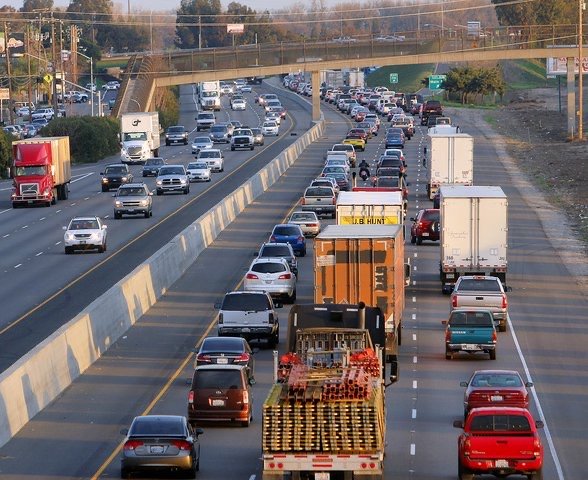
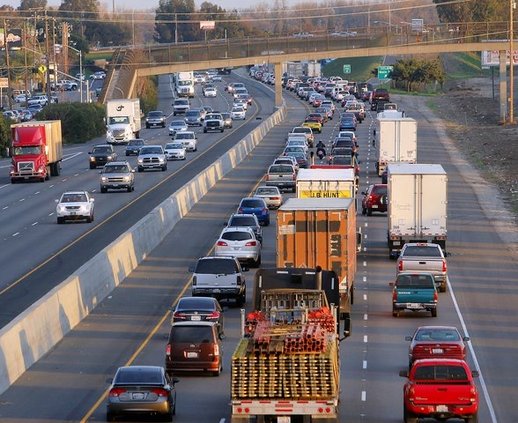
How important trucking is to the economy is clear if you take a drive down Highway 99.
You don’t have to go far.
Just hop on Highway 99 at Austin Road and head south to Kiernan Avenue where you will see the “bilingual” exit sign for Salida.
It is a 7-mile stretch.
During the 1 o’clock hour on Wednesday if you were heading north between those two points, you would have passed 147 semi-trucks going south.
Most diesel trucks have tank capacities averaging between 200 and 300 gallons.
The price of diesel has now surpassed $8 a gallon in California.
Put those two tidbits together and assume all of those 147 semi had their tanks topped off you will have passed independent truckers or firms that employ truckers that paid collectively somewhere between $235,200 and $352,800 to power their rigs.
Highway 99 is 424.85 miles long running between Redding in the north and Interstate 5 in the south near the Grapevine.
That means there is literally millions of dollars of diesel in the tanks of semis rolling down Highway 99 on any given day.
Highway 99 was once known as California’s “Main Street” given the amount of cargo and food it brings to market.
A Caltrans study back in the 1960s noted one out of every four vehicles on Highway 99 were semi-trucks.
Those days are long gone thanks to regional growth in hardcore agricultural communities such as Fresno, Hanford, and Madera and the proliferation of commuters from the San Joaquin Valley to the Bay Area, Sacramento, and the Los Angeles Basin.
As such, the traffic mixture on a Highway 99 likely won’t see even a noticeable drop if and when high speed rail starts rolling.
People are not going to rely on high speed rail to travel from Merced to Madera or Tulare to Bakersfield.
The available stations are too far apart to make sense for a lot of in-Valley commuters, trains will be relatively infrequent, and transportation will still be required to and from stations to go from home to workplaces.
The cost of such short hops have to compete with the necessity of vehicles in places like Madera, Bakersfield, and Tulare where public transit systems are light years from being in the same league as those in San Francisco, San Jose, or Los Angeles.
Run all the scenarios you want, but typical Valley households are going to view driving cars as a cheaper alternative given they are already forking our money for auto payments and insurance.
This is not a digression from trucking and the Highway 99 corridor.
Instead, it points to the obvious that the high speed rail project is going to do little for congestion relief on Highway 99 or the local economies except perhaps accelerate the valley being the de facto affordable housing growth solution for booming Bay Area and LA Basin economies.
High speed rail will perhaps create a new class of commuters — those that can travel 100 miles in an hour to a limited number of transit hubs in Bay Area and LA Basin to cover the physical distance supercommuters that are on the road 90 minutes in each direction do but in roughly a third to half the time.
It means high speed rail is likely to expand the reach of coastal urban sprawl into the heart of the San Joaquin Valley much like the dawn of the Freeway Age brought it to Tracy, Manteca, Stockton, and Modesto.
High speed rail is clearly the wrong solution for what the San Joaquin Valley needs and by extension the rest of California.
Given the fact 8 per percent of this country’s agricultural output occurs in the eight counties along the San Joaquin Valley stretch of Highway 99 from Kern County, the amount of trucks transversing the corridor hauling everything from tomatoes to prepackaged salad mixes underscores the impact that the high cost of diesel ultimately has on household budgets.
Then there is the fact the San Joaquin Valley is, by extension, where the biggest share of farm equipment powered by diesel can be found in the country.
High speed rail addresses neither truck movements or diesel powered equipment whether it is for farming, construction, or other purposes.
What does is electric batteries — or other non-fossil based means — to power trucks and vehicles.
The question no one asks is whether California would be better off converting the high speed rail into a hybrid rail system and dumping future resources into replacing critical transportation’s reliance on $8 per gallon and climbing diesel.
By going whole hog on high speed rail and pursuing the end of fossil-fuel powered vehicles, California is fighting two major —and extremely expensive — green initiatives regarding transportation on two fronts.
Arguably, the most effective per dollar spent is not high speed rail that will cater to a small segment of the population of the SJ Valley and California as a whole.