Manteca literally has faith in its efforts to address homelessness in the community.
The city has successfully wedded government services with the power of faith-based community organizations that have been on the frontline of helping homeless — or those about to become homeless —in Manteca decades before the issues were popping up on everyone’s radar.
And those same faith-based organizations — Love INC, His Way Recovery, and HOPE Family Ministries — were enjoying success to a degree before a class action lawsuit prompted the city to abandon its futile “catch and release” approach with homeless who violated various ordinances such as urinating in public, illegal camping, and other laws in the process of simply trying to live.
The 2015 settlement in response to four homeless men that had a civil rights lawsuit filed against the City of Manteca is what prompted city leaders to hire police officers dedicated to address homeless issues and start putting in place city-backed mechanisms aimed at helping getting individuals off the street while at the same time enforcing quality of life laws.
In the last two years, the combined effort of government agencies, faith-based organizations, and the city has helped reduce the number of homeless on the streets by more than 50 percent, based on the federal point in time council.
The number was 121 in January of this year as opposed to 235 in January of 2024.
That was the bottom line of the homeless summit last week at the Manteca Transit Center that took place a decade after the first “homeless” officer hit the streets.
Mike Kelly, who led the summit designed to update the community on the city’s programs, led the presentation. Kelly was also the first officer hired and the city’s point man for efforts to bring available homeless services together.
In the course of the last 10 years, more than 400 individuals have left the streets due to the coordinated efforts.
Those success stories range from securing shelter and jobs as well as being reunited with families willing to take them into the homeless getting in, to addiction recovery programs, and other assistance they need.
And while Kelly and others still read endless social media postings of people calling out the city for not doing anything it address homeless issues in Manteca, he offers proof that the city’s efforts are working based on what you no longer see.
Among the examples:
*Dozens of homeless are no-longer sleeping and going to the bathroom overnight in the library courtyard.
*And they aren’t sleeping overnight by the dozens on the wide sidewalk along Center Street in front of the library after the courtyard was secured by wrought iron fencing.
*The homeless sleeping in downtown store entrance areas and in shopping centers is now a rarity as opposed to once being commonplace.
*Makeshift encampments along the Highway 99 southbound offramp — complete with beds, couches and even a bookcase and desk — are history.
*The proliferation of homeless encampments along the 120 Bypass has largely disappeared.
*Thanks to the seven-day-a-week contracted services of Manteca Property Services augmenting city crews, the level of homeless related trash around Manteca — as well as that of illegal dumping — is gone within a day or so.
*Large groups of homeless milling around during that day at places such as Wilson Park behind the post office have dropped off to one or two on the rare days that they do show up.
Kelly during his presentation noted repeatedly that being homeless is not a crime, meaning they have the right to walk down the street or hang out in a park just like anyone else.
They are not doing so in large numbers anymore as the city has provided an alternative hangout at the emergency shelter, complete with a day room.
Today, the coordinated homeless effort in Manteca includes:
*Two police officers dedicated to working with the homeless while enforcing laws.
*A 75-bed emergency shelter (50 beds for men and 25 beds for women) at 555 Industrial Park Drive.
*Basic services such as food, shelter, bathroom, showers, pet care, security and such.
*Access to health care, mental health services, addiction recovery programs, veterans programs, and government services needed to secure identification and such to apply for jobs.
*Group outreach efforts to encampments and such providing services to the homeless while encouraging them to get off the street and avail themselves to shelter, services, and help getting their lives back on track at 555 Industrial Park Drive.
*Once a month quality of life enforcement where officers arrest those with outstanding court warrants — most often for failing to appear on previous citations — and breakdown and remove illegals encampments. Those camping illegal without outstanding warrants are given the option of being taken to 555 Industrial Park Drive or told to move on or be cited for illegal camping.
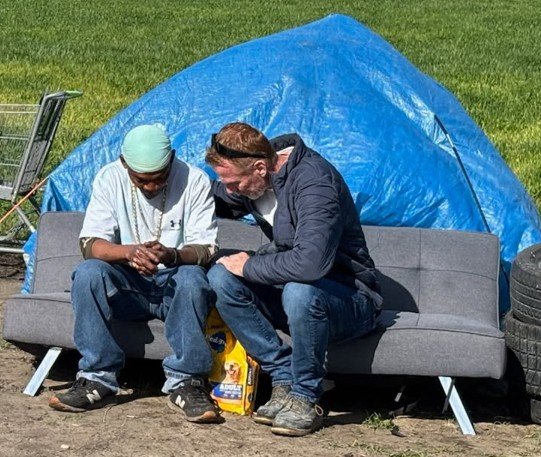
*More frequent outreach involving a handful of individuals — faith based and plugged into the network of agencies and ministries — that repeatedly engage individuals in conversation in a bid to help them find a way off the street. The goal is to dignify people who otherwise feel invisible.
*Coordinating with Caltrans in a coordinated effort to respond to — and remove — illegal homeless encampments on state right-of-way along the 120 Bypass and Highway 99.
*The city contracting with Manteca Property Services daily to clean up illegal encampments that police officers direct them to as well as retrieve abandoned shopping carts in addition to addressing illegal dumping on streets and on city property that is not being done by the homeless.
On a daily basis, the city’s two police officers dedicated to homeless issues also:
*Respond to complaints about homeless issues called into the non-emergency police line or using government outreach. (Posting about issues on social media with the expectation the city will follow up on them doesn’t work.)
*Keep individuals — mostly homeless — from hanging out in areas property posted using anti-loitering ordinance signs that properly references the city ordinances.
*Make frequent contacts with the homeless.
*When asked, advise property owners of effective ways to reduce homeless from “setting up shop” on their property and/or the written process needed to give police the legal authority to move unauthorized individuals of their property.
*Patrol areas looking for makeshift homeless encampments. Manteca Property Services is alerted when there is a need for a cleanup.
Faith-based organizations
His Way is the contracted operator of the current homeless shelter and resource center.
The city funds the effort — as well as security — using state and federal pass through funds.
The use of armed security has helped reduce police calls to the shelter, which has had a major impact of freeing up officers for patrol especially during overnight shifts.
Medical care at the emergency shelter has helped, to a degree, reduce 9-1-1 calls requiring a fire engine company and Manteca Ambulance to respond to some medical emergencies the homeless incur living on the streets where they do not have access to basic healthcare.
His Way was founded as a faith-based ministry decades ago to deal with addiction.
HOPE Family Ministries since 1993 has been helping homeless families as well as single moms with underage children get off the streets.
Love INC (In the Name of Christ) serves as a hub to bring churches, ministries, and churches together as a way to help prevent people from becoming homeless and to help homeless get back on their feet.
The city is now working on converting the former Qualex building at 555 Industrial Park Drive at 555 Industrial Park Drive.
It is being covered by a $16 million state grant that Mayor Gary Singh played a pivotal role in securing.
To contact Dennis Wyatt, email dwyatt@mantecabulletin.com