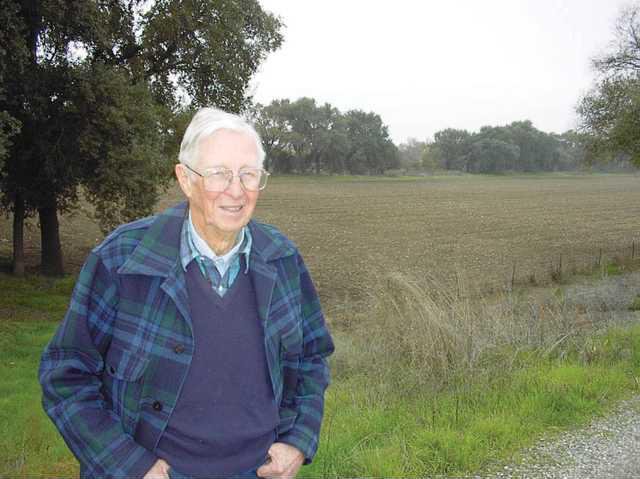
Alex Hildebrand passed away at his rural south Manteca home Monday surrounded by what he loved and fought passionately for - his family, farming, and water.
Hildebrand’s 98-year journey through life took him to the Middle East during World War II where he served with the Navy to keep critical oil refineries up and running to the national presidency of the Sierra Club that he later forsook of what he felt where radical policy departures from its core mission.
His biggest accomplishment besides the family and farm he established with his beloved wife Barbara was the major behind-the-scenes role he played in the never-ending battle involving water in California.
Hildebrand - always the gentleman and dedicated pragmatic scholar - served on no less than 20 federal, state, and local boards dealing with water-related issues. He left his mark on numerous pieces of legislation but none more so than a 2002 bill passed by the California Legislature requiring the state to analyze the amount of water needed to provide an adequate food supply for its residents.
In Hildebrand’s mind it was wildly irresponsible for the leaders of any civilization not to take steps to assure they can feed people.
Hildebrand came to the water wars that have ravaged the state since gold was discovered in 1848 with a unique perspective as one of California’s few remaining farmers that rely heavily on riparian water rights to irrigate their crops. That led to his more than 35 years of service on the South Delta Water Users Board and a lengthy stint as the agency engineer.
He is given credit for originating the idea to augment the San Joaquin River flow by re-circulating Delta water via the Delta Mendota Canal back to the Delta. That decision was significant in improving the health of the San Joaquin River’s final stretch before reaching the Delta as well as the Delta itself. It also reduced the pressure to cut deliveries to Southern California and the large farms on the west side of the Southern San Joaquin Valley in order to protect the San Joaquin River and parts of the Delta.
State elected leaders as well as career water experts called upon Hildebrand for his advice on various water issues.
Hildebrand was born in Berkeley in 1913. After fire destroyed their home in 1923, Hildebrand’s family moved to the open country north of Berkeley. It is there that he raised chickens and ducks. He also delivered newspapers on a donkey. He worked as a teen on the cattle ranch that is now Tilden Park.
He met his wife Barbara on a Sierra Club cross country ski outing near Sugar Bowl. It was also during his stint in the Sierra Club that he developed a long-time friendship with world-famous photographer Ansel Adams.
Hildebrand earned his degree in physics with minors in chemistry and engineering from the University of California at Berkeley where he graduated with honors in 1935.
He had a 27-year career with Standard Oil as a refinery design engineer, assistant chief engineer of the Richmond refinery, manager for the atomic energy subsidiary of Livermore Lab, and director of Chevron’s oil field research lab.
His Chevron career was interrupted by World War II.
In 1962, Hillenbrand retired from Chevron and moved his family to a farm on Hays Road south of Manteca. In his later years he continued to farm in partnership with daughter Mary. The Hildebrands have three daughters: Mary, Janet, and Harriet.
Hildebrand is also a former Manteca Unified School District board member.
Both Hildebrand and his wife are Manteca Hall of Fame inductees. He was inducted for agriculture while his wife for community service for her legendary tireless volunteer work on behalf of the Manteca Library where it wasn’t uncommon for her to log in excess of 1,000 volunteer hours a year.
Hildebrand has been honored as “Irrigation Person of the Year” by the California Irrigation Institute in recognition of 40-plus years of service to irrigation and agriculture.
Hildebrand is well known in the irrigation community for his expertise in irrigation efficiency and his influence on water policy.
Among the boards he has served on are the Bay-Delta Advisory Council, Bay-Delta Oversight Council, State Water Resources Control Board advisory committee, San Joaquin Flood Control Association, California Farm Bureau Water Advisory Committee and the Water Education Foundation Board of Directors.
His many honors include the highest award granted by the California Farm Bureau, the Distinguished Service Award, presented in 1997.
Hildebrand never passed up an opportunity to point to numerous state reports that clearly project a water crisis by the year 2025. That’s when demographers expect the state’s population to swell by another 12 million.
When that happens California won’t be able to grow enough food to meet its own residents’ needs.
“There’s no getting around that it takes three quarters of an acre foot (or 270,000 gallons of water) to grow enough bio-mass to feed an individual for a year,” Hildebrand said in 2003. “Plants need a set amount of water to grow and you can’t change that.”
Hildebrand noted that simply relying on conservation won’t do the trick. He underscored the need for more storage and for more pressure on recycling water as it moves from the Sierra to the ocean.
Hildebrand noted in interviews that a lot of valley cities are moving toward water recycling with their treatment plants. He astutely pointed out pressure to do so does not exist on the coast where politically they have the clout in the California Legislature to make water recycling an upstream issue.
“It might be my training as an engineer that makes me look at water (issues) the way I do,” Hildebrand said back in 2003. “But it’s also the fact I have children, grandchildren and great-grandchildren that I want to make sure will have enough food to eat.”
ALEX HILDEBRAND
Tireless fighter for sustainable water policy