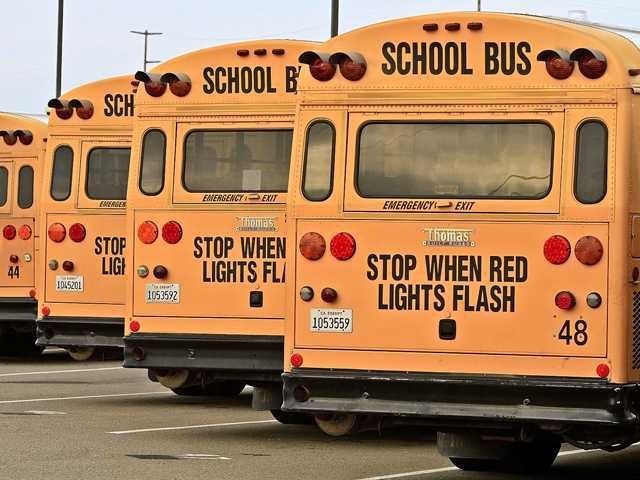
Manteca Unified is gearing up to comply to a state mandate that requires all newly purchased or leased school buses to be zero emissions vehicles starting Jan. 1, 2035.
To reach that end, the district has secured a $3.8 million San Joaquin Valley Air Quality District grant to install infrastructure to charge the equivalent of 47 medium duty vehicles.
But don’t expect the district to immediately go on an electric bus buying spree.
“It doesn’t pencil out financially currently,” noted Victoria Brunn, the district’s chief financial officer.
The California Legislative Analyst’s Office indicated an electric school bus costs between $320,000 and $480,000 upfront in California, compared to $90,000 to $250,000 for a fossil fuel-powered (diesel or propane) bus.
However, aggressive state and federal incentives can reduce the net out-of-pocket cost for California districts down to $0 to $50,000.
That said, the analyst’s office said lifetime fuel and maintenance savings can exceed $100,000 to $170,000 per bus.
It upfront cost is one reason the district plans to ease into electric buses unless they secure grants to cover replacement buses.
The other is changing technology is expected to improve battery life and power in the coming years.
Manteca Unified is pursuing a state grant to help purchase of 10 electric school buses with a state grant that would knock $360,000 off each bus that can cost as much as $480,000 apiece.
Not going “whole hog” — the district has the opportunity to apply for as many as 47 buses —it isn’t because the school district is not committed to being green.
It needs to be smart in doing so as they can’t afford to risk running out of green, as in the green needed to educate 26,000 students when it comes to matching the grant with local funds
It also doesn’t want to have 47 new buses at one time as it would mean maintenance would not be spread out, creating logistic problems and other cost issues.
Buying all 47 buses using the state grant would roughly save $21.7 million at a local expense of $4.7 million to $5.5 million.
Not only would the school district have to divert the local match from another source before the application clock runs down, but they would need to build the infrastructure.
That is what the district plans to do with the San Joaquin Valley Air Pollution Control District grant to place charging infrastructure for light to medium duty EV charging.
Two large solar arrays are in the process of being designed for construction east of the bus maintenance building along Airport Way.
But upgrading the apparatus for the charging project that is now in the design phase will cost additional money in order to accommodate all of the district’s needed buses.
And in order to stabilize PG&E prices to a degree, the district would need to put in solar panels capable of generating electricity to charge 63 school buses, the number that they are currently operating.
The opportunity to get help with buying as many as 47 became available after MUSD went from the wait list to the eligible list for the $360,000 grant per bus after other districts ahead of them either passed or cut back greatly on the buses they’d replace using the grant money.
And while MUSD is better positioned financially than many of the state’s 1,000 school districts, they can ill afford not to avoid future costs if it puts the district into a financial bind.
MUSD administrators have made it clear the district understands the clean emissions aspect of electric buses although they noted the manufacturing of the massive battery packs electric buses need create other pollution issues that are almost as bad — or worse — in terms of creating potential health and climate-related issues.
But at the same time, the district can’t afford to undermine its ability to accomplish its primary function which is educating students.
Ironically, the biggest challenge currently facing MUSD when it comes to busing isn’t technology. It’s manpower.
The district is in need of more bus drivers, a chronic problem that poses a threat to the ability of the school district to transport students.
The district buses 2,786 students to and from school, up from 2,097 in 2022-2023.
The district now has 63 buses and vans compared to 56 three years ago.
To contact Dennis Wyatt, email dwyatt@mantecabulletin.com