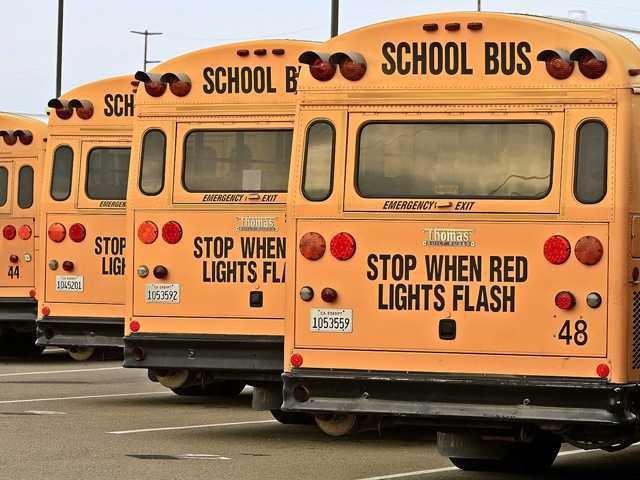
Manteca Unified is pondering the potential purchase of 47 electric school buses with a state grant that would knock $360,000 off each bus that can cost as much as $480,000 apiece.
But it is an opportunity that Manteca Unified is not likely to take 100 percent advantage off even though year-to-year diesel prices have soared nearly 70 percent.
And it isn’t because the school district is not committed to being green.
It needs to be smart in doing so as they can’t afford to risk running out of green, as in the green needed to educate 25,000 students.
“PG&E costs are right up there (with diesel),” notes District Superintendent Clark Burke.
It is why the district is doing an exhaustive cost and benefit analysis to determine exactly how many buses they will ask the state to help MUSD buy before the deadline passes for the district to access the grant funds.
The decision making process also can’t ignore politics.
The state has made it clear they want zero emission school buses.
That said, the “drop-dead” deadline for that to be fully implemented keeps moving due to politics beyond the local level.
Taking advantage of the grant to avoid future costs given buying all 47 buses using the state grant would roughly save $21.7 million at a local expense of $4.7 million to $5.5 million.
Not only would the school district in the coming months have to divert the local match from another source before the application clock runs down, but they would need to build the infrastructure.
The district has secured a $3.7 million San Joaquin Valley Air Pollution Control District grant to place charging infrastructure for light to medium duty EV charging. But upgrading the apparatus for the charging project that is now in the design phase will cost additional money.
And in order to stabilize PG&E prices to a degree, the district would need to put in solar panels capable of generating electricity to charge 75 school buses, the number that they are currently operating.
Assistant Superintendent Victoria Brunn, who oversees the district’s business operations, said it is likely the MUSD will take advantage — at least to a degree — of the grant opportunity.
It is an opportunity that became available after MUSD went from the wait list to the eligible list for the $360,000 grant per bus after other districts ahead of them either passed or cut back greatly on the buses they’d replace using the grant money.
And while MUSD is better positioned financially than many of the state’s 1,000 school districts, they can ill afford not to avoid future costs if it puts the district into a financial bind.
Burke made it clear the district understands the clean emissions aspect of electric buses although he noted the manufacturing of the massive battery packs electric buses need create other pollution issues that are almost as bad — or worse — in terms of creating potential health and climate-related issues.
But at the same time, the district can’t afford to undermine its ability to accomplish its primary function which is educating students.
Ironically, the biggest challenge currently facing MUSD when it comes to busing isn’t technology. It’s manpower.
Clarke stressed the district is in need of more bus drivers, a chronic problem that poses a threat to the ability of the school district to transport students.
To contact Dennis Wyatt, email dwyatt@mantecabulletin.com