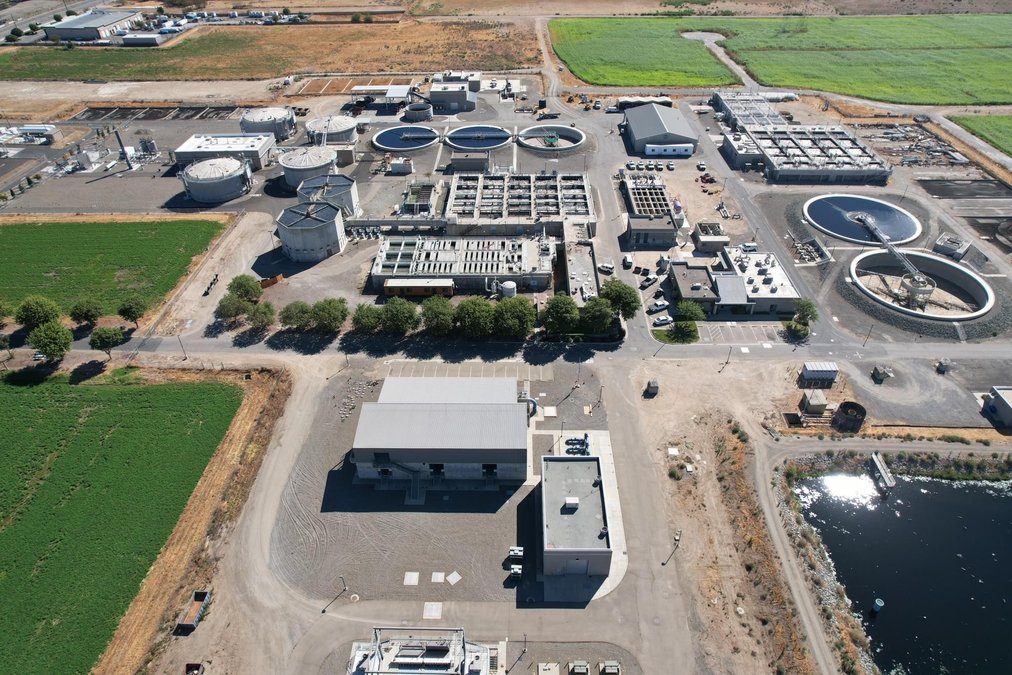
Upwards of 220 acres bought more than 56 years ago for future wastewater treatment spray fields are now seen as key to transforming over a square mile of western Manteca.
Part of that land has already been used to build the 500-room Great Wolf Indoor Water Park Resort as well as the 30-acre Big League Dreams sports complex.
The city has spent more than $42 million extending Daniels Street — and the infrastructure such as water, sewer, and storm lines below — to McKinley Avenue as well as creating the McKinley Avenue/120 Bypass interchange, in a bid to develop the 150-acre family entertainment zone.
Manteca is currently exploring a private sector partnership designed to secure restaurants, family-centric entertainment ventures, hotel and retail on the 150 acres.
Those 150 acres are bounded on the east by Great Wolf and BLD, the north by the treatment plant, the west by McKinley Avenue, and the south by the 120 Bypass.
The remaining land along the future extension of Milo Candino Drive to Yosemite Avenue, that will eventually go farther north where it will swing to the east to connect with Airport Way, is targeted for high density residential.
The Candini extension is expected to open up areas along the Airport Way corridor and West Yosemite Avenue that are a hodge podge collection of what were once rural parcels.
There is already an apartment project proposed in the area off of Wawona that would be the city’s tallest with four stories.
In addition, a commercial/apartment development is being eyed on the south side of Yosemite Avenue just west of Airport Way.
Mayor Gary Singh noted the eventual extension of Milio Candini Drive will open the door for the area to be transformed using the synergy of the nearby FEZ and other existing commercial projects.
Last land purchase
was back in 1966
Looking toward the future in 1966 as Manteca started growing, the city padded its land holdings for future treated wastewater spray field use by 56 acres at a cost of $34,333 or just under $700 an acre.
At the time plant smell and state disposal requirements made it a sound decision so the “new” treatment plant wouldn’t have its life shortened as the previous one did on Union Road.
The old treatment plant eventually became the back 9 holes of the Manteca Municipal Golf Course.
The front 9 holes and the clubhouse, by the way, sit on the site of the former municipal dump.
Evolving technology eliminated plant odors and made treated wastewater clean enough to the point that it not only can be returned safely to the San Joaquin River but it is actually cleaner than the river water it is joining.
The latest project on the former wastewater treatment plant land, miniscule as it is in comparison, is the Loma Brewing Co. The brewery next to the BLD is opening this summer.
Thirty years ago, the city leadership resolved the push back against locating a BLD sports complex at Woodward Park by building it instead on land no longer needed for the wastewater treatment process.
That led to an epiphany of galactic proportions.
The city — between the 1966 purchase and land acquired beforehand for the treatment plant — realized it was sitting on a municipal Mother Lode.
They had more than 200 acres that were no longer critical to the operation and future growth of the treatment plant.
That was due to cutting edge technology they used in the last upgrade that allowed the city to be among the first in the region to meet extremely high state standards to return treated water to the river.
The land sat on top of an interchange — Airport Way — that had no development around plus freeway exposure to the heavily traveled 120 Bypass.
The city made two key decisions.
They parlayed the huge jump in RDA bonding capacity made possible by the conversion of the shuttered Spreckels sugar beet plant into a dynamic 362-acre multi-use development to build the $29 million BLD complex plus the initial extension of Daniels Street.
That not only provided access to the BLD complex but it opened up land to develop the Stadium Retail Center originally anchored by Mervyn’s and allowed the city to snare Costco.
They also hedged their bets by tapping the sewer fund to buy 220 acres some two miles to the south along Hays Road.
The purpose for the Hays Road acquisition was simple.
If the state’s ever-changing rules forced a return to even more robust land disposal of treated wastewater the city wouldn’t be caught flat-footed. All it would need to do would be to extend a pipeline.
To contact Dennis Wyatt, email dwyatt@mantecabulletin.com