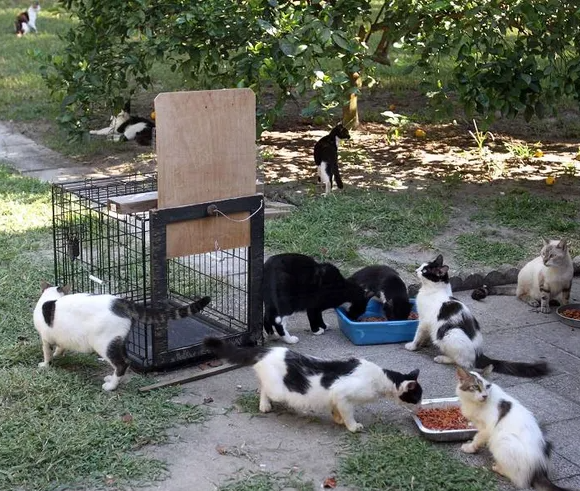
Those willing to manage feral cat colonies in Ripon want the City Council to establish “clear administrative guidelines” before enforcement starts of an ordinance designed to fine those that feed feral cats at Stouffer Park and elsewhere.
The second reading of an ordinance imposes fines of $100 on the second offense and $200 on subsequent offenses after a warning is given to those caught feeding feral cats without written city permission.
The ordinance also includes a provision making it unlawful for anyone to abandon an animal enforceable with a fine of up to $1,000 for each violation.
It is not usual for nonprofits or individuals to employ the feeding of feral cats to capture and then have cats spayed or neutered and then returning them to where they were caught.
There is also concern that the city has limited resources to manage the feral cat population
A staff memo notes the City Animal Shelter has 11 cat crates available for housing cats, with 7 cages designated for domestic cats and 4 cages designated for feral cats.
The shelter does not have sufficient space to relocate and temporarily house the existing stray cats at Stouffer Park while continuing to provide standard shelter services for other abandoned and stray cats in the community.
It does not prohibit City Animal Control staff from working with “qualified and vetted organizations” to implement animal-control measures that effectively prioritize the well-being of City residents, wildlife, and stray, abandoned, or feral animals located on City property.
Feral cat advocates plan to attend tonight’s 6 p.m. Ripon City Council meeting at City Hall, 259 Wilma Ave., in a bid to press the council for further clarification of the city’s plans to deal with the feral cats as well as address the ability of non-profits or residents to gain written permission to manage the local feral cat colonies.
The proposed ordinance change makes the feeding of stray, wild, feral, unowned, or abandoned animal, or any animal running at large on any public property without written approval from a City Animal Control Officer and the abandonment of animals on public property.
Staff noted the feral cat population has increased because many of the cats have not been spayed or neutered. Individuals have also begun leaving food in the park to feed the cats.
In a memo to the council, staff notes that while the intent of individuals feeding the cats may be to provide care, the practice has contributed to additional community impacts, including:
*Public Health: The stray cats create a potential transmission of diseases and parasites and increases the exposure of park users, particularly children, to stray animals and animal waste.
*Animal Population: Uncontrolled reproduction can result in continued population growth, and feeding without a corresponding spay/neuter program does not address the underlying population issue.
*Public Facilities: Cats can damage or occupy public facilities and landscaping, while the accumulation of food can attract other animals and animal waste creates sanitation and maintenance concerns.
*Park Use: The concentration of cats and feeding activities affects the use and enjoyment of the park, and food left in public areas creates litter, odors, and other nuisance conditions.
To contact Dennis Wyatt, email dwyatt@mantecabulletin.com