
Back in 1991 when California was in the throes of a five-year drought, you could take a drive on Stewart Tract via the old washboard Paradise Road and see pockets of water oozing to the surface.
That’s because the highest water table that close to the San Joaquin River on the reclaimed Delta island is between 5 and 8 feet below ground level. The water is non-potable seepage from the river flowing by.
Fast forward to Monday.
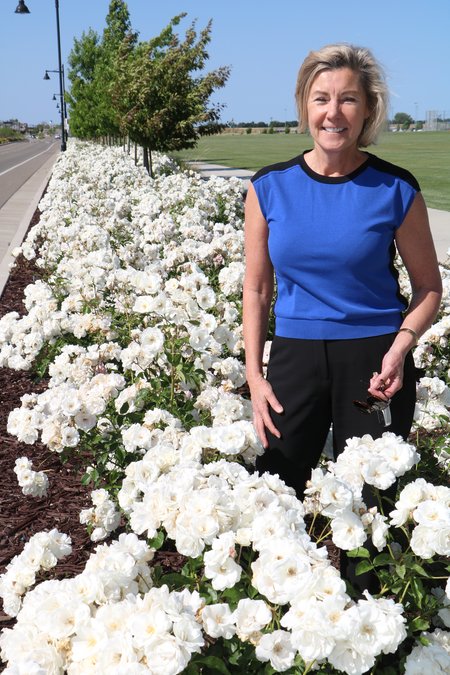
In roughly the same area where the four-lane River Islands Parkway passes a community park the edge of the road is lined with around 1,000 brilliant white rose bushes.
It is the end result of:
*An environmentally sensitive solution to controlling the ground water that — with the exception of storm run-off — 100 percent fills 13 of the 26 manmade lakes created so far in the 4,200-acre planned community.
*Harnessing recycled wastewater for common area and park irrigation.
*A commitment to make River Islands livable complete with an appealing setting.
*The fact the one developer — Cambay Group — is constantly adjusting plans to accentuate the living environment as the 15,001 home project unfolds.
The brilliant white roses are found in abundance throughout River Islands common areas and parks.
“They’re gorgeous,” noted River Islands President Susan Dell’Osso as she stood amid a solid row of the rose bushes lining the landscaping strip between a sidewalk running along a 16-acre park and River Islands parkway.
To understand how rare such a display of roses are in any development today, you have to consider the cost involved in the upkeep.
A previous Manteca City Council a decade ago looked at plans for utilizing roses in a somewhat less grand way in an extensive landplaning plan for the new Lathrop Road/Highway 99 interchange. Caltrans said they had no issue with it but the city would need to foot the $120,000 annual maintenance bill. The city opted for a less intense landscaping plan that reduced ongoing costs.
Maintenance crews use specialty power shears to cut the roses throughout River Islands multiple times throughout the year. Dell’Osso noted they come back each time as abundant and brilliant with white blooms as they are now.
The common area landscaping overall, except for park and playfield turf where River Islands uses grasses that are on the lower end of the water consumption spectrum, is decidedly low-maintenance without sacrificing looks.
There are roughly two dozen basic trees and shrubs employed throughout the project. The common areas, though, aren’t simply cookie cutter designs.
River Islands is designed to
get people out of their homes
That — coupled with mini-parks, neighborhood parks, and community parks along with the lakes — are all part of a grand scheme to encourage people to get out of their homes, interact with neighbors, and walk for exercise and relaxation as well as to access community activities.
Recently, the Lathrop Lions held a carnival event in the parking lot at the baseball field. Dozens of dozens of families attended opted to walk from neighborhoods that weren’t near the site instead of driving.
With more than two dozen lakes planned, there is not a long distance to walk to soak up glimmering water and the landscaped perimeters. If you need to rest or sit and enjoy the scenery, River Islands has been anything but miserly with stylist wrought iron benches found in parks and along the water’s edge.
The approach to community parks underscores the livability of neighbors.
Cities typically out aside 50 to 60 acres for community parks. That way they can gain an economy of scale by grouping things such as tennis courts, baseball fields, soccer fields, picnic shelters and such in one place.
River Islands has six community parks of 16 acres apiece planned. Each will be devoted to a different activity such as baseball or soccer. At the same time the parks will all have restrooms and support facilities.
The approach means community parks are closer to homes.
The emphasis on landscaping doesn’t stop at common areas.
Dell’Osso noted River Islands is working with a Southern California concern to open a nursery adjacent to one of the community parks.
The plan is to use it as a one stop shop for people landscaping their backyards. Not only will the nursery sell plants, trees shrubs and various items needed for gardening but they will design yards if asked to do so. They also can do the work to landscape yards.
The plan is also for the nursery to be a place where garden clubs can meet.
Just as important, they will be able to sign off to make sure back yards comply with general perimeters River Islands has in place to make sure backyard landscaping complies with River Islands guidelines.
The overall design maximizes
water while minimizing its use
And those guidelines are based on the reality of the California climate.
River Islands uses water sensors throughout to dictate irrigating and not a timer system. Such an approach coupled with drip irrigation can significantly reduce water consumption not to mention weed growth.
It is a natural extension of how Cambay Group has literally used engineering to work with the natural hydrology to tackle two diametrically opposed water issues California faces on a perennial basis — flooding and drought.
Given the lakes are the creation of essentially land sculpturing that means surrounding land graded for neighborhoods have essentially squeezed water into the manmade depressions, there is not an ounce of water that isn’t from the high non-potable water level or storm runoff that is in the lakes.
At the same time the recycled waste water and using the non-potable water table means landscaping — responsible for almost half of the typical water consumption of a California household — isn’t tapping into limited water available for urban farm and environmental uses.
Protecting the community that will ultimately be home to more than 45,000 people, are 300-foot wide levees Cambay Group created to encircle Stewart Tract with 14 miles of protection that is expected to secure a 200-year flood protection rating.
The dirt for the levee enhancement came from areas where the lakes have been created.
The top of the levees is also a continuous greenbelt with a walking path that will be accessible to everyone, including non-River Islands residents.
Several bridges have been put in place to make sure pedestrians and bicyclists won’t have to contend with cross traffic if they opt to make an uninterrupted 14- mile loop.
To contact Dennis Wyatt, email dwyatt@mantecabulletin.com