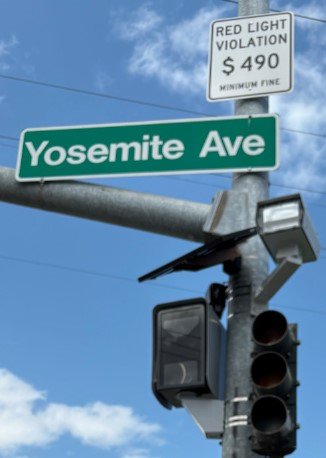

A switch from a $490 criminal infraction for running a red light at a Manteca intersection armed with cameras and radar to a $100 civil penalty will reduce the impact on pocketbooks of violators and likely increase Manteca net revenue.
And that net revenue under state law would be plowed into traffic calming investments in Manteca such as bike lanes, chicanes, chokers, curb extensions median islands, raised crosswalks, road diets (narrowing lanes), roundabouts, speed humps, and traffic circles.
The City Council will decide whether to make the change when they meet Tuesday at 6 p.m. at the Civic Center, 1001 W. Center St.
Currently, the $490 criminal infraction goes through San Joaquin County Superior Court. The Manteca Police Department receives 20 percent or $98 of that amount. The rest goes to the state.
The vendor that installed and monitors the 14 red light approaches at five intersections makes the initial review.
Manteca Police conducts the final review and identifies the driver before a citation is issued.
A conviction can result in one point on DMV driving records monitored by insurance companies that may use it to adjust premiums due to exposure of careless driving habits. It can also add court process payments.
The Senate Bill 720 model the council is considering is a civil penalty that is handled by an administrative process.
It does not lead to a DMV point or license suspension.
The notice goes to the registered owner and not the driver based on the rear plate and captured video.
There is a local review and administrative hearing. There is also the availability of a Superior Court appeal after the administrative hearing.
How it could increase
revenue to the city
Based on fiscal year from July 1, 2025 to June 20, 2026, there were 43,971 violations reviewed by the police for red light violations.
There were only 15,959 approved by Manteca Police.
The 28,012 that were rejected were either because the department has given those turning right on a red light and do not come to a stop a break if they are traveling at a speed of 10 mph or less or if they can’t identify the driver by comparing the image caught on camera with the driver’s license photo connected to the registered owner of the vehicle.
By going with SB 720, literally thousands of possible citations that were dropped would have gone forward as the violation is tied to the registered owner of the vehicle and not the driver at the time.
Based on those 15,959 citations issued in the last fiscal year, if the program being weighed Tuesday had been in place, the city would have received $1,595,000 of which $882,000 would have gone to the vendor for installing, maintaining, and monitoring the red light cameras.
That would have left a net bottom line to the city of $713,900.
As such, it would be almost $32,000 more than the city would receive with the existing program before other costs are factored into the equation.
That, however, is based on all citations being for a first offense with a $100 fine.
Multiple offenses within three years trigger higher fines. The second offense is $200, the third $350, and the fourth — as well as any subsequent offenses — are $500 each.
All of the additional amounts on each offense goes to the city as well.
Manteca also will be able to collect up to $50 for the first late fee and up to $100 — for subsequent late fees for the same violation.
There would be no add-on processing charges and no additional processing fees per se except electronic payment processing fees.
The notices under SB 720 must be mailed within 15 calendar days of the alleged violation.
The vehicle owner may seek a free initial review within 30 days and may request an administrative hearing.
Where the money goes
After the vendor is paid, Manteca can only use the balance for traffic calming measures.
And it must be in addition to its historic average for traffic calming expenditures during the past three fiscal years.
If the money isn’t spent within three years, it is forfeited to the state’s active transportation improvement fund.
As such, the endeavor could accelerate the city’s traffic lump program, add roundabouts where feasible in developed areas, add median islands on major arterials where turn movements can be an issue such as East Yosemite Avenue between Spreckels Avenue and Commerce Avenue, as well as expand and refresh street bike lane markings.
To contact Dennis Wyatt, email dwyatt@mantecabulletin.com