A 9-1-1 call comes into the Manteca Police Department.
There is a robbery in progress at a downtown bank.
The dispatcher types the information and address into a computer.
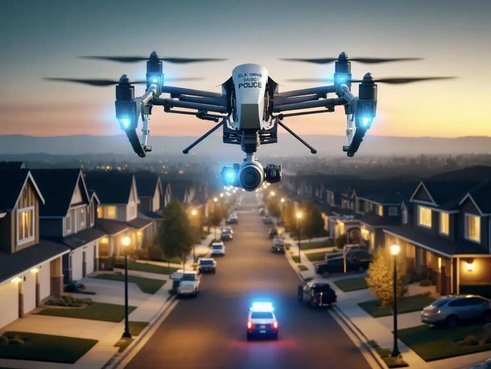
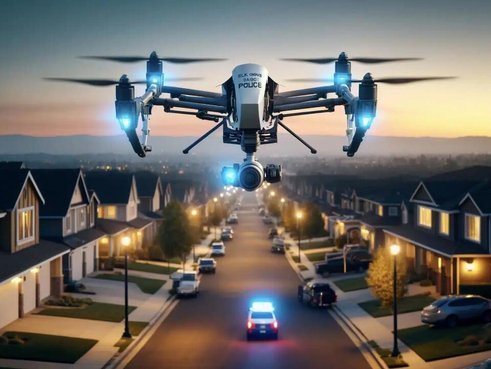
Seconds later, the roof of a “hanger” on a landing pad on top of the police station roof opens and out comes a first responder drone.
In as little as 15 seconds, the drone is over the crime scene without any human interaction
It’s cameras are feeding images in real time of suspects fleeing the bank to computer screens at the department, in patrol vehicles, officer smartphones, and servers that collect and store evidence.
The deployed drone, now in the control of trained personnel, is directed to zero in on the vehicle the suspects have entered.
It then trails the suspect vehicle’s movements while officers are still responding, allowing some officers to be diverted to give chase.
And when officers stop the vehicle, the drone — if needed, will also provide live footage from its aerial vantage to track suspects as they flee on foot.
That is just one scenario of how a $77,000 annual investment in emerging drone technology can increase the efficiency of police as well as enhance their safety and that of the public.
Manteca Police Lt. Ian Osborn shared with Manteca Rotarians on Thursday the first response drone technology the department is exploring.
The first responder drone endeavor would be tied into a real time crime information center in space next to the dispatch center in the new police department being built in the 600 block of North Main Street.
The real time crime information center also has the ability to monitor 20 Flock cameras in place so far at intersections throughout the city.
It also would be tied into business cameras — for those concerns that opt to participate.
If businesses do participate, they have full say on how the video feeds can be used.
In addition, the system would be tied into body cams, mounted cameras in police units, police computers, and even officers’ smartphones.
“This would be a huge benefit for the department,” Osborn said of the ability to effectively and quickly respond to incidents using the first responder drone and real time crime center.
On lower priority calls that are not crimes in progress or incidents involving guns, police personnel would make the decision whether to dispatch the drone.
An example could be a fight in the 700 block of West Yosemite.
The department would be able to assess the situation quickly. If it has already cleared and nothing is happening, it would avoid diverting police from other incidents.
The advantages of the first responder drone include:
*Eyes on the scene before officers arrive.
*Reducing high risk entries.
*Improving the allocation of resources.
*Enhancing de-escalation.
*Improves officer safety by knowing where suspects are.
The first responder drone — just like the department’s existing 14 drones — can not be used for routine patrolling.
The system is fully autonomous meaning in situations such as a report of high priority crimes such as an armed robbery in progress, the drone is activated, launched, and travels to the coordinates without human intervention.
It also has the ability to know when it is running low on battery power so it can safely return to the launch pad and recharge itself.
The drone has a two-mile radius of operation.
It can travel 2 miles from its launch pad in 20 to 30 seconds.
The drones can withstand 35 mph wind gusts and operate in the rain and snow.
They also have a spotlight, infrared capabilities, flashing emergency lights, siren, and a public address system in addition to a camera.
The drones are also equipped with the ability to detect other drones and to take action, if needed, to avoid colliding.
They having a restricted operating ceiling of 400 feet — higher than existing structures in Manteca.
The initial drone — if the City Council approves a request to buy one plus the annual subscription service — would be placed at the department.
From that location with a 2-mile operating restriction, it would be able to operate over a large chunk of the city.
If other locations are desired for increased coverage that could be placed on strategically situated buildings throughout Manteca such as on the rooftop of schools.
The impact of first
responder drones
The impact the drones can have on faster response times and more effective outcomes is underscored by Elk Grove Police stats from May through September 2024.
During that time period, first responder drones arrived on scene of high priority calls before officers 74 percent of the time.
They also allowed 24 percent of the calls to be quickly cleared.
Former San Francisco Mayor London Breed credited such drone use as a major factor in crime dropping 35 percent in the city.
Traditional grid searches looking for suspects can take hours and require a small army of personnel.
Drone-based grid searches can often take place in minutes or even seconds.
Tracking fleeing suspects — such as those leaving the scene of an active burglary or theft — using first responder drones have been cited by departments from San Jose to Fremont as a game changer.
Instead of simply blindly following suspects over fences and such, drones can direct officers to where suspects are heading.
Departments that use drones have strict policies on how and when they can be used.
To contact Dennis Wyatt, email dwyatt@mantecabulletin.com