Congressman Josh Harder wants to help Manteca — and the greater San Joaquin County he represents — build on its roots.
And in doing so, he’ll be helping bolster the local agricultural economy as his great-grandfather did five generations ago when he settled in Manteca in the mid-19th century to establish a peach farm.
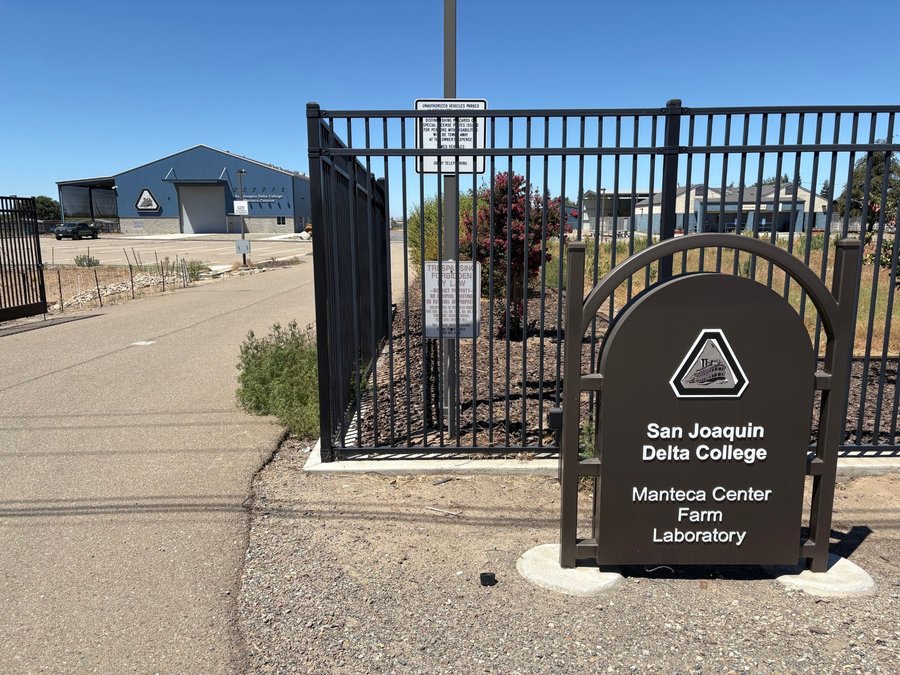
The Tracy Democrat representing the 9th Congressional is seeking a 2027 federal earmark request to help Delta College establish a bioeconomy training hub at the Manteca campus focused on agriculture north of the Lathrop Road/Highway 99 interchange next door to Perry & Sons wholesale melon brokerage.
In a nutshell, a bioeconomy is based on using sustainable renewable biological resources to provide food, energy, and industrial goods.
Harder sees it a way of “tying old Manteca with new Manteca” given the heavy influx of innovative tech sector workers drawn by the city’s family lifestyle and the fact agriculture is not only still the No. 1 industry in San Joaquin County, but has a lot of solid employment opportunities.
The bioeconomy &
SJ County agriculture
The bioeconomy is the portion of the economy based on products, services, and processes derived from biological resources such as plants and microorganisms.
Some predict that the future economy will be primarily a bioeconomy. According to the McKinsey Global Institute, "as much as 60 percent of the physical inputs to the global economy could, in principle, be produced biologically."
Such predictions are based, in part, on the advancement of knowledge and understanding of the biological sciences. For example, humans have long bred plants and animals for desirable traits such as higher yields and resistance to pests.
Now there is a standing of the genetic basis for some of these traits and how information can be transmitted within cells and between generations.
Potential benefits of a transition to a bioeconomy include the following:
*The substitution of renewable biomass or bio-based raw materials for fossil fuels in the production of energy, chemicals, and materials.
*An increase in crop and livestock production.
*Increased efficiency in the use of biomass and a reduction in waste.
*New drugs and diagnostics to improve human health.
*The creation of new jobs and industries.
*Boosting rural development.
Agriculture crop production during 2024 in California exceeded $61.2 billion, padding its substantial lead as the nation’s leading farm state.
It supports a year-round ag workforce of 882,000 jobs with many featuring head-of-household wages that range from mechanics to chemists.
Overall production in San Joaquin County reached $3.22 billion in 2024.
Based on that San Joaquin County — if it were a free-standing state — would rank between Maryland (36th at $3.9 billion in annual ag production) and Utah (37th at $3 billion in annual ag production).
County agriculture supported roughly 34,000 people in farming related jobs from the fields, orchards, and dairies to processing and support according to the state Economic Development Department. That’s almost one out of every 10 jobs.
San Joaquin ranks as the seventh largest county in both California and the United States in terms of farm production.
Based on world bank data for various nations, San Joaquin County — if it were a nation — would have the world’s 88th largest farm production between Croatia at $3.15 billion and Slovakia at $2.88 billion.
In 2024 in San Joaquin County there were:
*3,430 farms — almost all small family-owned concerns.
*Agricultural land accounted for 84.97 percent — or 1,207 square miles — of the county’s 1,421 square miles.
*Commodities grown in San Joaquin County were exported to more than 80 nations with almonds leading the way.
Exporting high value crops is part of San Joaquin’s economic strategy to generate more future employment.
Last year, the San Joaquin County Board of Superiors moved forward with developing a game plan to make Stockton Metro Airport an air cargo perishable facility for Northern California growers to ship perishable crops such as fruit overseas.
About the Delta College
Manteca farm campus
Delta students at the Manteca college campus work directly with crops, livestock, irrigation systems, and agricultural equipment as part of their coursework at the working farm.
The farm has 1,400 cherry trees on 10 acres, 33 acres of wine grapes, and 55 acres of almonds along with livestock programs.
Harder assisting another
SJ County higher ed effort
Harder is also working to secure federal funds to advance another local effort for higher education with federal funds — the San Joaquin Valley’s first medical school in Stockton.
The University of Pacific expects to complete the 100,000 square-foot medical school in 2030.
“The Valley needs more doctors, nurses, and health care workers — it’s that simple,” Harder said at announcement ceremonies in May.
“Bringing the first medical school to the Valley is a huge step forward because it means training more doctors right here in our community. The people caring for Valley families should know this community, understand our challenges, and be able to build their lives here, too.
The medical school will establish a clinical partnership with Dignity Health St. Joseph’s Medical Center, which is planning its own expansion as well.
The partnership will place third- and fourth-year medical school students from the University of the Pacific in clinical rotations at St. Joseph’s and other hospitals across the region.
To contact Dennis Wyatt, email dwyatt@mantecabulletin.com