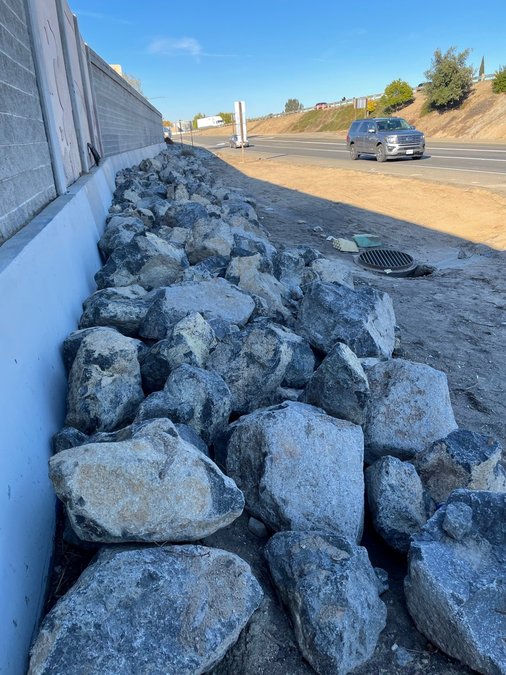
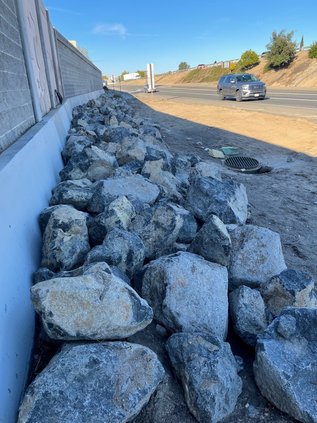
Homeless proofing Manteca is helping reduce damages and safety issues for Caltrans, the City of Manteca, businesses, and non-profit organizations.
The latest ploy is placing large rocks along the southbound off-ramp of Highway 99 at Yosemite Avenue.
Caltrans has spent the past several years repeatedly clearing out the area.
Not only has there been upwards of a dozen illegal encampments in the area that was once lightly landscaped, but individuals staying there had been cutting across the ramp as vehicles are deaccelerating from freeway speeds as they enter Manteca.
Last winter, several motorists reported almost hitting homeless people walking along the ramp at times of heavy fog after twilight.
At one point a homeless individual had commandeered an old office desk, several chairs and even had shelving complete with books as part of a makeshift shelter along the ramp.
The idea is to make the area useless as a place to illegally camp.
Caltrans is not through placing rocks.
On Thursday a homeless induvial had pitched a tent, parked two shopping carts and spread assorted items by the off ramp’s intersection with Yosemite Avenue where there was still barren dirt.
Earlier this year, Caltrans spent $270,000 to “homeless proof” right-of-way along freeways where safety is a paramount issue in Manteca and Tracy.
A contractor installed wrought iron security fencing with angled spikes at two locations along Interstate 205 in Tracy and one along the 120 Bypass between Van Ryn Avenue and Moffat Boulevard in Manteca.
The effort came after the homeless in Manteca repeatedly cut through cyclone fencing Caltrans installed in a bid to eliminate the proliferation of illegal homeless encampments between sound walls and the steep embankment of the freeway created as the 120 Bypass gains elevation to bridge Van Ryn as well as Moffat and the railroad tracks.
The homeless even moved aside K-rail placed to prevent them from driving vehicles into the right-of-way.
Caltrans had worked with the CHP repeatedly clear the areas after posting 72-hour notices as required under court rulings obtained by homeless advocates.
Aside for trespassing, the homeless encampments pose serious health and safety issues to the general public, motorists, and the homeless themselves.
The area along the Bypass is the location of a number of grass fires each year. The steep embankment on one side and the sound wall on the other creates a potential fire trap for those living there illegally. Occasionally vehicles as the result of freeway collisions will end up in the area in question.
There has even been a traffic fatality. That happened last year when a homeless man was struck by a city garbage truck while crossing the Bypass during the morning commute.
Then there is the stench, noise, and other issues.
Clean-up crews typically removed numerous 5-gallon buckets such as the type Home Depot sells filled up with feces for the area behind the Paseo Villa apartments. They also picked up countless hyperendemic needles. Then, of course, there is the tons of trash that the homeless leave behind when they move to another location after being served with 72-hour notices.
On the north side where the almond huller is located, the homeless at various times have erected small portable solar panels to charge their smartphones and to power appliances to cook food and to power lighting at night.
There are other issues less obvious to the public that Caltrans is concerned about.
Homeless building warming fires or cooking fires on a ledge beneath the east side of the northern most bridge crossing Moffat and the tracks have been intense enough to char the concrete with smoke. Over time such smoke can threaten the integrity of the concrete.
The homeless at other locations in Manteca — the Louise Avenue as well as the Cottage Avenue overcrossings of Highway 99 — have dug “caves” into bridge embankments.
Wrought iron fencing is being deployed more and more to keep the homeless out of areas such as private property as well as the Manteca Library courtyard where dozens used to camp at night in an area tucked out of view from the street.
They would leave behind trash, urine, and feces as well as repeatedly damaging light fixtures so they could use electric lines to charge cell phones and such.
The city decision to spend more than $7,000 on fencing three years ago has already been paid back in saved city worker time and equipment replacement costs due to the need to clean the area daily before the library opened. The homeless now gather at night to sleep on the expansive sidewalk in front of the gated courtyard.
They are reminded to clean up the area by Manteca Police community resource officers that make sure they are awake and clear out in the morning.
The homeless being displaced by the wrought iron fence along the Bypass have moved to other locations along the freeway including the quadrants of various interchange that are less of a safety hazard. The biggest concentration is now along both sides of the 120 Bypass where it joins Highway 99 where it is much more open as well as being more visible.
Wrought iron fencing is also being used by businesses to keep the homeless out of areas where they would sleep, defecate, leave trash and — in the case of the Legion Hall — find a way to tap into power supplies to run everything from electrical heaters and hot plates to charging cell phones.
In the case of the Legion before they installed wrought iron fence thing they saw their power bill increase by several hundred dollars give n electric heaters are expensive to run.
The homeless still camp many nights outside theLegion Hall on the front door steps as well as a ramp on the side of the building
To contact Dennis Wyatt, email dwyatt@mantecabulletin.com