Kevin Jorgenson knows all too well that weather predictions are fickle.
As one of Manteca’s two assistant city managers, he doesn’t have to go back too far for proof.
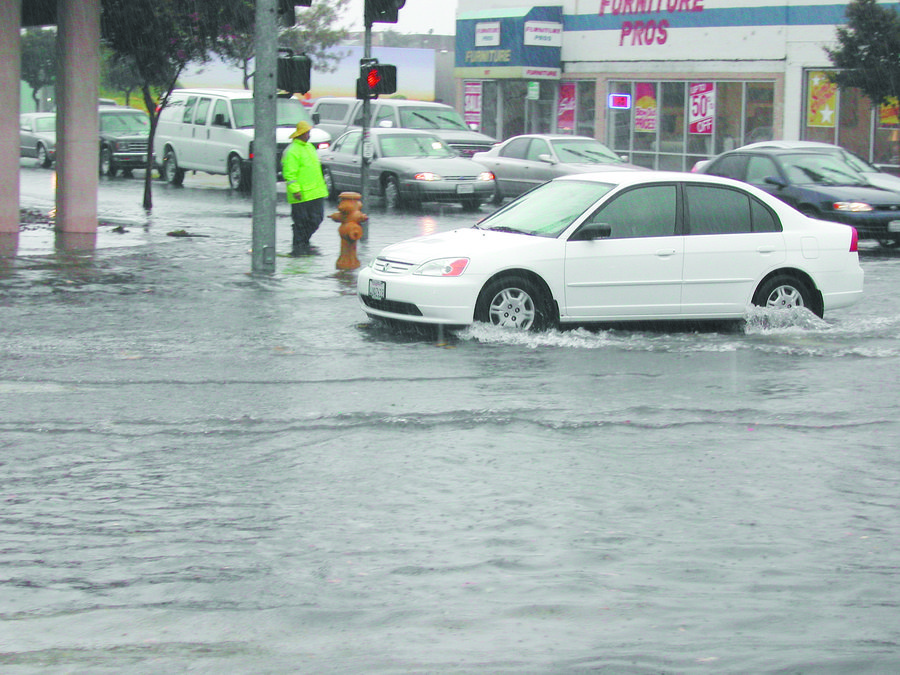
A mid-November 2025 storm system passing over Manteca was supposed to bring two-tenths of an inch of rain in a day, according to weather forecasts.
Instead, it brought 2 inches.
That ended up producing some unexpected flooding due to construction-related issues in the Yosemite Greens neighborhood along the Airport Way corridor and backs to Manteca municipal golf course.
The El Nino event hitting the Pacific Northwest is expected to be minimal on Manteca for the most part with the forecast calling for showers or rain Friday through Monday with a break Tuesday before the wet pattern continues.
The City of Manteca, however, isn’t taking any chances.
Workers from the streets, wastewater, water, and parks departments will be available if needed.
That is in addition to extensive work and preparations that have been underway for weeks and in some cases, months.
Long-range improvements undertaken include replacing several open drains — such as along the southside of the golf course — with storm drain pipes.
One of the biggest issues is not only keeping open drains clear of brush and even homeless encampments before storms but making sure such debris doesn’t flow into it and clog the flow of rain runoff.
Crews have also been clearing storm drain inlets.
Jorgenson noted residents can help ease the potential for localized street flooding by clearing gutters of leaves.
Flooding in downtown
area was regular annual
occurrence until 1989
Up until the late 1980s, it was a common occurrence for downtown businesses along Center Street, Main Street, Maple Avenue as well as nearby homes to have to deploy sand bags multiple times to prevent storm water from damaging floors and furnishings.
The work done in 1989 to install larger drain pipes under Center Street and some nearby streets along with more robust intakes cut into curbs, for years eased flooding. But then as infill projects started in earnest 21 years ago, the old issues started showing signs of coming back.
The latest issues for downtown was 2014 when storm water flooded Center and Main with flood water lapping at businesses such as Bank of America and Don’s Mobile Glass despite storm drain intakes being clear.
The problem was too much rain in a short period that overwhelmed the system upgraded in 1989.
Some of the downtown and nearby neighborhood issues were addressed in part by a storm retention basin the city installed on Moffat as well as replacing drain pipes south of Yosemite Avenue and east of Main with larger lines.
How Manteca’s
system works
How the city’s storm system works is part high-tech and part low-tech.
It starts as a light rain.
And then before you know it, the skies open up.
Rainwater runs off your roof, your driveway, your patio and other impervious surfaces.
It trickles into the gutter in a steady stream joining the run-off from nearby homes as well as the streets and sidewalks.
A running stream of water punctuated with a steady downpour flows into the storm drain and disappears beneath the streets of Manteca.
It’s below the surface in storm drains ranging from 12 inches to 48 inches or more that your rain run-off joins that from hundreds of other homes and commercial ventures.
But the trip ultimately to the San Joaquin River and into the San Francisco Bay is interrupted.
The city’s storm system is becoming overloaded.
Pumps kick on and the water is taken out of the system into a nearby park that has been designed to provide double duty as a storm retention basin. It is here the water will pool with other run-off waiting for the system to clear up room so it can continue its journey.
The goal is to take pressure off trouble spots to avoid street flooding and backing water up on to private property by controlling flow with a telemetry system that has been programmed to respond automatically when workers detect problems in the city as the torrential cloud burst continues.
The water level in the storm retention basin rises providing an effective safety valve against flooding. Then capacity is freed up in the system and a second pump starts removing the water from the basin and putting it back into underground drains that make their way to the west near the Union Pacific Railroad tracks.
It is here that the water comes gushing out through large screens covering culverts and into a San Joaquin Irrigation District drain.
The water will then make its way north to the French Camp Slough about eight miles away before turning west and heading past the northern levees on the northern edge of Weston Ranch in Stockton and into the San Joaquin River to continue its journey to the Bay Area and ultimately into the San Francisco Bay and beyond.
There are more than 3,000 storm drains citywide. All of the storm drains are cleaned before and after storms to prepare for the next rain. Even so it is a big help when citizens keep leaves and other debris away and off grates to the storm system.
System wouldn’t work
without SSJID canals
The system wouldn’t work without access to SSJID canals and drains that are between Manteca and the river. The city works closely with the district and shares in the cost to improvements along the drain that heads to French Camp Slough where all of the city’s storm drain water that enters pipes currently goes.
The city is dealing with a fact it can’t escape — any improvement to land increases the water run-off.
An acre of farmland that used to grow crops typical has a one-tenth of a rating for run-off.
It increases when you put grass on it, build homes, or put in streets.
It is the same reason why California’s rivers are flooding more often. There is more run-off because more land is being made impervious to percolation during heavy storms.
To contact Dennis Wyatt, email dwyatt@mantecabulletin.com