The Manteca Museum after a forced 15-month hiatus due to the COVID-19 pandemic is reopening its doors on Sunday, May 2.
The museum housed in the former Methodist-Episcopal Church structure built in 1917 at 600 West Yosemite Avenue has now weathered two pandemics. The first was the 1918-1920 flu pandemic that killed three localpeople and the current COVID-19 pandemic that has claimed the lives of 109 Manteca residents.
Initially the museum will be open two days a week — one half of its pre-pandemic accessibility. The new days and hours are Sundays from 1 to 4 p.m. as well as Wednesdays from 1 to 4 p.m.
Masks and social distancing will be required.
The museum is the ultimate time machine for everything Manteca.
There’s the old switchboard for the Manteca Telephone Company.
A 1910s era kitchen decked out with every modern convenience of the time is part of the collection.
And so is everything imaginable from military uniforms from as far back as World War I, replica model of Manteca High and its beloved tower as well as an out-of-service old-fashioned outhouse.
The Manteca Historical Society Museum has been faithfully preserving and sharing the history of Manteca and the surrounding countryside for 29 years this July.
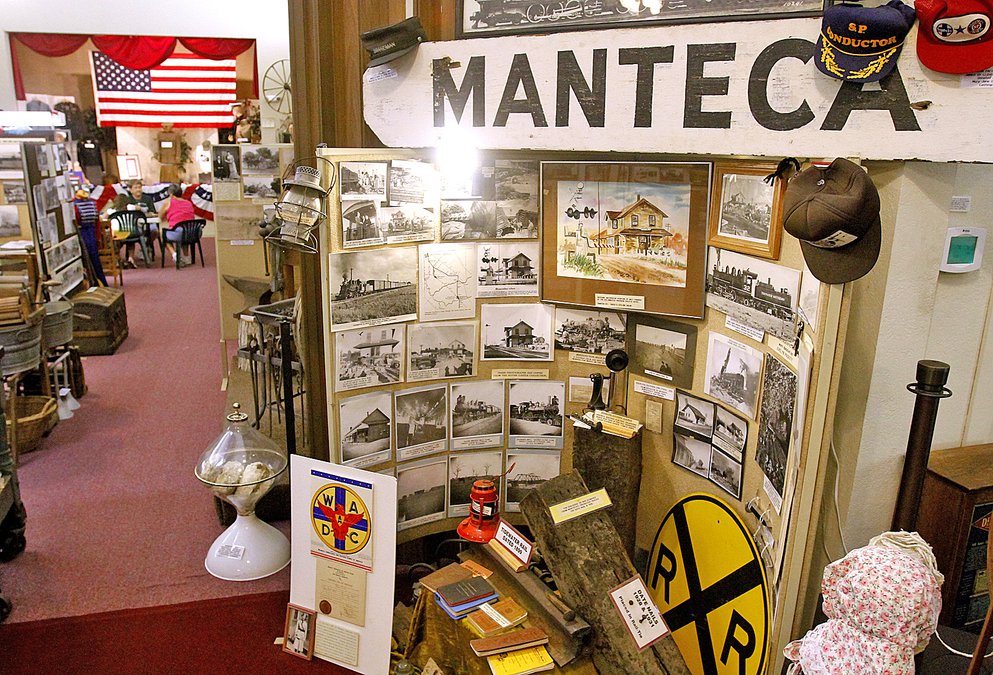
It is more than just a repository of old photos, dated clothing, antiquated farming implements, old newspapers, and tidbits ranging from the “Manteca” sign from the Southern Pacific Railroad station that once stood near today’s Library Park to the desk from Congressman John McFall’s Congressional office.
The museum — or more precisely the Manteca Historical Society — has served as a social club of sorts for old-time and newcomers alike who share a common love for Manteca.
A surprising number of newcomers over the years have made their way to the museum where admission is free eager to find out more about their new home. They never go away disappointed. In fact some of the static exhibits such as a century-old kitchen, an old-time barbershop, and other as well as farming equipment in the museum annex and rotating stage displays of everything from military clothing, Christmas trees, and Valentine’s to the Fourth of July are reflective of not just of Manteca’s past but of the country as a whole.
The old church and annex are crammed with display cases, photos you can slip through much like browsing at carpet samples, and knick knacks including advertising gizmos for local businesses.
There is literally no trivia that has gone untouched right down to the display of the poster that was hawking the current movie playing when the El Rey Theatre burned down on Aug. 6, 1975 — “The Towering Inferno.”
If you go to the museum expecting a musty, disorganized hodge podge you will be disappointed.
Great care has been taken over the years to save and display artifacts in a professional manner.
And, with a little luck, you can engage a docent in conversation about the history of the various items in such a manner that it can take you back to Manteca’s younger days.
The desire to establish a museum was driven by the disappearance of Manteca landmarks that ran the gamut from the Manteca High mission-style tower to the Southern Pacific Railroad station. Back in 1989 there was a concern that Manteca would lose more than just landmarks if steps weren’t taken to establish a respiratory of sorts to collect and preserve historical items tied to Manteca and the surrounding areas.
The goal was simply to establish a place where people could gather to share memories, heritage; to preserve and store photographs and other artifacts for future generations to enjoy.
As word spread of the effort, the organizing group was soon inundated with people offering to provide historical items. That prompted a search for a building to store what was collected.
The first museum was the old Christian Science Room in the 200 block of Polar next to the tennis courts located across from the Manteca Library.
In the fall of 1991 Delicato Vineyards opened their warehouse to host a food and wine tasting event that ended up being the precursor to the annual Gourmet Sampler. The charter membership drive lured nearly 400 people and gave the museum effort a big boost.
In April of 1992, the society decided to purchase the old 1917 church at the corner of Yosemite and Sequoia streets as it was clear the Poplar location was inadequate in size given the outpouring of offers to donate artifacts. The society took possession of the church in July 1992 even though it was badly in need of repair, including a leaky roof. The museum opened for business 10 days later as remodeling progressed.
To contact Dennis Wyatt, e-mail dwyatt@mantecabulletin.com